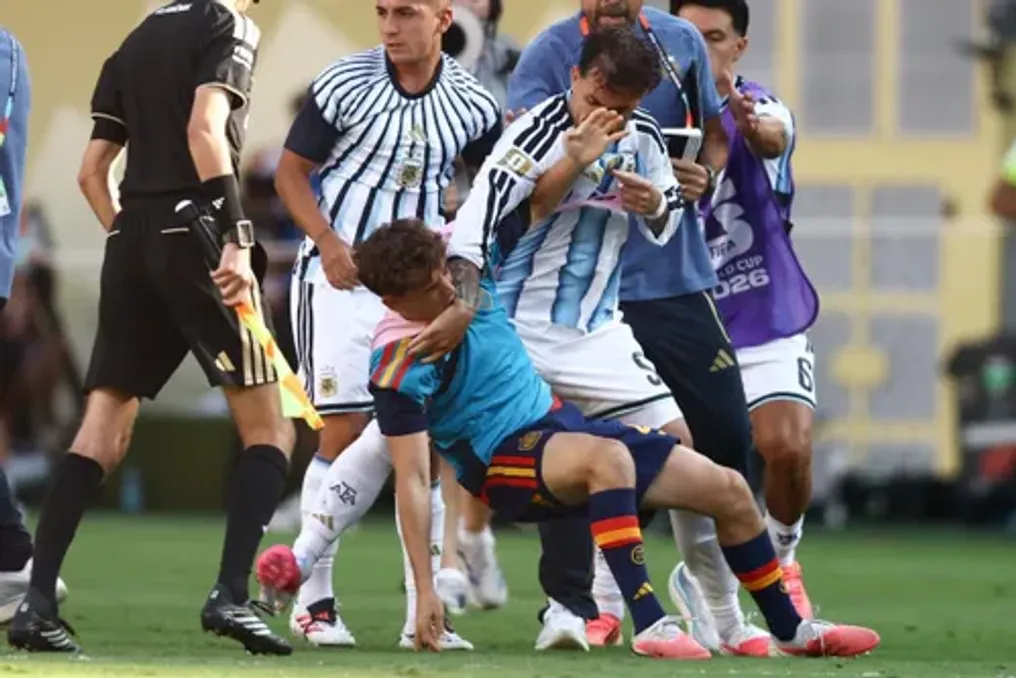
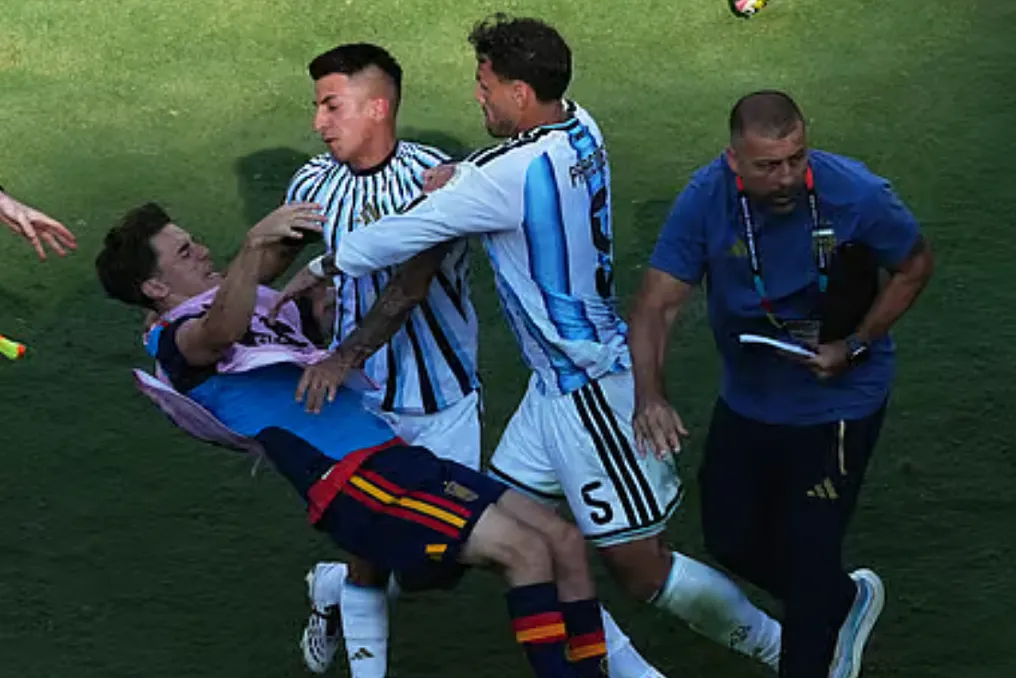
While the global community expressed strong disapproval regarding Argentina's cynical approach to football, particularly during the World Cup final on Sunday, many residents of South America likely view the team's performance against Spain with a sense of pride.
Особенности игры Аргентины
Criticism often focuses on statistics such as the absence of shots on target for the first 120 minutes, coupled with five yellow and one red card. However, these metrics are seen by some as less relevant than the team's aggressive style, exemplified by actions like tackling an opponent forcefully after being defeated.
Arriving at the 2026 World Cup without the peak form seen in Qatar 2022, the defending champions adopted a more combative style in North America in pursuit of historical significance. Their objective was to join Brazil and Italy as only the third team to successfully defend the World Cup title.
Исторический контекст и игроки
Brazil achieved this milestone previously in 1962 with a dazzling, Garrincha-inspired performance. Argentina, however, struggled with consistent form, and several key players, including Julian Alvarez, Gonzalo Montiel, and Cristian Romero, faced injury concerns upon arrival. Despite these challenges, the team relied on the enduring ability of Lionel Messi, remarkable resilience, and a 'street fighter' mentality while navigating every knockout match.
Early in the final, Lionel Scaloni's squad recognized they could not match Spain's midfield skill. Their strategy shifted to disrupting the flow through constant tackling. Although Spain maintained dominance without creating clear opportunities for long stretches, Argentina struggled to maintain cohesive passing sequences, often isolating Messi.
Тактика и сравнения с прошлым
As Spain continued to press, Argentina focused on blocking space, rendering the game dull. This defensive posture contrasted sharply with Spain's commitment to possession football. Furthermore, Argentina's hesitation to initiate counterattacks diminished the spectacle of the final. These highly negative tactics and cynical fouls brought to mind the 1990 World Cup final against West Germany.
In a repeat of the 1986 final, West Germany defeated an ultra-defensive Argentina 1-0 with a late second-half goal. Even then, Argentinian fans remain proud of their 1990 squad, celebrating their tenacious drive to reach the final, despite ultimately being outperformed by the Germans.
Культурный аспект футбола
This pattern of featuring Argentina in two of the worst World Cup finals (1990 and 2026) is noted by observers. While neutral parties criticize their anti-football methods, Argentinians value the heart shown by their players in high-stakes situations. British football writer Jonathan Wilson, in his book 'Angels With Dirty Faces: The Footballing History of Argentina', documents both the brilliant talents—such as Diego Maradona, Alfredo di Stefano, and Lionel Messi—and the darker aspects of Argentinian football, where a win-at-all-costs attitude is valued alongside technical skill.
In Argentina, the impact of Maradona's 'Hand of God' is deeply felt by the public. For the players, intimidating opponents to gain an edge is ingrained from early street games. When focused solely on football, Argentinian teams can execute mesmerizing passing displays. However, when facing superior opposition, they can transform into fierce competitors, mirroring the struggle of many players rising from poverty.
Argentina demonstrated this approach effectively against England, using tackles and gamesmanship before unleashing a decisive attack in the second half. Following England's semifinal loss, US-based Argentinian sports presenter Nico Cantor explained the cultural roots of this behavior to BBC 5, stating, 'There is a cultural element. These kids had to come up from the slums... You learn to get by with anything you can get.'
Against the technically proficient Spanish side, however, Argentina failed to impose its psychological game, resulting in a performance reminiscent of the 1990 team, employing similar tactics to force extra time. Ultimately, Ferran Torres secured the victory for the team that prioritized playing football.