Two founders began their project by purchasing ten acres of arid land near the Kanha National Park. Initially, for about three years, they left this semi-desert area in Madhya Pradesh virtually untouched after acquiring it in December 2015. At the time of purchase, there were fewer than 300 trees.
Ecosystem Restoration
Today, this protected area boasts over 6000 native plants and trees, as well as 59 species of birds. Furthermore, an artificial pond was created, which attracts wildlife during the summer when water is scarce in the region.
The founders, who had extensive experience in India's travel industry, noticed that tourism often benefits visitors but provides limited advantages to surrounding communities and ecosystems. They aimed to create an alternative model near one of India's renowned conservation areas.
The Concept of Surwahi Social Ecoestate
The Surwahi Social Ecoestate project was conceived as a long-term social impact venture where tourism could contribute to land restoration, support local populations, and preserve traditional skills. The founders continued their corporate activities, funding the development of the property, including during the pandemic. During the first ten years, one founder actively participated in all stages of construction and management, while the other focused on shaping the ecological vision and overall direction.
Natural Regeneration and Construction
After fencing off the land, locally known as Satkata Jungle, its restoration began. The fence prevented illegal logging and stopped vehicles involved in illegal sand mining along the nearby Sanduk River. Within two or three monsoon seasons, the forest began to regenerate naturally.
The team also dug an artificial pond named Arjun Talab to collect floodwaters and replenish groundwater, reducing the amount of unused rainwater flowing into the Sanduk River. A hydrogeological survey was conducted before drilling wells to map the aquifer and determine a suitable location. The study also recommended creating catchment trenches and using local plant species, such as Paras Pipal, Cassia siamea, and local bamboo, which determined the planting of about 1000 trees.
Of the more than 6000 plants and trees growing on the site, approximately 1500 were planted, with the remaining 4500 appearing through natural self-regeneration. As the forest recovered, more bees, birds, and butterflies returned, whose pollination activity supported further growth. Recently, the team added about 300 fruit and flowering varieties to the main complex.
Architecture and Local Resources
As the land began to recover, Ankit and his team sought architects who shared their values. They eventually found Mrinmayee Architects from Bangalore, led by renowned professors from IISc and a young architect who worked with local stonemasons to realize the vision. The building plan was simple and uncompromising: the team aimed to avoid burnt red bricks, glass, and steel. Instead, thick mud walls were used, which helped the buildings naturally respond to temperature changes. The roofs were covered with recycled terracotta tiles collected from the debris of nearby village houses.
Ankit emphasized that 'every worker, from stonemason to painter and plumber, came from surrounding villages. This was a non-negotiable condition. This land belongs to these people. The least we could do was ensure they built it.' All furniture was either bought second-hand at the Gurundi market in Jabalpur or made by local bamboo craftsmen.
Development and Sustainability
The first space, Maikal Express, opened in October 2019. The eight-bed earth dormitory was named after the Maikal hills near Kanha and designed as a 'wildlife co-living' space where nature, community, and tourism could coexist. After a few months, the pandemic paused Surwahi's plans, but the founders continued to support the project using their corporate earnings.
In December 2021, two family suites, Jolar and Karivah, named after villages relocated outside Kanha in the 1970s during the creation of the national park, were added to the eco-hotel. Ankit noted that they named them intentionally to keep this memory alive.
Today, Surwahi is fully operational, remaining small in scope while continuing to develop every part of the property according to its ecological and social goals.
Resource Management Innovations
When preparing the buildings, the team faced the question: how to manage a hotel in a forest buffer zone without harming the environment? They approached the study of sanitation, water, energy, and waste with the same rigor applied to the land and construction. Conventional septic tanks were excluded from the start. Finding another solution in a remote forested area required extensive research.
With support from Safalgram in Uttar Pradesh and international sanitation expert Martha Vanduzer-Snow from the USA, the team installed an evapotranspiration toilet. In this zero-discharge system, waste decomposes naturally using banana trees and other nitrogen-loving plants. The team claims this is the first such system in Madhya Pradesh.
A 1500-liter biodigester was installed on the other side of the property, utilizing bacteria developed by the Defence Research and Development Organisation. According to the team, this was also the first such system used by a hotel in the region at that time. Water received equal attention. Ankit stated: 'You don't gamble with groundwater in the forest. We believe we can be the first lodge in Madhya Pradesh to do this before drilling.'
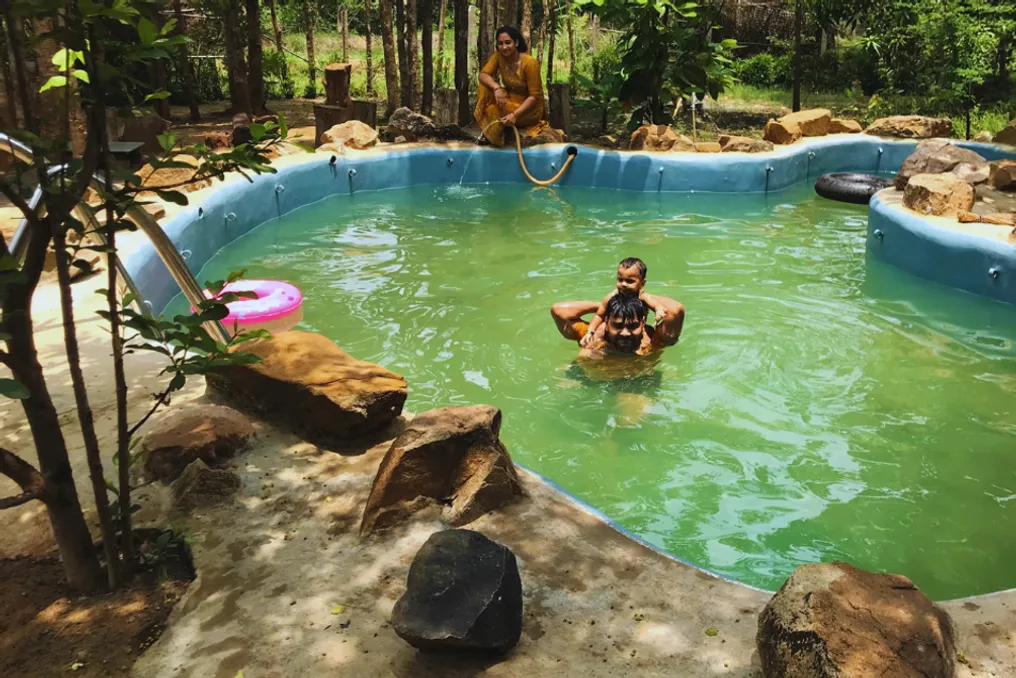
Rainwater from the Satkon dining hall roof is directed into an internal fish pond. When the pond fills, an overflow helps replenish an old nearby well. The property also uses a chemically pure earth swimming pool instead of a conventional one. The power station is fueled by solar energy, and hot water is provided by a wood-fired steam boiler. Thin cotton towels reduce water consumption per wash, and plastic is completely banned.
Social Projects and Infrastructure
The founders extended this mindset beyond the property boundaries. In 2017, Ankit proposed building a dam on the nearby Sanduk stream so farmers could retain water and grow a second crop. According to Ankit, it took years of persistent appeals at the Panchayat (village council), Tehsil (administrative unit), and district levels before it was finally approved and built under the MNREGA program. He noted: 'This is what it means to do the right thing in this country. You have to be prepared to wait and keep showing up.'
The banks of the dam suffered erosion after the first two monsoon seasons. Since then, Surwahi staff and local residents have maintained it seasonally, using burlap sacks filled with sand and excavated catchments. Water is now available longer, supporting the second crop, fishing, cattle grazing, and vegetation along the Sanduk. At least 10 families directly benefit from this.
However, water alone was not enough to solve the farmers' irrigation problem. They had access to water but lacked electricity to pump it to the fields. In 2019, Surwahi financed and provided an 11 kVA transformer and grid connection for agricultural land. The team describes this as the first installation of this kind in Madhya Pradesh. Thanks to the power line and subsidized state electricity billing, at least seven farmers have started growing a second crop.
Measuring Success and Goals
Surwahi's work has received recognition from ICRT, TOFT, Outlook Traveller, and the Wildlife Tourism Conclave among others. Nevertheless, the founders continue to measure their progress by what still needs to be done. Their internal sustainability assessment covers water conservation, clean air, chemical-free soil, waste sorting and recycling, toilet waste management, reforestation, and community participation beyond direct employment.
The system also accounts for inclusive amenities for pets, the elderly, and guests with disabilities, alignment with UN Sustainable Development Goals, local sourcing of food and materials, and sustainable building design, including the earth swimming pool. According to this assessment system, the team claims that Surwahi is confidently past the halfway point and rates its current sustainability at 70–80 percent. Ankit states: 'Currently, we are operating at a 70–80 percent sustainability level. But our goal is to continue closing this gap and soon reach 100 percent.'
Co-prosperity of Nature and People
Since all efforts were focused on land restoration, Ankit believed that conservation should improve the lives of the people living around the forest. He stressed: 'If the forest thrives, but the people living around it do not, then we haven't really solved anything. That's what we wanted to change.'
The team started with a clear principle: hire locals, patiently train them, and create opportunities that last longer than individual jobs. Priyanka Rastogi, another travel industry veteran, joined the team to lead planning and strategy. Suraj Singh and Lokesh Dongre joined as interns in 2024 and soon took on key roles focused on community-based tourism.
Priyanka notes: 'Creating jobs is only the first step. Real impact is achieved when people gain the confidence and skills to take responsibility, grow into leadership roles, and build long-term careers.'
Careers from the Local Community
Narendra Patle from the village of Sarekha was one of Surwahi's earliest employees. He joined as a caretaker while the eco-hotel was still under construction. Hospitality was an unfamiliar field for him. Through training and mentorship from Ankit, Narendra grew into the role of estate manager and now helps run Surwahi.
Pradap Uikey followed a similar path. He joined without formal culinary training and now works as the eco-hotel's chef. For Ankit, their stories reflect what community-managed tourism should achieve. Priyanka believes it would be easier to hire experienced managers from outside, but then the knowledge leaves when they leave. When locals reach leadership positions, the benefits stay in the community.
Some of Surwahi's most significant social projects were implemented through women from neighboring villages. In 2017, the founders helped establish the Deetiya Jagriti Self-Help Group, noticing that local women had limited opportunities to earn independently or form a collective voice. Today, over 40 women from nearby villages are members of this group. Through small member contributions, they have raised over 1 lakh rupees. The group provides these funds internally at one percent monthly interest, functioning as...