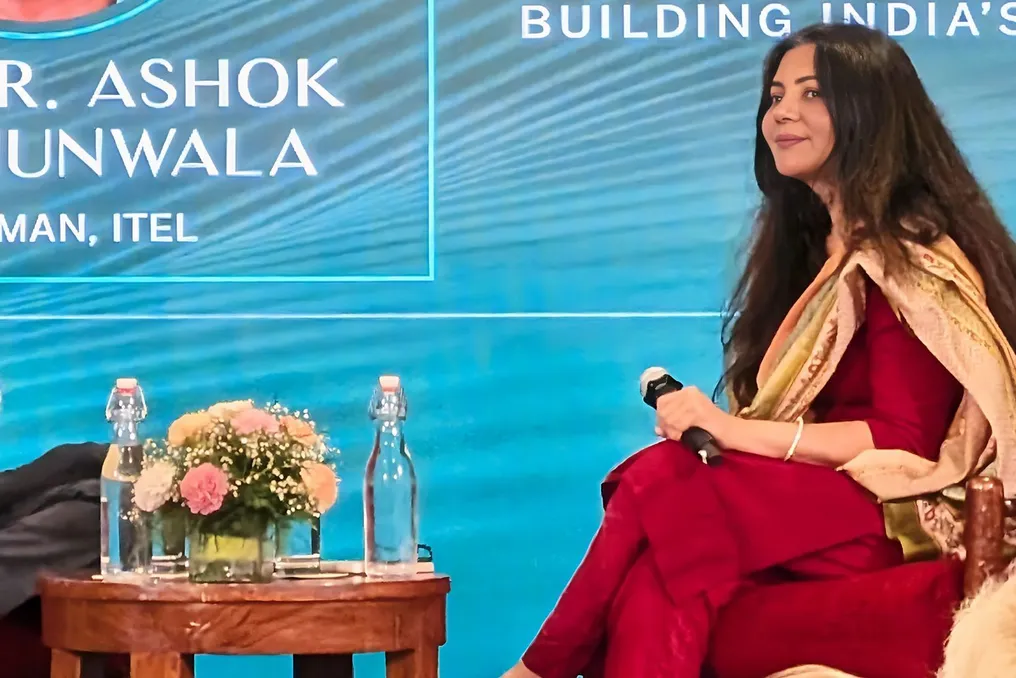
Professor Ashok Jundhvanwala, known for his contribution to the development of deep technologies in India, called on the country to think bigger. During the presentation of the biography 'Roots & Wings: Building India's Deep Tech Ecosystem' in Delhi, he stated that India's transformation would depend not on a small number of startups, but on creating a massive number of builders.
Vision for Economic Development
He suggested that if twenty million entrepreneurs could be created, it would transform the entire country. He made these remarks in a conversation with Shraddha Sharma, founder and CEO of YourStory and The Bharat Project.
The book, written by entrepreneur Saloni Malhotra, who studied under him for seven years, traces Professor Jundhvanwala's journey from his return to India in 1981 and his four-decade work in building institutions, most notably the IIT Madras Research Park—a model that changed the interaction between academia and industry in India.
Financial Achievements of the Research Park
The figures shared by the professor impressed the audience. The Research Park rejected government funding because, as he said, 'easy money is harmful.' Instead, it took loans of about 300–350 crore rupees from banks, repaid them in full, and achieved a net profit of 80 crore rupees. By June 2024, the park had created 350 startups with a total valuation reaching 70,000 crore rupees, having spent only about 2–3 crore rupees of public funds.
His approach involved uniting 150,000 Indian scientists who publish research but rarely translate it into practice with talented young people, especially from middle and lower-middle-class families, who aspire to create something new.
New Projects and Educational Reforms
This conviction now motivates his new challenge. Through the ITEL Foundation, which he heads, a consortium is being formed to develop an eco-friendly and affordable urban transport system. This system promises to move passengers 15 km in 20 minutes. After a successful demonstration of the model on campus, the team plans to implement it in the city of Sri City next year, with the Chief Minister of Andhra Pradesh N Chandrababu Naidu offering his state as the first testing ground.
Professor Jundhvanwala presented his most controversial views on education. He argued that 50% of engineering and school curricula could be completely eliminated, as educational institutions should teach students skills of learning and creation, not preparation for exams. He emphasized: 'We don't need training for exams. Learn to build, build anything, build together.' While acknowledging the controversial nature of this view, he insisted on his position.
He recalled how the proposal to reserve seats for women at IIT changed these institutions. Today, there are approximately 250 women in the batch of 1000 undergraduate students at IIT Madras, compared to only two in the class at IIT Kanpur, which had 400 people.
Comments on Technology and Mission
Responding to a question about artificial intelligence, he gave a realistic assessment: India imports almost all technologies, from battery cells to microchips, and must first solve its own problems, such as transport, waste, flooding, and fertilizer imports, which he called huge opportunities.
For a person who has declined leadership positions at IIT and states that he seeks neither money, nor fame, nor power, the mission remains unfinished. He expressed a desire to see India transform and become happy on a large scale. If his goal of twenty million entrepreneurs is achieved, this future may arrive sooner than expected.