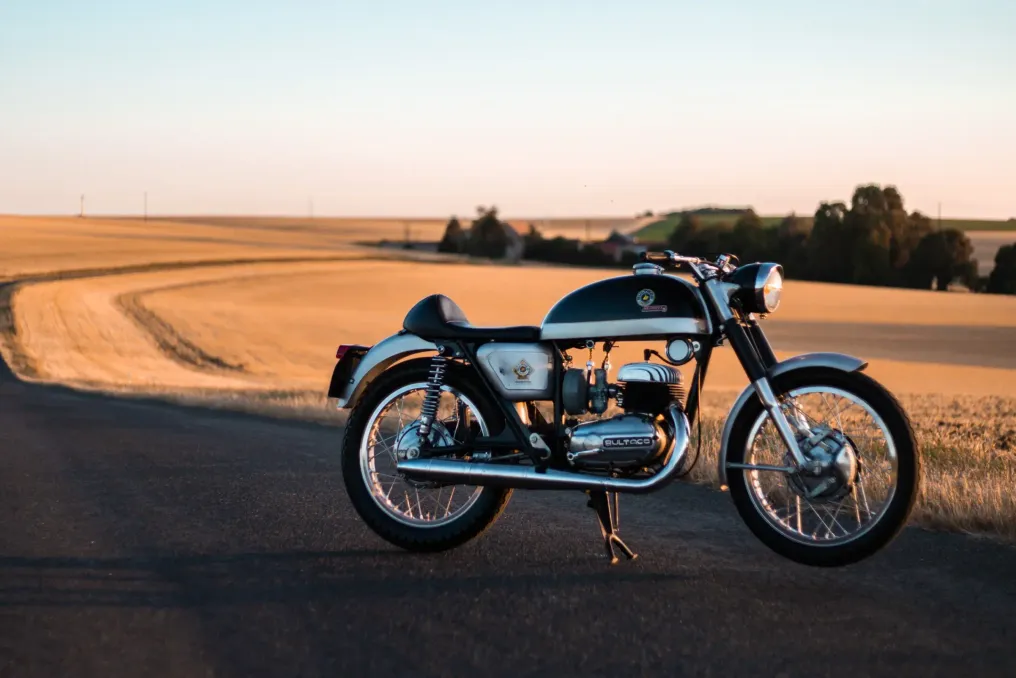
Bultaco, a Spanish manufacturer, has become an icon of world motorcycling, distinguished by its tradition in two-stroke engines despite having a relatively short trajectory.
Spanish Automotive History
Although the focus is on motorcycling, Spanish automotive history has deep roots. SEAT, for example, was known in Brazil for models like Córdoba and Ibiza, launched in 1995, although the brand left the Brazilian market in 2002. Before the influence of Volkswagen, Hispano-Suiza elevated Spanish engineering to a luxury level, competing with brands like Rolls-Royce and Bugatti. Later, Pegaso emerged with exotic supercars, such as the legendary Pegaso Z-102.
The Rise of Bultaco
The true Spanish competitive passion, driven by the culture of racing and two-stroke engines, found its maximum expression in Bultaco. This brand put Spain on the global motorcycling map and redefined sports categories. Bultaco existed for 25 years, from 1958 to 1983, and its success is linked to the dedication of Francisco Xavier Bultó Marqués, known as Paco Bultó.
The Trajectory of Paco Bultó
Paco Bultó was born in Barcelona on May 17, 1912. From an early age, he showed a fascination with speed, signing the British magazine The Motorcycle in 1926, at the age of 14. He began exploring mechanics by dismantling a DKW engine. At 17, after seeing the European Grand Prix of Motorcycling, he decided to race, initially using false names such as 'Francisco Roig' and 'Patek'. In 1935, he won the Amateur Champion title of Spain in a Velocette 90 Plus.
However, his vocation turned to engineering. He graduated in Industrial Engineering and founded Barella y Bultó, specializing in the manufacture of pistons and rings. This company evolved into FISA (Fundiciones Industriales), a main supplier to the Spanish automotive industry, and established a partnership with Mahle.
The Birth of Montesa and the Turnaround
In 1944, Paco Bultó joined businessman Pere Permanyer to create two-wheeled vehicles. During the post-war crisis, they used a French Motobécane B1V2 engine, which Bultó had borrowed, to assemble the engine and gearbox unit. Thus, in June 1945, Montesa was born, with a 98cc engine, which quickly participated in competitions.
Montesa prospered for more than a decade, but in 1958, a financial crisis and a recession in Spain led the board to close the racing department. Bultó contested this decision, stating that 'The market follows the checkered flag'. In protest, he resigned. A few days later, former collaborators from the competition division invited him to found a new company, resulting in Bultaco, named after his surname and nickname.
Launch and Initial Success
The agreement for the new factory was sealed in Masía San Antonio, in Cunit. Bultaco adopted the iconic 'thumbs up' emblem, inspired by gestures of British riders. In four months, the team developed the first motorcycle, the Tralla 101, a 125cc two-stroke single-cylinder. This model, launched in 1959, was technically advanced, offering 12 hp and reaching 114 km/h. Sales were immediate, exceeding 1,100 units in the first year.
The decisive test took place in May 1959, at the Spanish GP, where John Grace piloted a Bultaco in second place. A more striking event happened in Zaragoza, where the Tralla 101s were disqualified from the original category and placed in the top class. On the wet track, the lightness of the Bultacos allowed Marcello Cama to win, surpassing giants like MV Agusta and Ducati, catapulting the brand's prestige.
Driven by this success, Paco Bultó expanded the line in 1960, launching the 155 for touring and the Sherpa N for off-road. The successful strategy resulted in a production jump from one thousand to over 7,000 motorcycles sold in 1961.
International Expansion
Recognizing that the Spanish market was insufficient for growth, Paco Bultó sought the international scene. In October 1960, Bultaco participated in the Montlhéry circuit in France with a 175cc aerodynamic prototype. Maintaining his engineering philosophy, Bultó opted for the traditional cylinder window system, refusing technologies like rotary valves, and the small single-cylinder reached over 172 km/h on the French track.