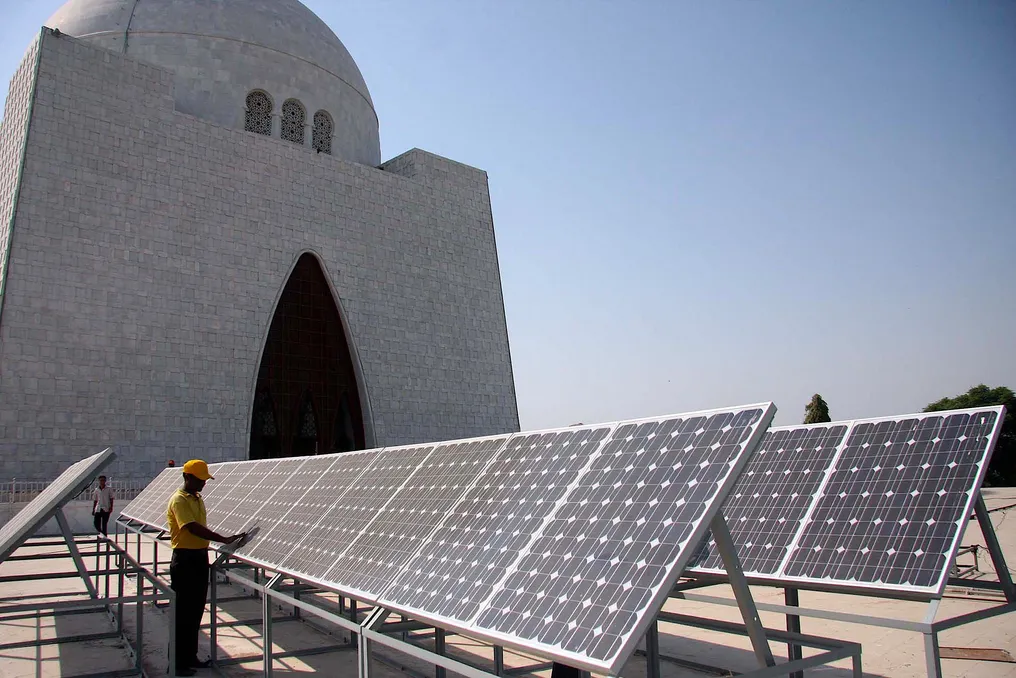
The solar revolution in Pakistan relies on the labor of workers who are forced to operate in intense heat. For instance, Abdul Rehman, who previously cleaned solar panels on Karachi rooftops during the hottest parts of the day, experienced a severe episode leading to dizziness and severe dehydration.
Experience and Risk Awareness
Rehman shared his experience, noting it was one of the worst moments, and realized he had to take care of himself because no one else would. This story is part of the CATCH project by Dialogue Earth in collaboration with Boston University, funded by the Wellcome Trust.
Pakistan is experiencing a boom in solar energy, which helps mitigate the immediate consequences of the war in Southwest Asia. According to an analysis by the Secure Energy Project, by February 2026, the country avoided importing over $12 billion worth of oil and gas and plans to save another $6.3 billion by the end of the current year.
Scale of Solar Energy Adoption
According to a recent report by energy analytical centers Ember and Renewables First, nearly one-fifth of Pakistani households use solar energy. The country's overall electricity demand growth of 21% in just two years has been fully met by new distributed solar generation, bringing the nation closer to the global average electrification rate.
However, this solar revolution rests on the shoulders of workers who install, maintain, and clean the panels. They often perform this unseen work in extreme heat without adequate safety measures.
Labor Issues and Worker Rights
Farooq Tariq, a human rights advocate and president of the Haqooq Khalq party, stated that while everyone involved in Pakistan's solar program has benefited, the workers engaged in this green energy revolution have gained no advantage, as they are deprived of rights and receive meager wages.
Rehman notes that clients expect the panels to be cleaned during the day, but he began objecting to these demands, suggesting work be done between 4 PM and midnight instead of during daylight hours. Nevertheless, Tariq points out that most young men cleaning panels in the city are 'labor migrants rushing to big cities in search of work' and are willing to perform tasks at any time of day.
Lack of Safety Measures
According to a technical report by Renewables First, the distributed solar energy industry in Pakistan created approximately 300,000 direct and 200,000 indirect jobs between the 2017 and 2025 fiscal years, with most concentrated in engineering, procurement, and construction.
Zehra Khan, a Pakistani trade union activist and Secretary General of the Federation of Women Working at Home, notes that data on manual laborers and installers is scarce because they often belong to the informal sector. Although training for potential solar technicians has become less rare, many program catalogs reviewed by Dialogue Earth focused mainly on equipment safety rather than safety measures, especially against heat.
Pakistan's Occupational Health and Safety (OHS) Act of 2018 does not explicitly mention heat stress, although it generally covers occupational hazards and risks to worker health, safety, and well-being. However, according to Tariq, the implementation of these regulations is insufficient, and he asserts that 'health and safety measures are practically non-existent for solar technicians and cleaners.'
Ad-hoc Work and Work Schedules
In Pakistan, some solar panel cleaners work on contract with companies that assign them slots, while others are permanent household maintenance staff. Muhammad Asif, 32, moved from South Punjab to work in a home in the prestigious Defence Housing Authority area of southern Karachi. Initially, he was tasked with observing and assisting a professional cleaner who came once a month. Now, after his employer acquired a pressure washer, Asif cleans the panels independently.
Asif reported that his employers are mindful of the heat, so they schedule work after 5 PM. He always carries a large towel and, even if it is hot in the evening, wets it and puts it on his head.
In Karachi, contracted cleaners are usually assigned time slots from 9 AM to 6 PM, and on average, cleaning one household's panels takes an hour, says Ali, an employee of the Karachi company Solar Sweep. This means some cleaning slots fall during peak heat hours.
Ali Habib, CEO of the consulting firm Sama Verte from Punjab, the parent company of Shama Solar, which specializes in comprehensive photovoltaic solar services, notes that the company has 'guidelines stating that solar panels should not be cleaned during the day when it is hot, as the sun shines brightly then and we achieve maximum solar energy output.'
Since solar panel workers are also at risk of electric shock, Shama Solar recommends using personal protective equipment (PPE) such as boots and helmets. Habib adds that a hat helps protect against heat. Due to the tight schedule for installing solar systems, Shama Solar workers are advised to perform indoor tasks, such as wiring or installing inverters and batteries, during the day, and panel installation in the evening.
Nadim Nawaz, a project manager at Shama Solar, indicates that installation work increases after April, meaning there are many more solar technicians on rooftops during the hottest months. He acknowledges that workers get sick and dehydrated from the heat and go to nearby hospitals, or are given the day off. However, atmospheric heat is not the only danger for solar energy workers. Nawaz notes that 'the frames and structures of solar panels are made of aluminum, so they heat up significantly, and technicians' hands can burn, but it is too hot to wear thick protective gloves,' adding that some technicians refuse to wear protective gear due to the heat. At the same time, Nawaz believes that working at night is impractical because 'additional light sources are required at night, and visibility is limited, making it unsafe.'
Long-term Health Risks
Safety experts advise using specialized protective gear to combat heat and direct sunlight. PPE supplier Oteplace from France recommends that renewable energy workers use a set including wide-brimmed hats, UV-filtered sunglasses, and special evaporative vests that can be soaked in water for cooling.
However, according to doctors interviewed by Dialogue Earth, most solar energy workers in Pakistan do not have access to such equipment, leaving them vulnerable to heatstroke, dehydration, and electrolyte imbalance.
Asia Shahab, a doctor who frequently organizes medical camps to assist the underprivileged in Karachi and its suburbs, warns: 'Even death remains a real possibility.' Doctors are also concerned about the long-term effects of UV radiation on solar technicians. Shahab explains that if panels are installed during peak heat hours when the sun is at its zenith, it can lead to intense UV radiation as sunlight reflects off light roofs.
She adds that such exposure can cause sunburn in just 10 minutes, leading to skin drying and premature aging, as well as eye diseases such as cataracts, eye tissue growth, and photokeratitis (sunburn of the eyes). Mariam Noaman, head of the Department of Medical Oncology at Dow Comprehensive Cancer Care Centre in Karachi, states that chronic exposure to UV radiation 'is a well-established cause of skin cancer.' She explains that UV rays cause cumulative DNA damage and can lead to mutations in important tumor suppressor genes, as well as impairing local skin immune surveillance. Over time, these changes increase the risk of developing skin cancer, including basal cell carcinoma, squamous cell carcinoma, and melanoma. She emphasizes that 'individuals with prolonged professional sun exposure, including solar technicians, are at high risk.'
According to estimates by the World Health Organization and the International Labour Organization for 2023, nearly a third of non-melanoma skin cancer deaths are caused by working in the sun.
Lack of Compensation Mechanisms
Zehra Khan notes that despite high vulnerability to heat stress, solar industry workers are not discussed in political debates and are not legally recognized. She states: 'There are no official laws protecting or ensuring the well-being of workers in solar energy.'
This means that if they suffer from extreme heat or any other occupational hazards, they have no systems for receiving treatment support. Khan adds: 'There is no available data on their numbers or details, so how can they participate in any political discussions or labor agreements?'
She stresses that this applies not only to installers and panel cleaners but to everyone in the solar energy supply chain, such as those involved in grounding. Khan insists that all such workers must be registered with social services like the Sindh Employees’ Social Security Institution (SESSI) or the Employees’ Old Age Benefit Institution (EOBI).
There may be hope on the horizon for improving heat safety for solar energy workers. Pakistan recently approved an Occupational Health and Safety (OSH) Code of Practice for the construction sector, which establishes legally binding standards to strengthen the protection of workers' health and safety in this industry. The International Labour Organization noted that this code is based on internationally recognized standards, including the ILO's own Code of Practice on Occupational Safety in Construction, which contains a section on heat stress.
Pakistan's new code applies to builders in the informal economy and may support solar system installation workers in the long run. Rabia Razzaq, an ILO Senior Programme Officer in Pakistan, confirmed that the new code covers 'broad terms to cover all electrical system equipment,' including solar energy. The main measures provided by the code include fall protection, electrical safety, ergonomic handling of objects, PPE, and emergency preparedness to reduce physical, electrical, chemical, and environmental hazards. It also includes proper training, risk assessment, and adherence to occupational health management systems. Khan concludes: 'Solar industry workers are invisible workers who need to be made visible.'