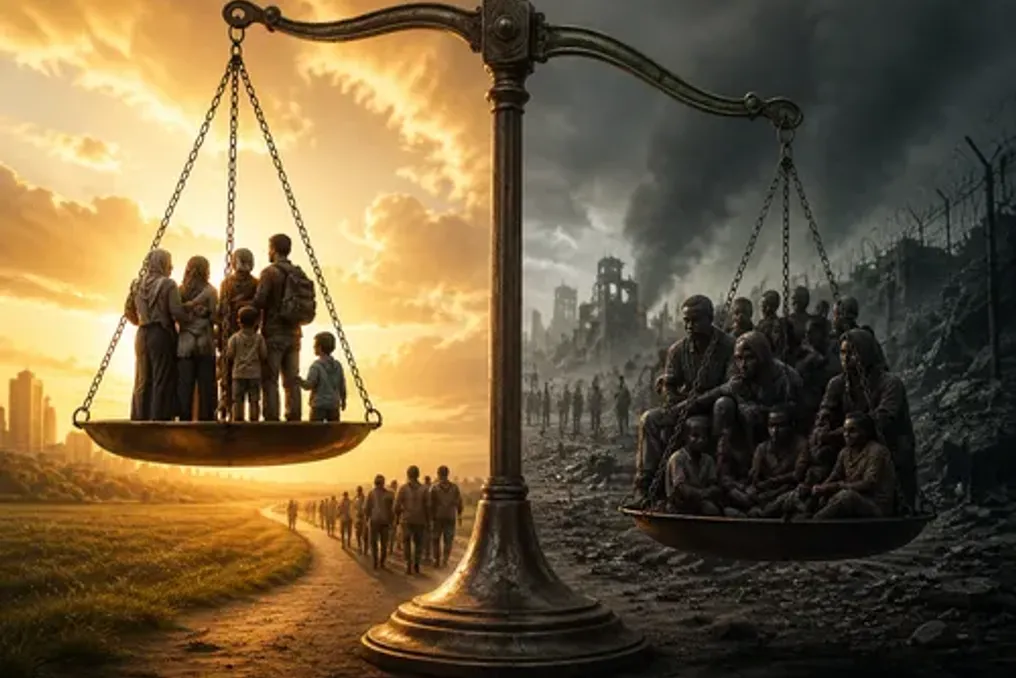
In the 'Letters to the Editor' section, readers shared their thoughts on a range of current topics, including cultural peculiarities, migration issues, the need for compassion, and questions related to power.
Cultural References and Traditions
One author expressed regret over uneducated readers and writers who claim complete ownership even over natural elements such as marigolds, which are used worldwide as garlands. The author noted that such flowers were used in his wedding, as well as in television dramas from India and Pakistan.
The author also mentioned that the expression 'Sita's line,' which he uses to describe 'dangerous borders,' is widely accepted both in Indian folklore and internationally. He emphasized that he draws inspiration from the literature of various religions and cultures, including Greek, Roman, Walt Disney traditions, Hollywood, India, Pakistan, Christianity, Judaism, Islam, and Hinduism.
Citing the advice of Cassius Brutus from Shakespeare's 'Julius Caesar,' the author stated that he is not at fault if some readers criticize other authors, asserting: 'The fault, dear Brutus, is not in our stars, but in ourselves.'
The Complex Reality of Migration
In response to those who continue to condemn protesters against illegal immigration, a series of balanced facts were presented. It was noted that if there is indeed targeted persecution only of 'Black Africans,' this raises serious concern. However, any illegal entry is a violation of the law anywhere in the world.
The thesis that African countries hosted activists opposing apartheid was also discussed. It was confirmed that this is true, but these individuals were exclusively political asylum seekers, not illegal or economic migrants. Furthermore, it was argued that they did not overload countries with millions nor deplete the economies of host nations, as the UN Programme for Education and Training for South Africa and the International Defence and Aid Fund for South Africa provided them and their families with living allowances, legal aid, and educational scholarships.
However, the country hosts 3.1 million migrants, including both legal and illegal ones. The question arises whether the country can afford such a number given millions of its own citizens suffering from extreme poverty, unemployment, poor infrastructure, inefficient healthcare, and collapsing services.
It was warned that if authorities do not take action, the situation could resemble that in India, which has about 5.2 million registered foreign residents, refugees, and expats, as well as about 20 million undocumented individuals. It was also pointed out that not all undocumented persons in South Africa originate from countries that hosted anti-apartheid activists; for example, Pakistan, Bangladesh, and Malawi did not host them, unlike India and many Western countries.
The question arose regarding the consequences if millions of people from non-Western countries who supported activists decide to arrive en masse in South Africa. Critics of the 'compassionate brigade' publishing opinions on 'vigilantes,' such as Lubna Nadwi, were called out for remaining silent about the fate of African migrants in Tunisia, Algeria, and Libya.
In these countries, the practice of auctioning African migrants as slaves in open markets is observed. Although Antonio Guterres of the UN labeled this crimes against humanity, and the African Union condemned this practice, it continues, as does the silence of some 'activists' and groups. One commentator noted: 'For Arabs (Libyan jailers), Black men are no more than animals—they treated the animals better.'
Lessons from the Operating Room
A story from 1991 was recounted when the author was completing a diploma in theatrical nursing at Natalspruit Hospital. A brilliant general surgeon from Ghana worked there. He often told his team that to become a good surgeon, one sometimes needs to listen to the nurse because she has extensive experience working with different consultants.
One night, a patient arrived in the emergency department with a gunshot wound to the abdomen, bleeding heavily. The attending physician could not reach the consultants. The patient was losing blood, and the doctor could not find the source of the bleeding. The author asked him why he did not use a bladder retractor, which could expose the site of bleeding. The doctor performed this, found the source, stopped the bleeding, and saved the patient's life.
This first experience interacting with the Ghanaian citizen left a positive impression on the author. He expected to meet rational and understanding people, but now he cannot understand the hostile attitude.
It is emphasized that the struggle between peoples only exacerbates the situation, as no single country can provide sustenance for the entire world. Each country is responsible to its own citizens.
Power and the Judgment of History
Nations can unleash fire upon smaller lands with merciless precision, bomb ruthlessly, destroying entire cities, turning generations to dust, exterminating the helpless, humiliating dignity, intimidating the weak, and degrading the broken, believing their power to be absolute and eternal.
These powers demonstrate their might to the trembling world, masking cruelty under the concept of necessity. However, behind the roar of destruction and the arrogance of unchecked power stands God, the ultimate arbiter, before whom every tyrant will be exposed, stripped of illusions, and confronted with the weight of their deeds.
At that decisive moment, neither armies nor alliances can protect them, nor can narratives distort the truth—only the cold and absolute calculation of divine justice. Disregarding Almighty God in the equation is perilous, for the judgment awaiting does not postpone nor deny itself. The fall from the height of power to accountability will be as destructive as the destruction previously caused. Humanity can deceive, delay, and deny, but every act of cruelty is recorded outside manipulation, because the illusion of salvation is the greatest delusion, for divine justice neither rushes nor forgets.