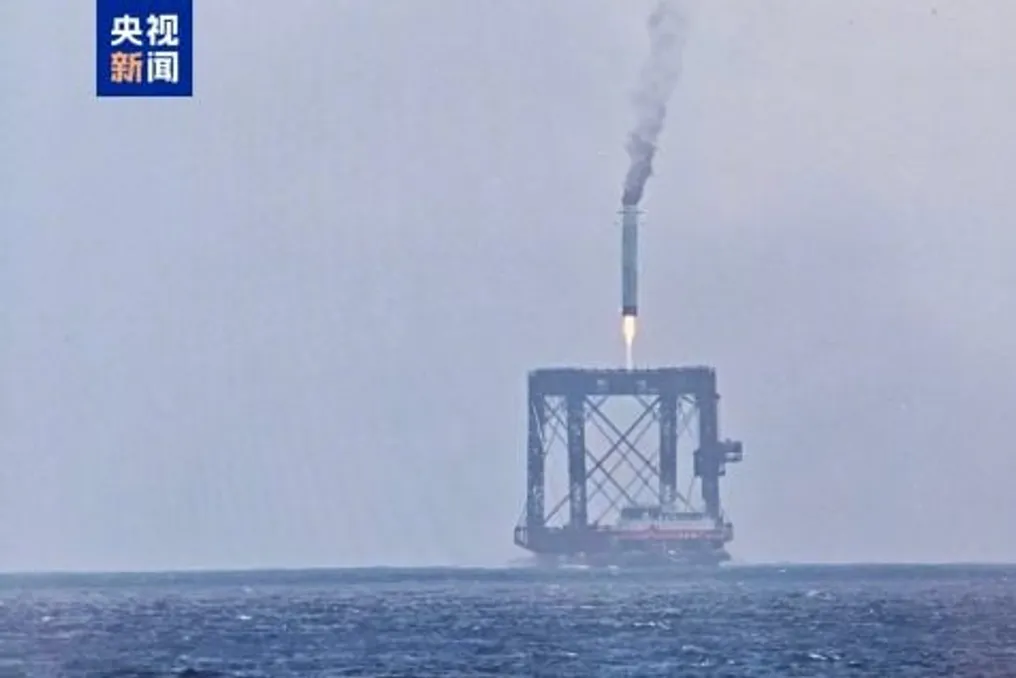
China achieved a significant feat by recovering the first stage of an orbital-capable rocket during the inaugural flight of the Long March 10B on July 10. This operation positions the country as the second global nation to recover an orbital-class booster and the first to capture it using an ocean net, rather than relying on landing legs.
Strategic Advancement in Space Program
This achievement represents a strategic leap for the Chinese space program, as the ability to reuse rockets contributes to reducing operational costs and enabling an increase in launch frequency. Although the United States maintains leadership in the sector regarding orbital missions and lunar exploration projects, China has shown remarkable growth in this area in recent years.
Rocket Recovery Details
The launch took place from the Wenchang Commercial Space Launch Center, located on Hainan Island in the south of the country. Approximately six minutes after the separation between the first and second stages, the booster began a controlled and guided descent. Some engines were reignited to assist the return, culminating in capture by the recovery vessel Linghangzhe.
Hooks attached to the fuselage engaged with cables stretched across the deck, while a hydraulic damping system absorbed the remaining energy. The China Aerospace Science and Technology Corporation (CASC), the state entity responsible for the project, stated that this was the world's first retrieval of a transport rocket via a net system.
Advantages and Technical Specifications
According to the manufacturer, this method eliminates the need for the landing legs used by SpaceX and Blue Origin, resulting in reduced vehicle weight and an expanded margin of error during capture. However, engineers involved in the program point out that these advantages still require validation on a larger scale, given that there has only been one successful recovery so far.
The Long March 10B, developed by the China Academy of Launch Vehicle Technology (CALT), a subsidiary of CASC, is 63 meters high, 5 meters in diameter, and weighs approximately 760 tons at launch. Its first stage is powered by seven YF-100K engines that use kerosene and liquid oxygen, while the second stage operates with methane and liquid oxygen. In its reusable configuration, the rocket has the capacity to carry up to 16 tons to low Earth orbit.
Future Plans and International Goals
CASC expressed its intention to reuse the recovered stage within the current year, a crucial step to convert technological demonstration into practical economy, as a single recovery does not establish a consolidated reuse program. Furthermore, China has significant space ambitions, including the development of large satellite constellations and crewed missions to the Moon. The Long March 10B is the cargo version of the Long March 10 family, which is under development, and its full version is expected to carry astronauts to the lunar surface by 2030. In contrast, the United States aims for a crewed landing in 2028, as planned in the Artemis program.