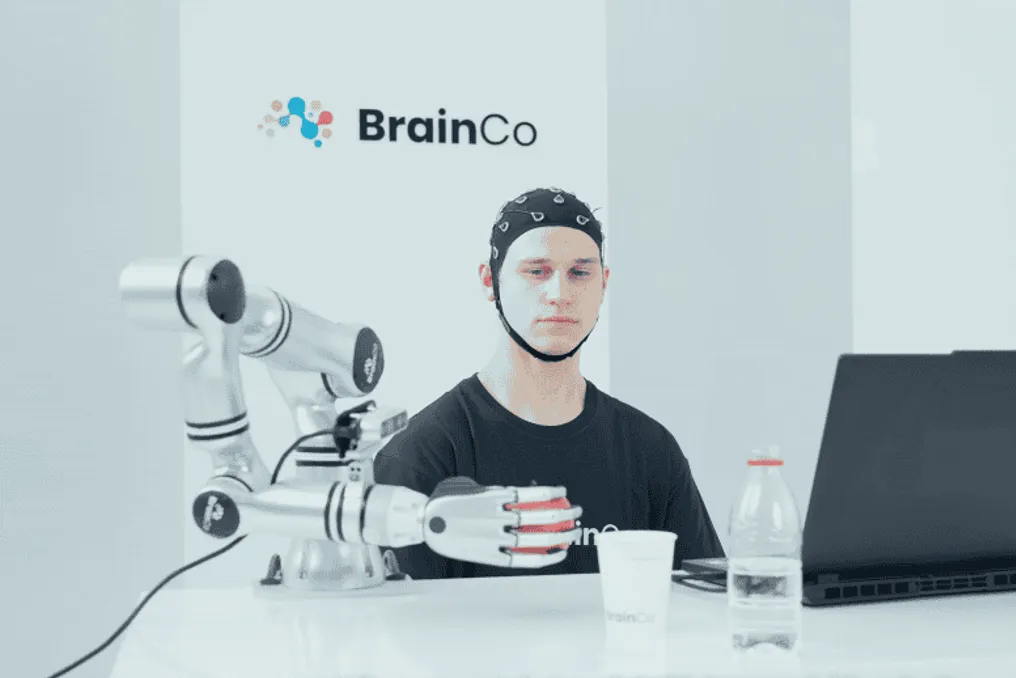
BrainCo, a company specializing in the development of brain-computer interfaces (BCI), has demonstrated a new platform that enables robot control via neural signals.
Demonstration in Shanghai
This technology was presented at the World Artificial Intelligence Conference (WAIC) in 2026, held in Shanghai, China. During the demonstration, one participant was able to control a robotic arm solely by thought.
The user wore a lightweight electroencephalography (EEG) headset connected to the company's BCI system. When the user mentally imagined picking up a cap, the robotic arm recognized this intention and automatically performed the action. According to BrainCo, the entire process, from reading brain signals to the robot executing the movement, takes less than 200 milliseconds.
System Operating Principle
The technology functions in three stages. First, the EEG headset records electrical signals emitted from the user's brain. Next, artificial intelligence (AI) algorithms analyze this information to determine the intended movement or control. Finally, this intention is converted into commands sent to the robot to perform the task.
Nick He, partner and Senior Vice President of BrainCo, noted that the system is the result of ten years of research in BCI. He stated in The Robot Report: 'A decade of BCI research has given us the ability to decode what a person intends to do and translate it into machine action.'
He also added that the combination of various technologies will trigger a new stage of human-machine interaction. 'By integrating brain-computer interfaces, AI, and embedded AI, we believe this will define the next chapter of human-machine collaboration.'
Expanding Robot Functionality
During the presentation in Shanghai, the robotic arm also performed more complex tasks requiring high precision, such as holding a glass and picking up an apple.
According to the company, the platform is designed to be compatible with various commercially available robots, including humanoid robots, robotic arms, and legged robots. The goal is for manufacturers and research centers to implement this technology in their projects without dependence on proprietary hardware.
BrainCo, based in Somerville, Massachusetts, describes the platform architecture as 'neuro-embodied AI.' In this model, the BCI determines the operator's intention, and the AI layer interprets this intention and breaks it down into executable steps. The robot systems themselves are then responsible for the physical execution of the task.
Data Collection for Robot Training
In addition to the neural signal control platform, BrainCo introduced its new AI-embodied data collection solution at WAIC. This initiative aims to solve one of the main problems in modern robotics—the lack of real, high-quality data for training AI systems capable of performing complex and delicate tasks.
BrainCo explains that training a robot to perform actions such as folding clothes, assembling components, or manipulating fragile objects requires huge volumes of data gathered in real-world conditions, which remains a barrier to the development of this field.
To address this, the company developed its own platform consisting of a mobile data collection system equipped with two robotic arms and a high-precision glove. This complex records information from three sources: actions performed by the robot; demonstrations performed by human operators; and virtual simulations. Furthermore, the system records the EEG signals of the human operator. Thus, the platform captures not only the human hand movements but also the brain commands that generated those movements.
According to BrainCo, this approach combines the quality of data obtained from real robots with the scalability of human demonstrations, allowing for the continuous generation of large volumes of data based on real-world tasks.
Company's Existing Products
Founded in 2015, BrainCo already sells three products in the fields of robotics and intelligent prosthetics. These include the Revo 3 Dexterous Hand, a robotic end-effector with 21 degrees of freedom. The company also offers the Intelligent Bionic Hand, a five-fingered prosthetic hand, and the Intelligent Bionic Leg, a smart knee joint for lower limb prosthetics.