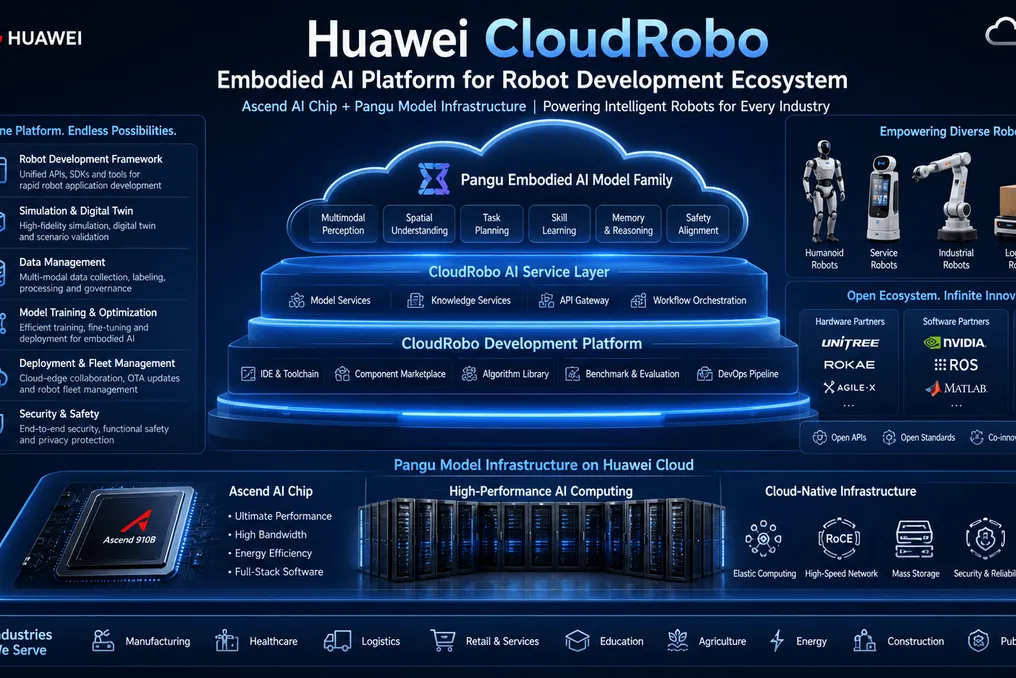
Huawei Cloud has introduced CloudRobo, a comprehensive platform for developing embodied artificial intelligence. This platform covers the entire workflow: from data creation and model development to robot simulation and deployment. With this move, the company has declared its position as a provider of the intelligent 'brain' for robots, rather than a direct manufacturer.
A Strategy Similar to the Automotive Sector
This strategy mirrors Huawei's approach in the smart car sector, which led to the success of SERES/Ask. Instead of creating the final product independently, Huawei provides the intelligent core, ecosystem, and development platform, allowing other companies to create competitive products. More than twenty companies, including Youibot and Huayan Robotics, have joined CloudRobo as initial partners.
CloudRobo Architecture and Capabilities
The architecture of the CloudRobo platform is based on three main elements. First, a PB-level data foundation provides access to millions of ready-made datasets. Second, a cloud engine for model production utilizes a series of Pangu models running on Ascend AI chips. Third, an internal Real-Sim evaluation system allows for realistic virtual testing.
Developers gain access to over 20 models optimized for Ascend and can connect a robot to the cloud in mere hours, while deploying a model takes minutes. The platform covers the entire process of embodied AI development: data collection, model training, simulation evaluation, hardware integration, and operation.
Application of the Business Model
The logic of this strategic decision replicates Huawei's proven model. In the smart vehicle segment, Huawei supplied intelligent driving systems, cockpits, and electric drive technology, while partners handled manufacturing. This model allowed SERES to transform from an unknown manufacturer into a premium electric vehicle brand, and the M9 model became a bestseller in the segment above 500,000 yuan. Now, Huawei is applying the same division of labor concept to embodied AI: the company provides the intelligent operating system, cloud platform, and basic AI models, while robot manufacturers focus on hardware development, production, and vertical application scenarios where they possess expertise.
The high gross profit margin of controllers at 79.8% compared to the equipment margin of 38.4% confirms the priority of the strategic focus on software-defined value.
Competitive Advantage and Prospects
The current time reflects industry maturity. Robot motion control capabilities are largely standardized among major manufacturers, making the intelligent processor the primary differentiator. The fragmented robotics landscape, encompassing industrial manipulators, service robots, quadrupeds, and humanoids, requires a unified development infrastructure to avoid every team recreating everything from scratch. Huawei CloudRobo solves the problem of manual development, where individual groups wasted excessive resources on creating custom data pipelines, model training, simulation environments, and hardware integration instead of innovating in applications.
Although it remains unclear whether Huawei can replicate its smart vehicle ecosystem strategy in embodied AI, given that cars feature high standardization and uniformity, whereas robots have extremely diverse requirements, Huawei already possesses the M-Robots OS based on OpenHarmony and over 15 embodied AI startups founded on talent nurtured by Huawei, indicating the company's influence extends far beyond the CloudRobo platform itself.