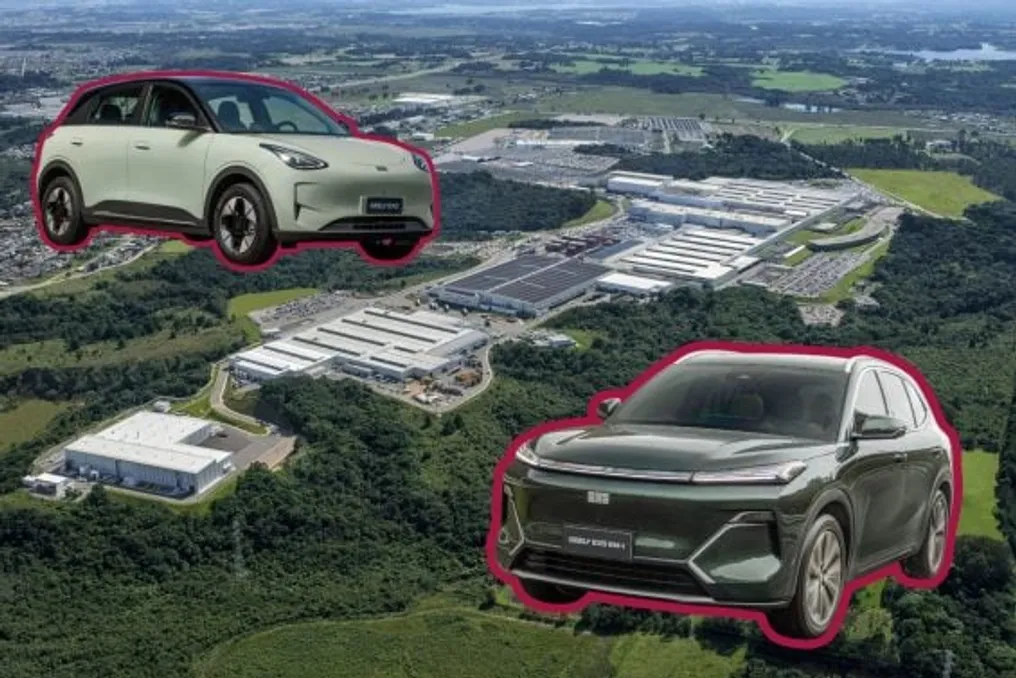
Geely will cease to be merely an importer of products in Brazil, as its domestic production will begin this September. Manufacturing will take place at the Ayrton Senna Complex, located in São José dos Pinhais, in the state of Paraná.
Geely will cease to be merely an importer of products in Brazil, as its domestic production will begin this September. Manufacturing will take place at the Ayrton Senna Complex, located in São José dos Pinhais, in the state of Paraná.
This new operation is being conducted by Renault Geely do Brasil, a joint venture that will use Renault's facilities to produce two vehicles sequentially. The first model to be launched on the assembly line will be the hybrid SUV EX5 EM-i, scheduled for September.
Subsequently, in the last quarter of 2026, the fully electric hatchback EX2 will enter the production line. This model is currently the best-selling one from the brand and is also the third best-selling electric car in the country. The schedule was confirmed by Ariel Montenegro, who holds the positions of president and general director of Renault Geely do Brasil, during an interview given to the newspaper Valor Econômico.
Both cars use the GEA (Global Intelligent Electric Architecture) platform, which will serve as the basis for future Renault developments. The EX2 will be assembled at the CVU (Curitiba Veículos Utilitários) unit, located within the Paraná complex, which received an investment of approximately R$ 3.8 billion. Initially, the hatchback will be assembled under a CKD regime—meaning it will be imported disassembled from China and reassembled in Paraná—with a gradual migration towards using locally manufactured components.
The decision to nationalize production aims to protect the models against the recent increase in the import tax applied to electrified vehicles and to reduce vulnerability to currency fluctuations. Additionally, this strategy allows for more effective inventory management and reduces dependence on international maritime logistics, a factor that had limited Geely's sales at the beginning of the year, despite the unexpected success of the products.
The nationalized EX2 is expected to be launched in a renewed version. According to information obtained by the website Autos Segredos, which captured a nationalized unit during testing, the hatchback will receive improvements, including a new bumper, full-LED headlights, multimedia center with native support for Android Auto and Apple CarPlay, in addition to an expanded battery of 47 kWh, surpassing the current 39.4 kWh.
The 'Shatakka Olish' mechanism contributes to strengthening the economic self-sufficiency of local production enterprises. Five years ago, at an industrial fair organized at the Noviy Machine-Building Plant of the complex, an exhibition took place. At this exhibition, new types of products replacing imports, developed based on inventions, rationalization proposals, and innovative ideas from a large industrial enterprise, as well as in cooperation with local producers, were presented.
The exhibition showcased products that were implemented, are planned for implementation, or recommended for implementation at local enterprises, replacing imported goods. Later, technological cooperation with local enterprises within the framework of the 'Shatakka Olish' mechanism continued.
Noviy Konmetallurgiya Complex became the first in the republic to implement this mechanism. To date, more than 200 types of import-substituting products have been purchased from partner enterprises under this mechanism. Over the past five years, new types of products have been acquired as a result of the 'Shatakka Olish' process, and goods worth 3 trillion sums have been purchased for the complex's needs.
According to Ulugbek Sanakulov, head of the 'NKMK' department, in 2025, products supplied by enterprises participating in the 'Shatakka Olish' program amounted to 783 billion sums, which is almost three times higher than the figure for 2021. He also noted that the economic indicators of these enterprises are growing steadily. Long-term partners include companies such as 'Gidro Stanko Servis' MChJ, which supplies equipment and spare parts for mines; 'Navpromlitmash' MChJ, which supplies mining equipment, filters, and steel alloys; 'Chilon Lubricants' MChJ, which supplies technical oils and reagents; 'Noviy Elektrod Zavod' MChJ, which supplies graphite electrodes; 'Noviy Elektromontaj' MChJ, which supplies electric motors and equipment; 'Euro Prom Lider' MChJ, which supplies filter fabric; and 'Carbon Polymer' MChJ, which supplies fluoroplastic and polymer products, as well as other types of goods.
Another positive result of this mechanism is the formation of the 'Shatak Pyramid,' where enterprises included in the 'Shatakka Olish' program begin to independently attract other, smaller enterprises into this system. One such example is the enterprise 'Navpromlitmash.' Established in 2007, the joint-stock company 'Navpromlitmash' produces dozens of components, including non-standard equipment, copper and brass pipes, and cast iron products. Furthermore, under the brand 'Universal Filter,' this joint-stock company produces air and oil filters for industry and automobiles, which contribute to import substitution.
Ibrohim Faiziyev, Director of 'Navpromlitmash' MChJ, recipient of the 'Dostlik' Order, reported that in 2025, the enterprise produced over 220 types of products. In cooperation with 'Noviy Konmetallurgiya Complex,' 400 billion sums worth of spare parts were produced last year. The manufactured equipment and spare parts are supplied not only to 'Noviy Konmetallurgiya Complex' but also to large industrial enterprises such as 'Olmaliq Konmetallurgiya Complex,' 'Noviyuran,' 'Noviyazot,' and 'Noviy Issiqlik Elektrostantsiyasi,' which strengthens the enterprise's reputation as a reliable partner.
As part of the program for expanding and modernizing production for the period 2022–2026, it is planned to produce 150 thousand aluminum and copper wires annually for cable conduits, as well as 300 thousand air and oil filters for industry and automobiles. It is important to note that this has created new jobs and provided the opportunity to produce import-substituting products worth 249 billion sums per year.
Thus, the 'Shatakka Olish' system not only strengthens the economic independence of local enterprises but also promotes the development of design and technological documentation, as well as the production of new types of import-substituting products.
Rallis India Ltd, a company engaged in the agricultural resources sector, reported a 31 percent increase in net profit for the period from April to June, amounting to 125 crore rupees, due to increased revenue.
In the same period last year, the company's net profit was 95 crore rupees. According to regulatory filings submitted on Monday, total revenue for the first quarter of the current fiscal year reached 1035 crore rupees, compared to 969 crore rupees in the corresponding period of the previous year.
Gyandendra Shukla, Managing Director and CEO of Rallis India, noted that the company demonstrated stable results in the first quarter of the fiscal year 27. He attributed this to 'focused execution across all business verticals, improved profitability, and continuous investments in strengthening our portfolio and capabilities.'
Rallis India Ltd is a subsidiary of Tata Chemicals Ltd and is part of the Tata Group, which has a valuation exceeding $180 billion. The company's operations cover the segments of seeds, crop care, soil health, and plant health.