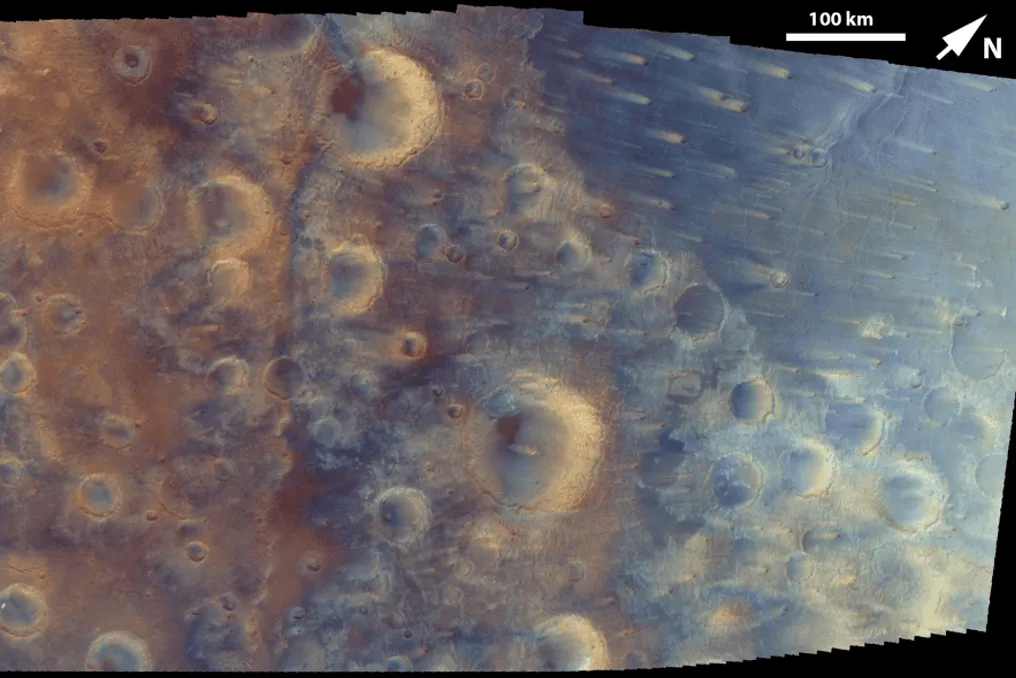
An area on Mars displayed a phenomenon that initially suggested the presence of metallic waves, but which was explained as giant dark sand dunes that acquire a shiny appearance due to the layer of ice present on the surface.
Discovery in Kaiser Crater
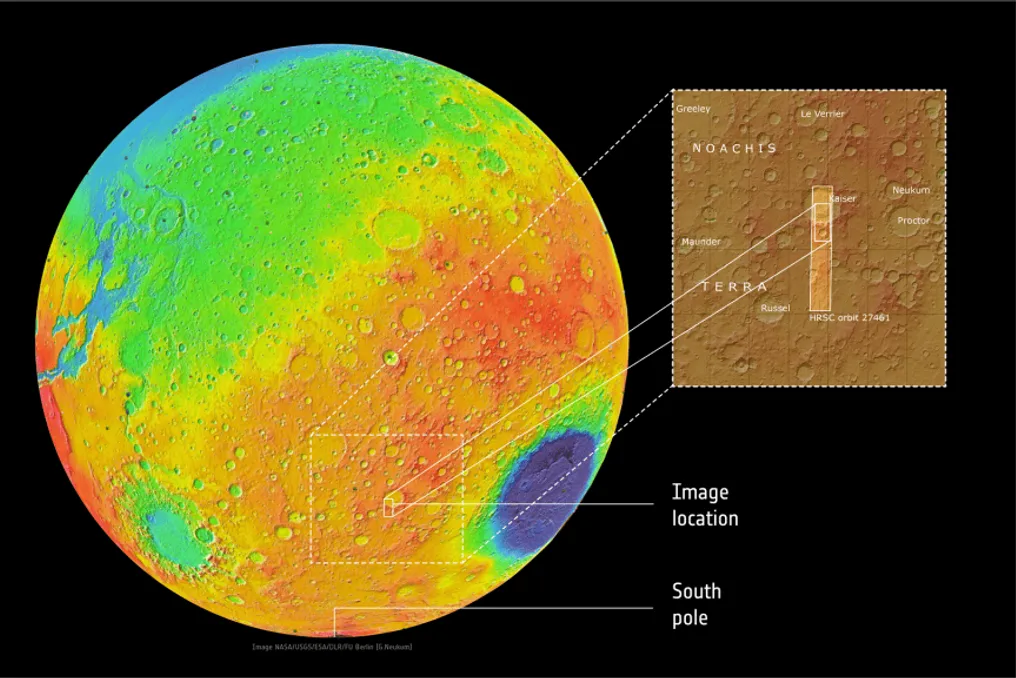
This scenario was documented by the Mars Express probe, belonging to the European Space Agency (ESA), specifically in Kaiser Crater, considered one of the oldest regions of the red planet. The photograph, obtained by the High Resolution Stereo Camera (HRSC), covers part of Noachis Terra, an area located in the south of Mars, characterized by asteroid impacts that occurred about four billion years ago.
Kaiser Crater is a massive formation, measuring approximately 180 kilometers wide and having depths of several kilometers. The location attracts attention due to the dark dunes scattered within it, some of which exceed 100 meters in height. Despite their unusual appearance, these structures are not composed of metal; the shine perceived by researchers results from deposits of ice on the southern-facing slopes, which gives the sand a polished look.
Details of Martian formations
The notable elements observed include dark dunes with a metallic-like sheen, formations shaped by Martian winds, sand rich in volcanic minerals, and indications of past modifications caused by water.
The region hosts various types of dunes, such as barchans, which have a crescent shape, and transverse dunes, which are more elongated. Such patterns are also observed in terrestrial deserts, such as those found in the Sahara and Namibia. According to the ESA, the dominant winds in this section of Mars blow from the west, moving fine sand composed of minerals such as pyroxene and olivine, thus keeping the formations in continuous change.
Evidence of ancient water
In addition to the dunes, the image revealed traces that may be linked to the existence of water in the past. In certain spots, the wind removed the surface layers of soil, exposing clay rocks that probably formed in aquatic environments.
Contribution of Mars Express
The Mars Express mission has been operating since 2003 and has been fundamental in the detailed mapping of the Martian surface, generating three-dimensional models and colored images of the planet. The HRSC camera was developed and operated by the German Aerospace Center (DLR), with the collaboration of scientific teams from the Free University of Berlin.
This new perspective of Kaiser Crater confirms that Mars still possesses landscapes capable of causing surprise. The shimmering dunes and the marks left by the interaction between wind and water help in understanding how the planet evolved since its formation.