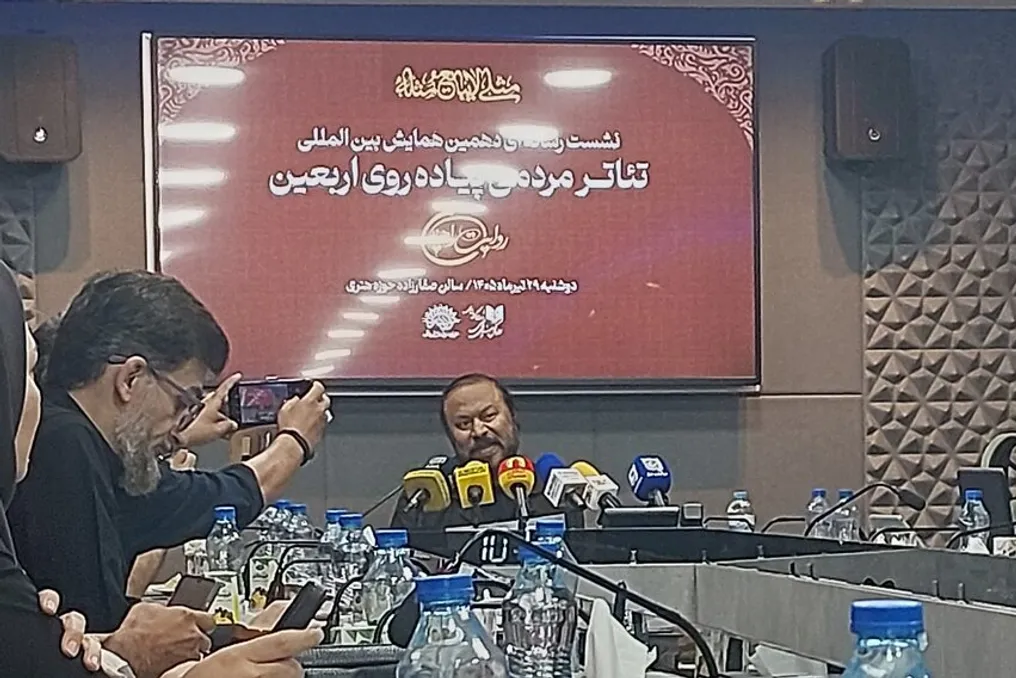
The tenth edition of the International Arbaeen Theatre Festival will feature a wide range of live performances along the pilgrimage route, emphasizing the significance of art as a spiritual and cultural service.
The tenth edition of the International Arbaeen Theatre Festival will feature a wide range of live performances along the pilgrimage route, emphasizing the significance of art as a spiritual and cultural service.
This was announced during a press conference held at the Arts Bureau in Tehran on Monday. Attendees included festival secretary Kurosh Zarei, executive secretary Seyed Mostafa Motorchi, and members of the press.
Kurosh Zarei stated his commitment to improving the quality of the annual event. He reported that out of numerous applications received from various Iranian cities, 13 theatrical works were selected. These pieces cover different genres, including Tazieh (Iranian passion play), Nakkali (traditional narration), street theatre, and puppet theatre.
The performances are scheduled to be shown at ten key points along the Arbaeen walking route, as well as in the cities of Najaf and Karbala from July 25 to August 5. Furthermore, the festival will deploy a mobile Mukeb to deliver theatrical performances directly to pilgrims.
Zarei noted a significant change in institutional support this year: for the first time, the General Directorate of Performing Arts of the Ministry of Culture and Islamic Guidance is participating. The Cultural and Artistic Organization of the Tehran Municipality has also joined as a partner.
A notable feature of the festival is the cultural oath taken by the participating artists. Zarei clarified that all creative groups agreed to participate without receiving payment, viewing their presence as a spiritual offering. Nevertheless, the best group will be presented with a special gift at the closing ceremony.
Addressing logistical difficulties, the festival secretary pointed to a significant increase in transportation and logistics costs in Iraq, which requires support from various collaborating institutions to ensure the viability of the event. He also highlighted the distinct nature of the Iranian productions: while many programs along the route are recorded by Iraqi troupes, all Iranian groups perform live on stage.
Regarding international participation, Zarei explained that there will be no foreign groups in the tenth edition. He explained that although high-quality international applications were received in previous years, the current submissions did not meet the required technical and artistic standards.
He added that the goal is to establish a presence among theatre figures of the Islamic world to expand theatrical communication and interaction between Islamic nations. Forming such a network can pave the way for collaborative creation, experience exchange, and joint production of dramatic works, thereby strengthening the theatrical potential of the Muslim world.
Motorchi, for his part, noted that the festival's repertoire is updated annually to reflect current events in the Islamic world. He emphasized that the current edition represents a quantitative leap in terms of the number and distribution of venues compared to the previous nine editions.
Although plays were previously staged at the festival in English, Turkish, and Arabic, performances this year will be limited to Persian and Arabic due to regional military conditions and financial constraints. He expressed the festival's long-term aspiration to create works that resonate with pilgrims of all languages and cultures, fostering global artistic connection on the path to Karbala.
Every year, hundreds of thousands of Iranians travel to the Iraqi city of Karbala to commemorate the sacred day of Arbaeen at the shrines of Imam Hussein (AS), the third Shia Imam, and his brother, Hazrat Abbas (AS). This pilgrimage is one of the largest peaceful gatherings in the world, attracting millions of devotees from around the globe to the heart of Iraq.
Arbaeen, which is observed this year on August 4, marks the end of the 40-day mourning period following the martyrdom of the Imam and his loyal companions on Ashura. Beyond rituals of grief, this event serves as a profound demonstration of unity and brotherhood, as millions of people from different segments of society gather in a shared expression of faith. The route to Karbala transforms into a landscape of hospitality, where volunteers provide food and shelter, reflecting the selfless values taught by the Imam himself.
Superstar Salman Khan will once again host the television show, and the organizers have announced the start of a new season of 'Bigg Boss 20'.
The popular and often controversial show 'Bigg Boss', which attracts millions of viewers with highly dramatic events between participants, traditionally enjoys success. The audience has particularly loved the hosting style of Salman Khan himself, especially during his 'classes' for participants on weekends.
Salman Khan has continuously hosted the program 'Bigg Boss' for the last sixteen years, and he has already begun preparations to host the upcoming season. The show's producers officially announced 'Bigg Boss 20', noting that this marks the 20th anniversary of the project. For this occasion, a completely new signature logo, 'Eye', was presented, which respects the rich history of the show and signals the beginning of a new era.
This new 'Eye' image, inspired by twenty years of bright moments, is conceived as a window into the world happening inside the house. The design hints at the presence of many new doors revealing the plot of 'Bigg Boss'. This new identity also implies that in the current season, any twist can drastically change the path of any participant, and every decision can lead to unexpected and astonishing moments.
The announcement has generated heightened interest among fans, who are actively discussing potential participants. Among the named names is Yogesh Rawat, who previously participated in 'Lock Up 2' and demonstrated good gameplay despite subsequently being eliminated. Sivet Tomar is also frequently mentioned. However, there is still significant time before the official start of the show, after which the list of participants will soon be revealed.
This year, the creators of 'Bigg Boss' have taken a new step; according to reports, new seasons of the show will be broadcast not only in Hindi but also in other languages, including Marathi, Bengali, Kannada, and Tamil. This will allow viewers from different regions to enjoy the program in their native language. However, there is no official confirmation from the creators at this time.
Representatives from the US and Mexico have started negotiations aimed at revising the USMCA—the North American Free Trade Agreement.
Representatives from Canada did not participate in the three-day meeting held in Mexico City. This meeting is considered the first official contact since the Donald Trump administration declined to renew the regional trade agreement for six years on July 1.
It is reported that the parties aim to reach a new agreement by the end of the year, as a faster conclusion benefits the interests of all three countries. The meeting discusses issues such as automotive manufacturing, steel, aluminum, agricultural products, as well as labor and economic security matters.
The US, Mexico, and Canada intend to strengthen protective measures against imports from China and other Asian countries.
The negotiations began one day after Washington imposed new tariffs on Canadian goods worth about $20 billion. Prime Minister Mark Carney stated that a proposal had been put forward to resolve the trade dispute with America.
The total annual trade volume between the three countries under USMCA is approximately $1.6 trillion.
Kajal Aggarwal, who gained fame in Bollywood, has now openly discussed why she decided to distance herself from the Hindi film industry. She emphasized that quality, not quantity, has always been her priority, which is why she chose projects offering strong roles.
In an interview with News Book, Kajal shared that the roles offered to her in South India were more suitable than those she found in Bollywood. She stated that she is not interested in playing mediocre roles, and her main goal has always been good films and convincing characters. She also noted that the language barrier never became an obstacle for her.
Initially, she was not very interested in cinema, but after participating in seven films, she fell in love with her work and began dedicating herself to it completely.
Comparing the work culture of the two film industries, Kajal advised Bollywood to adopt the punctuality of South India. She observed that schedules are often disrupted in Hindi films, whereas in South India, all processes are strictly regulated by time. She herself always arrives on set on time and prefers to work at this pace because the timing in Bollywood is very different.
When asked which actor made her wait the most, Kajal unhesitatingly named Salman Khan. She admitted that she is not accustomed to such delays and wondered what was happening. He often arrived on set in the afternoon or evening. During this time, she would exercise in the gym on set. She is used to the discipline and punctuality characteristic of South India.
According to Kajal, South Indian cinema is undergoing significant changes. She believes that female characters in modern films are becoming much stronger and more independent. She noted that South India is learning to write better stories about women and growing up, unlike Bollywood. She stressed that the era when heroines were simply shown exposing their stomachs is passing into the past. Kajal added that she has always categorically refused such scenes, stating, 'Don't throw fruits on my stomach, boss.'
Regarding her current work, Kajal Aggarwal will soon appear in the film 'The India Story'. Additionally, she will play the role of Mandodari in Nitesh Tiwari's mega-budget project 'Ramayana' in parts 1 and 2.