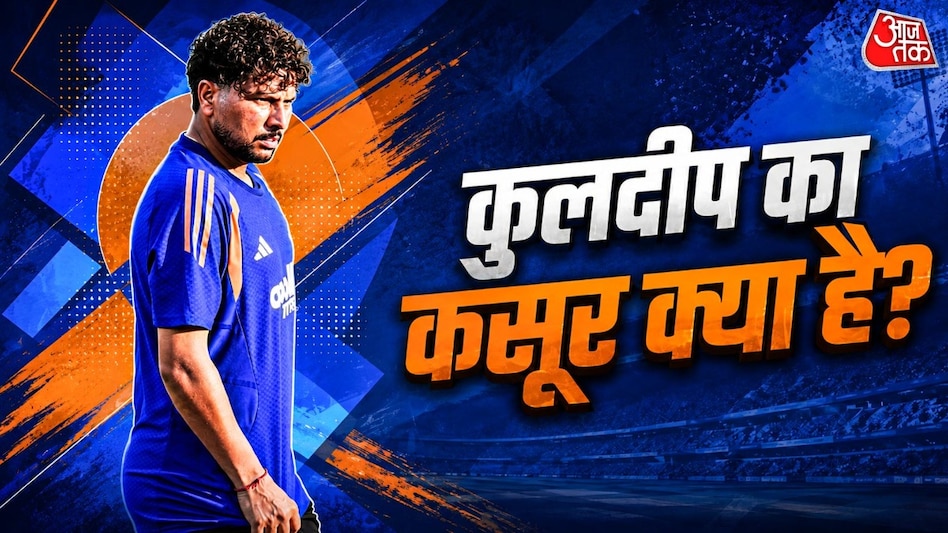
The careers of some athletes are determined not only by statistics but also by a long wait for their chance. Kuldeep Yadav, who debuted in international cricket in 2014, is approaching 32 years old. Over these twelve years, he has spent significantly more time waiting for a game than playing, which is reflected in his statistics: only 50 first-class matches and 136 List A matches.
The situation at Lord's and controversial moments
The recent ODI match at Lord's reignited this discussion. Despite the Indian squad including four tail-enders and the pitch being deemed favorable for spin, suggesting Kuldeep Yadav's participation, it did not happen. A natural question arises: if he cannot make the starting lineup even under conditions where he should be given a chance, when will that happen?
Statistics versus doubts
Kuldeep's performance is difficult to assess. Since his ODI debut, he has taken more wickets than any other spinner in the world. His average and economy surpass those of veterans like Adam Zampa from Australia and Adil Rashid from England. In Tests, his average hovers around 22. Thus, the statistics do not indicate that Kuldeep is a player who should be dropped from the team.
Change in team tactics
Previously, when the team featured world-class all-rounders like Ravichandran Ashwin and Ravindra Jadeja, who could bat and bowl, Kuldeep's absence was an understandable consequence of the squad composition. However, the situation has changed. Today, Kuldeep often loses out to players who have failed to secure a spot in either batting or bowling. This calls into question the selection policy of the Indian team.
Preference for all-rounders in different formats
Lately, the Indian team has shown a tendency to favor players capable of performing both batting and bowling roles. This strategy sometimes works in T20, where there are four overs and 20 overs for batting. Nevertheless, ODIs and Tests are different sports requiring performances over 50 or 90 overs. Under such conditions, one specialized bowler can have a greater impact than a semi-professional all-rounder.
The 2023 World Cup example
The 2023 World Cup was a clear example. After Hardik Pandya's injury, India decided to move away from extra batting depth and give a chance to a specialist bowler like Mohammed Shami. The result was obvious: Shami became one of the tournament's main winners. This showed that under pressure, the team relied on highly specialized players.
Takeaways from Lord's
The decision at Lord's was particularly unexpected. The pitch conditions were favorable for Kuldeep: dry grass and expectation of spin. Yet, India fielded four tail-enders, and Kuldeep was one of the most experienced bowlers in the team. Nevertheless, the team management opted for new fast bowlers, leaving Kuldeep out of the squad. This deepens the question about the management's intentions regarding Kuldeep.
Differences in approaches
An interesting point is that selectors constantly include Kuldeep in the team, indicating they consider him one of the country's best spinners. However, when forming the starting XI, the management does not show confidence in him. If this happens regularly, it suggests not only a problem with one player but also a divergence in vision between the selectors and the team management.
Possible solutions to the problem
Perhaps the management believes that Kuldeep does not meet the standard of the bowlers who performed well in the 2023 World Cup. If so, the responsibility for addressing his technical shortcomings lies with the coaching staff. If they believe he is not yet ready for the game, he should be sent to domestic cricket so he can regularly bowl. The worst option is to keep him in the squad for every series but leave him on the bench for the entire tour.
A question broader than Kuldeep
This discussion goes beyond Kuldeep Yadav. It concerns the very philosophy of selection in Indian cricket. Will the Indian team rely on highly specialized players, or will it continue to seek squad balance through all-rounders possessing only 'pieces and parts' of skills?
}))