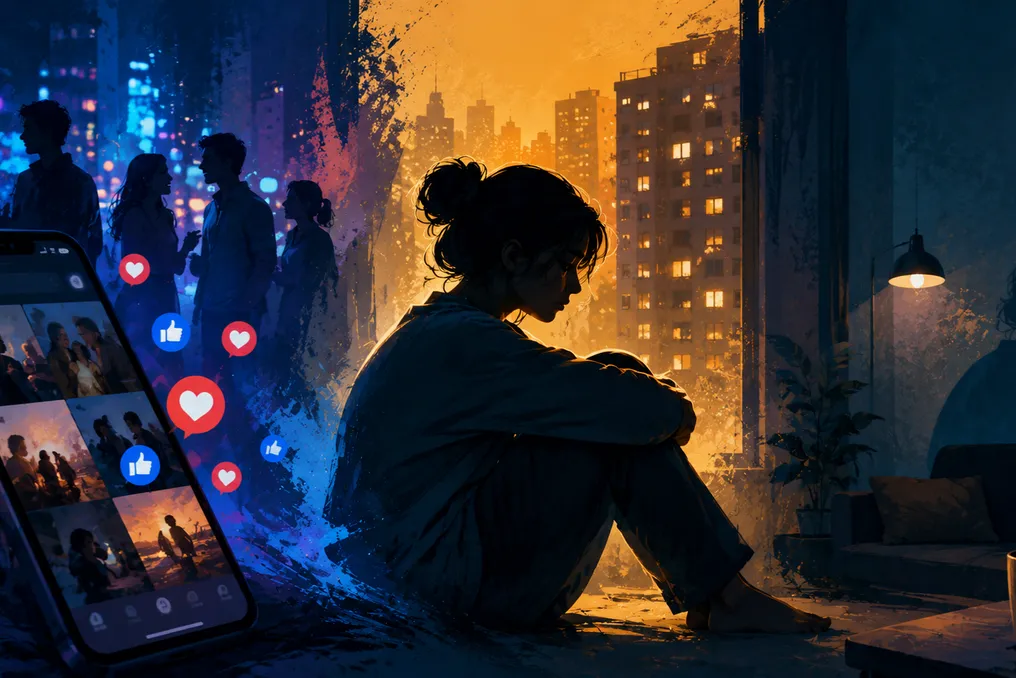
According to a JB.com study, India ranks second globally in terms of loneliness levels. This ranking reflects a complex picture of a country that is simultaneously aging, rapidly urbanizing, and experiencing a weakening of traditional social structures.
Demographic Trends and Population Aging
Similar stories
Popular
In 2011, approximately 100 million people aged 60 and over lived in India. However, projections from the Technical Group on Population Forecasting, cited in the Ministry of Statistics and Programme Implementation's report 'Older Persons in India 2021,' indicate that this figure could more than double by 2036, reaching around 230 million, which would constitute about 15 percent of the total population. Furthermore, a 2023 UNFPA report forecasts that by 2050, nearly one in five Indians will be over 60 years old.
Loneliness Among Youth and Migrants
The feeling of loneliness is not limited to old age; it is already present among young migrants living in rented apartments, in the silence of an empty house, during weekends spent watching other people's lives, and in subtle moments when no one asks, 'Are you home?' Minal from Bihar, living alone in Pune, describes this feeling as a sense of 'not belonging anywhere and no one caring about me.' Despite considering herself 'quite sociable,' she knows only a few people in her current city, leading to periods when she goes out alone. Her typical weekends include a day at a nice restaurant and a day staying home to cook, journal, or watch a movie. At home, she spends '8–10 hours' in front of screens, and after closing Instagram and viewing peers' travels or engagements, she feels 'empty, restless, and still bad about herself.'
Swadha, who lived alone in Noida for many years for studies and work, recalls the strange paradox of returning home. She notes a 'feeling of relief... but then comes the feeling of silence, and no one asks if you are home... nobody cares if you came in with your shoes or left them outside.' She placed a mirror near her home entrance, saying, 'Someone has to look at me, right? I used to do it myself.' Living alone, she claims that 'it means you absolutely have no one to talk to about your day... it hits you hard and pushes you away from the loved ones you actually talk to on calls.'
For Nehi, from West Bengal and working in Delhi, loneliness is simpler: 'there is no one to turn to when you are struggling... no one to ask where you are... how you are doing.' She states that she 'has no social life.' Her weekends are spent on 'grocery shopping... cooking and cleaning...'. When she gets home, her first thought is: 'what should I eat now.' She estimates screen time at 4–5 hours a day at home and says that after closing social apps, she feels: 'I am wasting my time... I should do something productive.'
Similar Emotional Patterns
Although their lives may seem distant from the problems faced by the elderly in India, the emotional patterns are strikingly similar. A study based on LASI data shows that about 13.4 percent of older Indians experience frequent feelings of loneliness. The odds are higher among those who are unmarried, have more than two chronic illnesses, or have small social circles or limited leisure activities. The 2023 UNFPA report identifies social isolation and loneliness as key stressors for the mental health of the elderly, exacerbated by migration, urbanization, and weakened family support.
Geographical Distribution of the Crisis
The country is moving towards this aging crisis. The elderly population in India is unevenly distributed. It is projected that the proportion of older people in Kerala will rise from about 13 percent in 2011 to nearly 23 percent by 2036, while Uttar Pradesh will increase from about 7 percent to 12 percent. Southern states, as well as Himachal Pradesh and Punjab, already have above-average percentages of elderly populations, creating hotspots where aging and risk of isolation are much more intense than the national average.
The profile also differs sharply by gender. According to LASI data, government summaries note a gender ratio of approximately 1065 women per 1000 men among the elderly in India, with women making up about 58 percent of the elderly population. More than half of elderly women are widows. UNFPA reports on aging emphasize that elderly women are more likely to become widows, have low personal incomes, and live alone, increasing their vulnerability to economic instability and social isolation.
The Loneliness Economy and Market Mechanisms
This is the demographic stage where India's loneliness economy is emerging. For generations, the family served as the primary social safety net in India. This network has not disappeared, but it has changed its form. Migration, urbanization, nuclear families, and unstable employment have moved millions of people away from the people and communities that once filled daily life. A home that once could accommodate several generations can now hold one person, one phone, and a delivery app.
Problem-solving mechanisms are increasingly mediated by markets. Food delivery replaces shared meals. OTT platforms fill evenings. Social media offers constant contact but does not necessarily provide companionship. For young Indians, these services are conveniences, but for the aging population, they are becoming part of a much larger care ecosystem.
Silver Economy and Government Support
Policy is increasingly viewing this demographic transition as an economic opportunity. The NITI Aayog report 'Reforms in Elderly Care in India' and schemes from the Ministry of Social Justice and Empowerment speak of a 'silver economy' built around the needs of the elderly. Government estimates related to the 'Senior Ageing Growth Driver through Elderly Care' (SAGE) initiative value the Indian silver economy at approximately 73,000 crore rupees in 2024, with potential for multiple expansion as the elderly population grows.
The first pillar is financial security. According to the Pension Fund Regulatory and Development Authority data, subscriptions to 'Atal Pension Yojana' grew from approximately 1.54 crore in March 2019 to 8.27 crore by October 2025. Assets under management exceeded 49,000 crore rupees. The Indira Gandhi National Old Age Pension Scheme covers about 2.21 crore beneficiaries, offering 200 rupees per month to those aged 60–79, and 500 rupees to those over 80. These amounts are modest, but they establish a minimum income level that can help with food, healthcare, and basic services.
The second pillar is health protection. Ayushman Bharat-PMJAY provides an annual medical insurance package worth 5 lakhs for vulnerable households. In October 2024, the government announced free treatment up to 5 lakhs annually for about 60 million citizens over 70 years old from 4.5 crore families, regardless of socio-economic status. By January 2025, over 40 lakh elderly people were registered. Meanwhile, the National Health Programme for the Elderly now covers all 713 health districts, providing geriatric clinics, wards, and physiotherapy services, according to the Ministry of Health and Family Welfare.
The third pillar is care. The SAGE portal invites startups to develop solutions in healthcare, housing, technology, and social interaction, offering equity capital support of up to 1 crore per project, with government capital limited to 49 percent. A comprehensive program for senior citizens funds 696 old age homes in 29 states and territories, with another 84 homes selected for 2025–26. A geriatric caregiver training scheme, implemented through 32 accredited institutes, trained 36,785 caregivers in 2023–24. None of these programs are explicitly named loneliness prevention programs, but they address many conditions that make loneliness more likely: widowhood, frailty, financial instability, and living alone.
Technology and Legal Framework
Technology is becoming another layer of this support system. The government's telemedicine platform, e-Sanjeevani, has provided nearly 140 million teleconsultations across the country, including over 10 million consultations involving elderly citizens, according to an update from the Press Information Bureau of India in 2023 and a national telemedicine assessment. For an elderly person who cannot travel easily, a screen consultation can be a lifeline. But a broader shift is also significant: more needs, including emotional ones, are now being met through digital interfaces.
Elderline 14567 offers elderly citizens a telephone channel to file complaints, report abuse, and receive emotional support, connecting callers with local services and authorities. Meanwhile, the legal framework continues to place responsibility on families. The Maintenance and Welfare of Parents and Senior Citizens Act of 2007 and its 2019 amendment expand the definition of 'children' and 'parents,' abolish the limit of 10,000 rupees for maintenance, mandate that the elderly live 'with dignity,' and require the allocation of special police units and geriatric facilities in hospitals. The amendment expands the concept of 'maintenance' to include healthcare, security, and housing. This acknowledges that neglect, isolation, and abuse are not just private tragedies.
Quality of Connection Versus Physical Presence
However, loneliness is not always linked to physical absence. Anandeshwar, a civil service aspirant from Uttar Pradesh now living in Delhi, describes it as 'a lack of understanding or connection with people around you, even when you are surrounded by them.' He 'has a reasonably large circle of friends,' but he meets them infrequently. Deep conversations happen 'after drinking.' His ideal weekends are full: 'writing good things, spending time with friends, participating in debates.' Reality is often different. He stays home, 'watches YouTube, Twitter, or just lies in bed smoking,' joking that 'every day is weakened by unemployment.'
Thus, the problem is not simply the absence of people, but the absence of meaningful connection.
Micro-economies of Solitary Weekends
Loneliness often manifests through small choices. Cook or order food? Call someone or scroll through the feed? Go out or stay in bed? Minal divides her weekends between visiting restaurants and cooking at home. Nehi's ideal weekend is 'reading, writing, and cleaning the apartment,' although reality often boils down to errands and rest. Yukta, a psychology student from Bangalore living in Jaipur, describes a more connected version of the same urban life. When not overwhelmed with work, weekends with a neighbor mean 'sleeping, cooking, and enjoying delicious food together, watching something funny on an OTT platform, or... a date at a cafe and a walk through the market for pleasure!'. She says, 'Now I finally feel like I am home.' 'I can do whatever I want, be who I want, and just exist in a space that offers only comfort.'
Studies based on LASI data identify regular social contact, leisure activities, yoga or meditation, and moderate use of television or computer as factors associated with better well-being among the elderly. The difference is that in cities like Delhi, Pune, Hyderabad, and Jaipur, these activities are increasingly curated by markets: OTT subscriptions, cafes, delivery services, and paid experiences.
On the other end is Srabasti, from West Bengal, living in Delhi for work. 'It is the feeling that no one really knows what is going on in your head, even when you are surrounded by people... when you have something exciting or heartbreaking to share, and you can't think of who to call.' She communicates with family and 'occasionally writes to a few friends,' mostly sharing memes and reacting to stories. Weeks pass before they meet. After scrolling through the feed, she often feels 'exhausted,' comparing her usual weekends to laundry, shows, and ordered food with peers who seem to be 'getting promotions, buying houses, getting married, traveling the world.'
The same platforms that offer entertainment and convenience also fuel comparison. The same screens that connect people can deepen the feeling of falling behind.
Who Will Pay for Connection?
NITI Aayog asserts that elderly care must be recognized as a separate sector, with regulations, standards, public-private partnerships, and dedicated funding. Their vision combines government programs, such as pensions, NPHCE, telemedicine, and old age homes, with private startups and NGOs. This is where the silver economy begins.
Despite another delay in the deportation case, Chidimma Adetshina has stated her intention not to give up. Her current case in the immigration court was postponed to Wednesday, August 19th, by the Cape Town Regional Court.
Reasons for the postponement and arguments from both sides
The postponement occurred after the High Court of the Western Cape ruled that magistrates do not have jurisdiction to issue arrest warrants for immigration detention, and that this authority belongs exclusively to immigration service officers. The Department of Home Affairs is seeking the detention of the controversial beauty for deportation, arguing that despite the defense citing measures to legalize her status, she lacks the necessary documentation.
The state also insisted that Adetshina still possesses a South African passport and allegedly refused to surrender it. However, her legal team objected, stating that they are prepared to continue the proceedings since the case was initiated by the Department of Home Affairs, and therefore they must be ready for further action. Furthermore, her lawyers submitted an affidavit to the court last month detailing the steps she has taken to legalize her status in the country.
Additional case details
Adetshina also informed the court that she has no other residence besides South Africa. Nevertheless, documents were presented to the court confirming that the 25-year-old woman can reside in Nigeria. The case was adjourned for a ruling by presiding magistrate Riemie Horan.
Adetshina's arrest took place last month following alleged illegal entry into South Africa through the Lebombo border from Mozambique. Authorities found her and her younger son residing in the country without legal immigration status. Her immigration case began back in 2024 when she first participated in the Miss SA competition after the public demanded that the Department of Home Affairs verify her citizenship.
Post-proceedings status
A few hours after appearing in court, Adetshina shared her condition on Instagram amid ongoing legal difficulties. In a video, she admitted to feeling tired, experiencing emotional burnout, and depression. She emphasized, however, that she does not intend to give up, writing under the video: 'Exhausted—yes. Burned out—yes. Depressed—yes. Will I give up? NO!' This marked the first time Adetshina publicly discussed this issue since the case began.
Praveen Suhraj-Eli, an advocate with visual impairments, has been appointed as the Executive Director of the Department of Women, Youth and Persons with Disabilities. This appointment is viewed as a significant step towards implementing principles of inclusive leadership in South Africa.
Details of the Appointment and Experience
The appointment was announced last week by Sindisiwe Chikunga, Minister in the President for Women, Youth and Persons with Disabilities. Suhraj-Eli possesses extensive experience in public administration, constitutional law, disability rights, gender-based violence and femicide (GBVF), as well as in policy development and public administration.
She holds a PhD in Public Policy and an MA in Political Science, both obtained with distinction. Her career has focused on advancing democracy, human rights, and inclusive governance.
Contribution to Social Sector
In her statement, Chikunga noted that as a state representative in the Employment Equity Commission, Suhraj-Eli advocated for setting a target of 7% employment for persons with disabilities by 2030. Furthermore, she represented South Africa on international platforms, including the United Nations, the World Intellectual Property Organization (WIPO), and the International Alliance of Disabled Persons, actively championing the rights of people with disabilities.
Her track record includes participation in the implementation of the Domestic Violence Act, the development of the Femicide Strategy, and the preparation of the Access to Justice Policy for persons with disabilities.
Government and Organizational Stance
Chikunga emphasized that this appointment demonstrates the government's commitment to promoting equality, dignity, and inclusive leadership. She welcomed Suhraj-Eli, noting her integrity, legal competence, and understanding of constitutional mandates, especially regarding the protection of the rights of women, youth, and persons with disabilities. The Minister added that this appointment reflects the government's focus on inclusive leadership and the pursuit of equal representation, expressing full confidence in her ability to improve the department's performance.
The International Council of Education for Visually Impaired (ICEVI), where Suhraj-Eli is a senior staff member, also highly praised her appointment. The Council stated that Dr. Suhraj-Eli is an outstanding lawyer, a public policy expert, and a passionate advocate for disability rights who has dedicated her career to advancing inclusivity, human rights, accessible justice, and equal opportunities.
The Pamoja House, part of Project 51 A, was conceived from a practical observation, not from a traditional work request. The starting point was the fact that a family had exceeded the limits of their residence, both in terms of size and in their need to accommodate changes in their lifestyle habits.
Project Concept
This project was developed to meet the needs of a three-generation family located in Muhamma, in the state of Kerala. It proposes a new vision for domestic life, emphasizing the maintenance of spatial continuity, generous distribution of spaces, and daily interaction among residents.
Focus on Family Connection
Instead of merely increasing the physical dimension of the construction, the design of the Pamoja House aims to create environments that reinforce the bonds between different family members while ensuring the preservation of each individual's privacy.