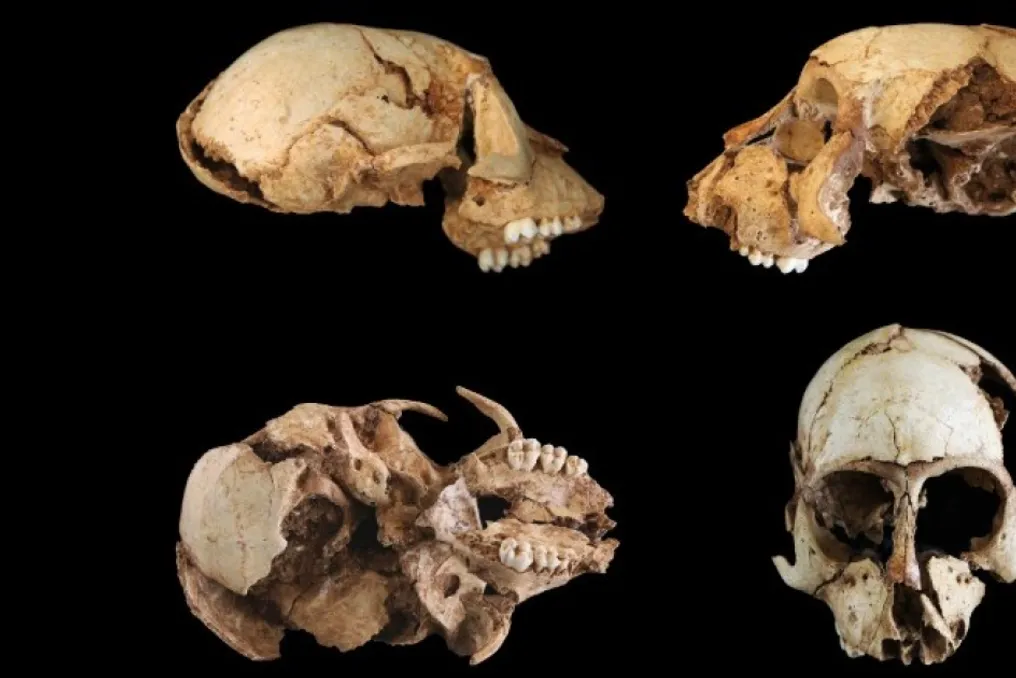
Spanish paleoanthropologists conducted a study on three fragments of parietal bones extracted from the Gran Dolina cave. The analysis indicated that these remains could belong to two or three adult individuals of the species Homo antecessor.
Spanish paleoanthropologists conducted a study on three fragments of parietal bones extracted from the Gran Dolina cave. The analysis indicated that these remains could belong to two or three adult individuals of the species Homo antecessor.
The study of the thickness of the skull bones revealed that they are significantly thinner than those of early Homo representatives and bipeds. However, the thickness of these bones falls within the range of variability observed in modern humans and Neanderthals.
The Gran Dolina cave is located in the Sierra de Atapuerca mountains in northern Spain and is part of a series of significant archaeological sites, such as Sima del Elefante and Sima de los Huesos. Sima del Elefante has yielded some of the oldest human remains in Europe, including a zygomatic bone and upper jaw dating from 1.1 to 1.4 million years ago. In Sima de los Huesos, scientists discovered remains of at least 29 Heidelbergensis people discarded into the shaft about 430 thousand years ago.
Chronologically, Gran Dolina occupies an intermediate position between Sima del Elefante and Sima de los Huesos. As early as 1997, findings from this site, dated to approximately 850 thousand years ago, allowed paleoanthropologists to identify a new Homo species—the predecessor human (H. antecessor)—based on a fragmented child's skull who lived around 10–12 or 13–15 years old. Additional discoveries were later made in this cave, including evidence of cannibalism.
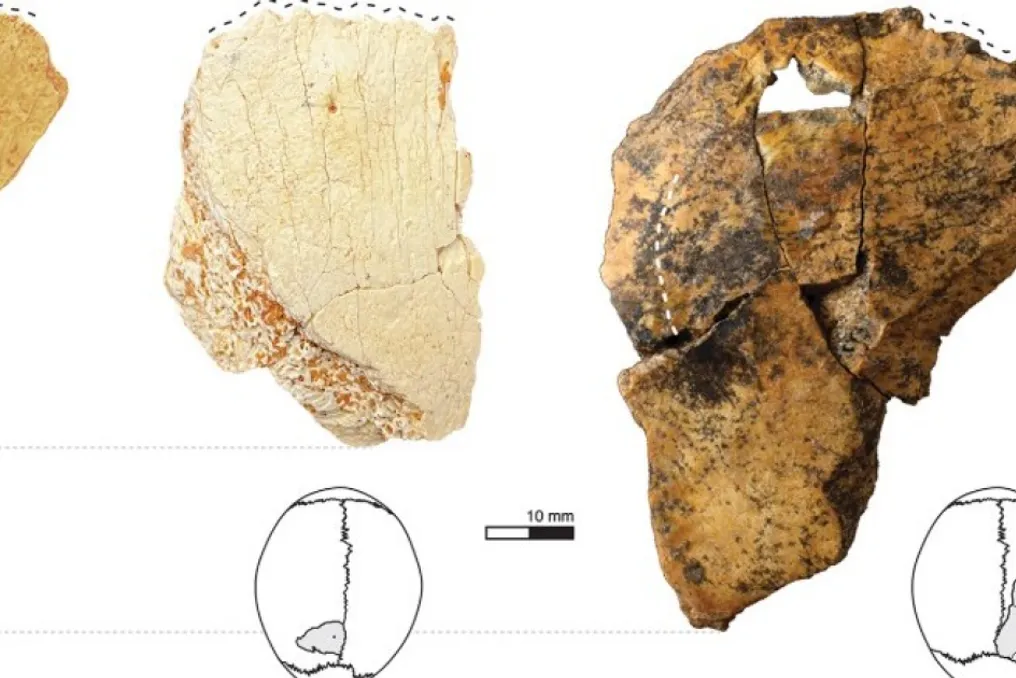
Recently, Rafael Gallaredo-Sande from the National Center for Human Evolution Research in Burgos, together with his colleagues, described three fossils found in the Gran Dolina cave across different years: in 2005, 2007, and 2023, in excavation area TD6. The authors of the new publication noted that the remains belonged to at least two individuals, although the possibility that they belong to different people is not excluded.
These findings consisted of pieces of parietal bones: two were right, and one was left, and all belonged to adult individuals. Two fragments were quite small: one find (ATD6-115) measured 41.5 × 34.6 mm, another (ATD6-128) measured 49.6 × 36.4 mm, and the third (ATD6-401) was larger—70 × 57.8 mm. Despite differences in coloration, this is not grounds to assert that the bones belonged to three different people.
To study all three samples, as well as the previously described adolescent skull (ATD6-100/168), which served as a comparative material, scientists used micro-computed tomography. Comparative analysis was conducted with data on other representatives of the genus Homo from the Pleistocene epoch and modern humans.
The main focus was on bone thickness: in the three new specimens, it ranged from 6.07 to 7.03 millimeters. This figure corresponds to the range of variability in modern humans and Neanderthals, although the bone thickness in living individuals is usually smaller. However, the parietal bones of H. antecessor proved noticeably thinner than those of early Homo included in the sample (about 10.26 mm) and bipeds (H. erectus) (about 9.7 mm). Thus, the bone thickness in the skulls of H. antecessor is considered a progressive trait compared to more ancient hominins, linking the archaic inhabitants of northern Spain with late Pleistocene and Holocene humans.
Previously, the predecessor human was considered by some scientists as a potential last common ancestor of Neanderthals and modern humans, but most researchers believe that these ancestors inhabited Africa. Recently, a new candidate for this role was discovered in the Gominhid cave in Morocco, where remains of people living approximately 773 thousand years ago were found.
Of particular note are the results of paleobiological analysis of proteins extracted from the dental enamel of at least 20 fossil humans from the Rising Star cave system. Proteomic research showed that all analyzed individuals were girls or women. Nevertheless, researchers note that it is impossible to rule out that the absence of specific proteins characteristic of boys or men may be related to yet unknown genetic changes in this archaic population. These findings were published in the journal Cell.
Various artifacts were discovered during excavations of a Roman tomb in the city of Antalya, among which was a magot skull. These findings were made by Turkish scientists who described the monkey skull that had been found back in 2010.
Researchers concluded that a resident of ancient Attalia was buried with a macaque between the end of the 2nd and beginning of the 3rd century AD. It is assumed that this was a young magot that may have arrived in Asia Minor from North Africa. This information is presented in a publication in the International Journal of Osteoarchaeology.
The site of the modern Turkish resort city of Antalya was an Hellenistic and Roman settlement called Attalia. The city was named after the Pergamene king Attalus II, who founded it in the mid-2nd century BC. Between 2008 and 2010, archaeologists conducted research in the extensive necropolis of this ancient city, discovering a total of 840 different burials, including burial chambers, stone boxes (cists), and hamosoria, which are tombs carved into the rock.
One of the studied tombs, designated as M267, was originally built in the Hellenistic period and later reused for burials in Roman times, presumably in the late 2nd – early 3rd century AD. The burial chamber contained the remains of 22 people, as well as household items such as fragments of an unguentarium (small vessel), an oolpe (pitcher), and a bronze strigil (scythe-shaped skin scraper), along with many animal bones, including a complete dog skeleton and a skull that became the subject of scientific analysis.
The study of the almost complete monkey skull with preserved teeth was conducted by Ahmet Ihsan Aytekin and Alper Ener Yavuz from Mehmet Akif Ersoy University in Burdur. This find, kept at the educational institution, was significantly deformed, likely due to pressure from the deposits in which it lay for about two millennia. Analysis showed no signs of pathologies or artificial alterations on the skull.
Scientists determined that the remains belonged to a young animal that lived for approximately 20–24 months. Although researchers could not definitively determine the sex, a male is the most probable. The skull was identified as a representative of the genus Macaca (Macaca sp.), with the magot (M. sylvanus) being the most likely candidate, although the possibility of it being a rhesus macaque (M. mulatta) cannot be entirely ruled out.
Researchers hypothesized that the magot might have come to Asia Minor from North Africa. This is consistent with the fact that Attalia and other cities in Anatolia had trade links with the provinces of North Africa, evidenced by amphorae found at archaeological sites. Scientists believe that this domesticated monkey could have been a pet of a wealthy resident of Attalia, whom it may have been buried with. Nevertheless, other versions remain open for consideration. It should be noted that previously, remains of non-human primates had not been found in ancient burials in modern Turkey, except for some little-known finds from a Byzantine monument.