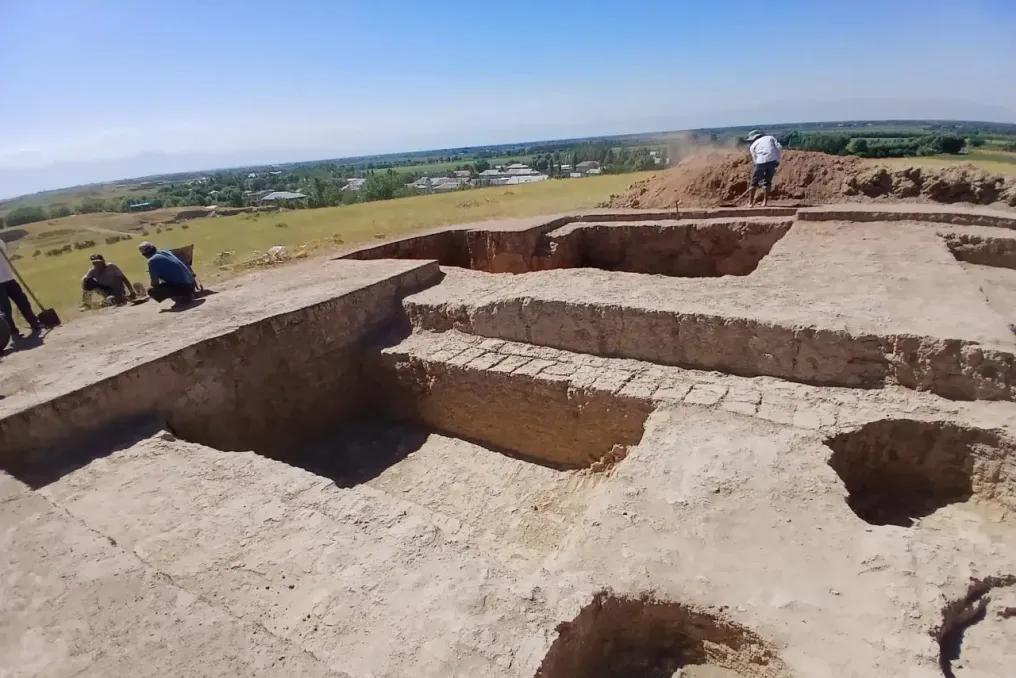
Archaeologists excavating the archaeological site of Mintepa in the Jambai area of the Samarkand region of Uzbekistan have discovered architectural remains that specialists believe may belong to a palace complex dating back to the eighth century AD.
Archaeologists excavating the archaeological site of Mintepa in the Jambai area of the Samarkand region of Uzbekistan have discovered architectural remains that specialists believe may belong to a palace complex dating back to the eighth century AD.
Researchers from the Yahya Gullyamov Institute of Archaeology in Samarkand conducted the excavations. During the work, they managed to uncover the architectural layout of a complex located inside the citadel (Ark) of the ancient settlement. According to the research group, this structure dates back to the first half of the eighth century AD.
Archaeologists noted that the construction methods and architectural features of this complex are of significant scientific interest. These findings are capable of deepening the understanding of urban planning, architecture, and governance systems during the early Middle Ages.
The team also found 8th-century sculptures in the hall of the presumed palace. These artifacts are currently undergoing scientific examination. Archaeologists believe that the results of these studies may provide new information about the political and cultural life of the Mintepa settlement, as well as the history of the entire region during the early Middle Ages.
The musical talents of the Kemradj family will be a central event at the upcoming Red Mango Arts Festival, which will take place from July 22 to 27 at the Sassridge College in Durban.
This second iteration of the festival is the brainchild of renowned South African actor and director Rajesh Gopi. It promises a dynamic blend of theatrical performances, musical concerts, and spoken word acts, while celebrating South Africa's rich heritage and fostering youth development.
On July 23rd at 7:30 PM, Vishin, along with brothers Vaahir and Vihaan Kemradj, will perform with the program 'Sufis, Mystics and Qawali.' This presentation is viewed not merely as a family event but as a deeper connection to their cultural roots.
Vaahir, aged 18 and recognized for his roles in the films Kandasamys, shared how music has influenced his life. He noted that he has been involved in music since the age of seven. Performing as a singer, he stated: 'It is not just entertainment, but a profound experience.'
His mother, Vireka Kemradj, introduced him to the harmonium at the age of three, and his father continued to develop his musical abilities. Although Vaahir was initially more inclined towards drama and acting, his passion for music led him to embrace his family's musical legacy.
He recounted performing for the first time at age seven, singing a bhajan written by his mother—Satya Sai—which he performed in various Satya Sai temples. Vaahir added that he cannot recall a time when he wasn't a musician and singer, and that he has been performing since seven years old, although he still considers himself a novice professional.
Vaahir mentioned listening to many musical styles, but his favorite remains Shastriya Sangeet. He explained that Shastriya Sangeet encompasses two streams: Hindustani classical and Carnatic music. Hindustani classical is distinguished by covering everything from light music to heavy classical, and it is highly spiritual, requiring great concentration and repeated systematic practice (riyaz).
In Vaahir's opinion, Sufi music represents an 'abstract thought' that transcends a mere genre. He emphasized that a true connection with music demands a deep understanding of the text's meaning; otherwise, one risks missing the opportunity for a passionate performance. He also noted the humility that music teaches him: 'The more you think you know, the less you actually comprehend.'
He performs alongside his younger brother Vihaan, a 13-year-old singer who also plays guitar and dholak. Vihaan started singing at four years old and became one of the youngest dholak performers in the country at nine. Vaahir's father, Vishin, is a renowned South African musician.
Vishin, founder of Taal Music, has performed with famous African jazz musicians such as Lou Daminy, Madala Kunene, and Mabuso, as well as Indian artists including Sunidhi Chauhan, Kumar Sanu, and Sukhwinder Singh. He plays tabla and harmonium.
The event also features other activities, including a comedy night with Jayloshni Naidu and friends on July 24th at 8:00 PM, and the Global Ballie monologue by Kurt Egelhof, scheduled for July 25th at 5:30 PM. The festival will also offer food, outdoor relaxation areas, books for sale, exhibitions, and displays. Further information can be found on the website webtickets.co.za.
This overview of historical events that occurred on July 21 presents various moments related to destructions, scientific discoveries, and significant milestones in world history.
In 356 BCE, the Temple of Artemis in Ephesus, one of the Seven Wonders of the World, was burned down. Of the original seven wonders, only the Great Pyramids of Giza remain today, unlike the Hanging Gardens of Babylon, the Lighthouse of Alexandria, the Temple of Artemis, the Colossus of Rhodes, the Statue of Zeus at Olympia, and the Mausoleum at Halicarnassus.
In 365 BCE, a powerful earthquake off the coast of Crete raised the island and triggered tsunamis along the coasts of Libya and Egypt. Thousands of people died as a result of this disaster, and in the Egyptian city of Alexandria, the destruction was so massive that the event has been called the 'day of terror' for centuries.
In 1816, Baron Paul Julius von Reuters, founder of the Reuters news agency, was born in Germany under the name Israel Ber Yosephat. In 1853, Central Park was created in New York after over 300 hectares of land were allocated on Manhattan Island.
In 1901, Cape Town registered three cases of bubonic plague. In 2025, an investigation into the alleged assassination of Nobel Peace Prize laureate and former ANC president Chief Albert Luthuli in Grootville in 1967 concluded that he was killed by the police.
In 1973, Israeli agents mistakenly killed a Moroccan waiter, believing him to be involved in the Munich Olympic Games attacks. In 1978, the world's strongest dog, an 80 kg German Shepherd, demonstrated the ability to pull 2909 kg over a distance of 27 meters.
The world record for the lowest temperature, recorded at -89.2°C, was set in Vostok, Antarctica, in 1983. In 1999, gold medalist Sergio Mosouaneng admitted to cheating, allowing his brother to run part of the Komrades Marathon for him.
In 2005, four suicide bombers attacked London's public transport system two weeks after the July 7th attacks; however, none of the four bombs detonated. In 2021, China unveiled the world's fastest train, capable of reaching speeds of 600 km/h, in the city of Qingdao.
In 2023, a two-thousand-year-old stone slab used for grinding spices was discovered in Southern Vietnam. This find is the earliest evidence of the appearance of curry in Southeast Asia and still retains the scent of nutmeg.
In 2025, 28 countries, including the United Kingdom, issued a joint statement calling for an immediate end to the Israeli war in Gaza, noting that civilian suffering has reached 'new depths.'
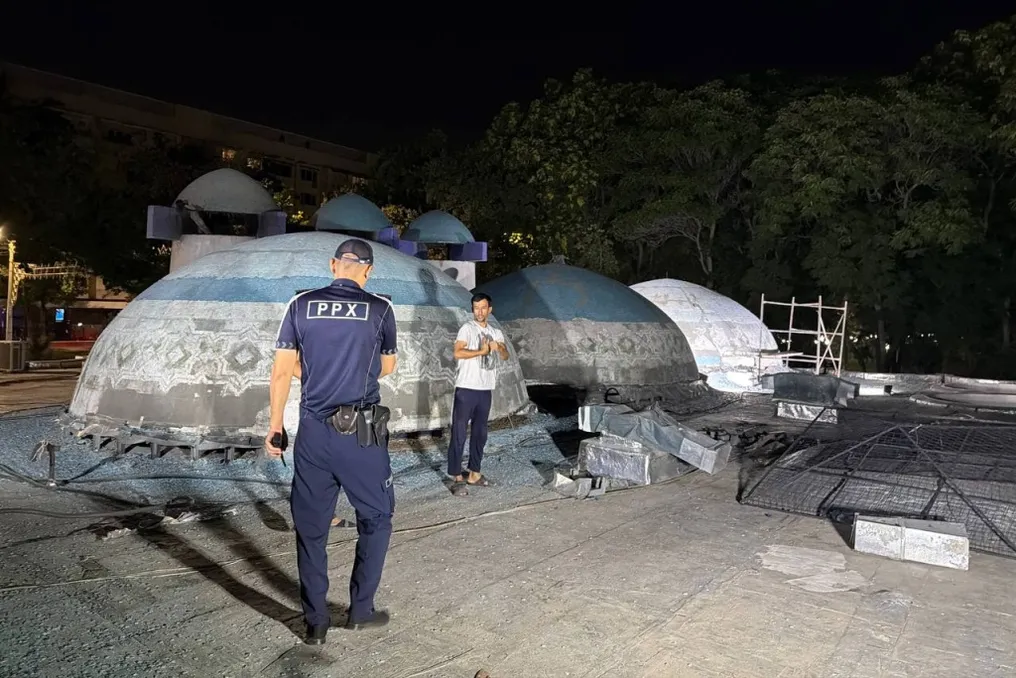
Illegal renovation work was halted at the well-known 'Blue Domes' cafe in Tashkent. Information about the repairs at this establishment, located in the Yakkasaray district, caused significant public outcry because the building is a cultural heritage site and is protected by the state.
According to the Agency for the Protection of Cultural Heritage, the building is included in the National Register of Cultural Heritage Real Estate of Uzbekistan under number 308 and is classified as a protected architectural monument. This status was officially confirmed by the Cabinet of Ministers decree No. 846 dated October 4, 2019.
Social media users reported that during the renovation, a historical mosaic panel decorating the cafe was destroyed. Videos circulated online demonstrate the dismantling of this decorative element. The Agency emphasized that the 'Blue Domes' cafe possesses high historical and cultural value and serves as an example of modernist architecture.
After receiving reports of violations, representatives of the Agency went to the site for inspection around 10:00 PM on July 20. The inspection revealed that renovation work was being carried out on the building's roof without obtaining the necessary permit from authorized bodies. The illegal activities were immediately stopped. The management of the facility was informed that any construction, restoration, or repair interventions in cultural heritage sites are permitted only with an official authorization and in accordance with established legal procedures. Mandatory directives regarding compliance with legislative norms were also handed over to the owners.
The Agency's official statement did not specify whether a separate legal assessment would be conducted regarding the destruction of the mosaic or if there is a possibility of its restoration. Nevertheless, the agency stated its intention to continue strict control over the preservation of cultural heritage sites to prevent any attempts at unauthorized damage or alteration. Previously, this agency had commented on the situation with the Sergei Yesenin Memorial House-Museum, which was planned to be closed for renovations in the autumn of 2025.