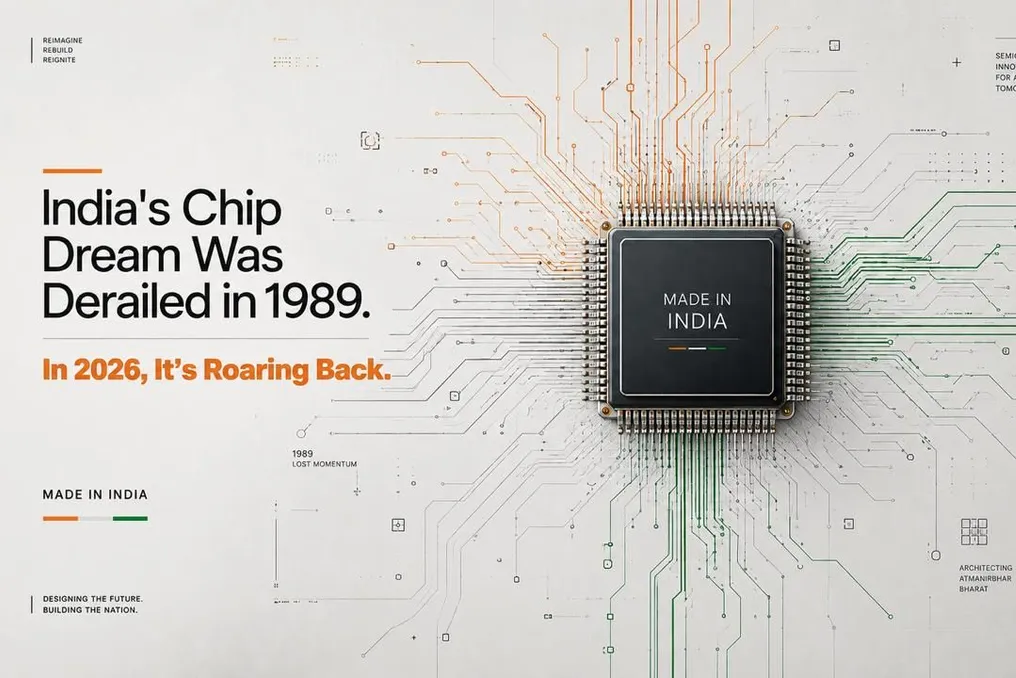
India's dream of semiconductor manufacturing was interrupted in 1989. However, by 2026, this initiative is gaining momentum through the realization of policy intentions at the manufacturing site level. Currently, 12 approved manufacturing projects worth 1.64 lakh crore rupees are being implemented in India, alongside support under the Semicon 2.0 program amounting to 1.27 lakh crore rupees.
History of the Semiconductor Industry Development
Before the establishment of TSMC, which later transformed the global semiconductor industry, India engaged in semiconductor manufacturing for three years. What was lost in India was not technical capability, but process continuity. The Council of Ministers of India approved the creation of Semiconductor Complex Limited (SCL) in 1976, and chip production of 5-micron size began in 1984, just three years before the creation of TSMC.
India was not lagging behind the start of the semiconductor race. The problem lay in the interruption of the pace of building a globally competitive commercial ecosystem for large-scale semiconductor production. A catastrophic fire in 1989 destroyed the main SCL production line in Mohali. Although the enterprise resumed operations in 1997 and continues to participate in strategic applications, this interruption lasted 37 years.
Achievements by 2026
Unlike previous years when government programs often remained mere ambitious statements, there is now a shift from plans to actual production. As of mid-2026, the Indian government has approved 12 semiconductor manufacturing projects worth approximately 1.64 lakh crore rupees. On February 28, 2026, Prime Minister Narendra Modi inaugurated the Micron facility in Sanand, which began commercial production, delivering the first memory modules produced in India to Dell Technologies. A month later, Kaynes Semicon transitioned from laying the foundation to commercial production in just 14 months, and on July 4, CG Semi joined them, making Sanand the busiest chip cluster in India.
Support Mechanism and Sequencing
On July 15, the Council of Ministers approved the Semicon 2.0 program with a budget of 1.27500 lakh crore rupees, continuing the development of Phase I projects. The key breakthrough is not the size of the subsidies, but the order of their application. Under the semiconductor manufacturing schemes, India provides central fiscal support of 50% of the project cost, supplemented by regional incentives. Importantly, this support is provided on a pari-passu basis, meaning government aid follows the actual project expenditure and does not obligate investors to bear the entire financial risk until construction is complete.
According to MeitY Secretary C. Krishna, this is likely the most generous industrial policy ever implemented in India. The realization that semiconductor manufacturing cannot be built relying solely on private capital, which assumes all risk until the end, has been crucial. The administrative apparatus, represented by leaders such as C. Krishna and Additional Secretary Amitesh Kumar Sinha (CEO India Semiconductor Mission), is transforming policy into physical projects.
Opportunities for Entrepreneurs
The Semicon 2.0 program expands ambitions across six strategic areas, covering not only fabrication plants but also design, equipment, materials, and domestic supply chains. For Indian entrepreneurs, this means a quiet revolution. The government is now co-investing equity capital with venture capital in chip design startups, planning to exit these projects as they scale up and reinvest the proceeds into deep technology research, tools, and materials. As of mid-2026, MeitY confirmed the approval of 24 semiconductor design companies for fiscal support.
Strategy of Mature Nodes
India has chosen to start with mature technology nodes (from 28 nm to 110 nm), which aligns with sound industrial logic. Chips in this range remain critical for the automotive industry, power management, industrial electronics, defense platforms, and telecommunication infrastructure. This gives India a realistic path to mastering core manufacturing disciplines: process control, yield, reliability, and unit economics. As Krishna stated, for a country building manufacturing capacity from scratch, success using established technologies is more sensible than immediately taking high-risk bets on the most advanced nodes.
Key Challenges in the Near Term
The next 18 months will be a serious test. The Tata Electronics plant worth 91,000 crore rupees in Dholera, being built with participation from Taiwan's PSMC, could fundamentally change the perception of India's potential, moving the country from assembly and packaging to commercial wafer production. However, success is determined not by laying the foundation or completing construction, but by repeatability, yield, and consistent orders from customers.
Five key tasks lie before India: ensuring high yield rates, deepening the supply chain for specialized chemicals and equipment, building manufacturing talent, winning customer trust, and maintaining cycle continuity, as global markets are subject to sharp fluctuations and geopolitical shocks.
Significance of 2026
Under the leadership of Prime Minister Narendra Modi, India's semiconductor ambitions have entered a qualitatively new phase. The real test is whether the country's institutions can withstand the harsh decade required to sustain the functioning of the entire ecosystem. India's story is the story of a nation that started earlier than many, lost commercial momentum, and is now regaining it, step by step.