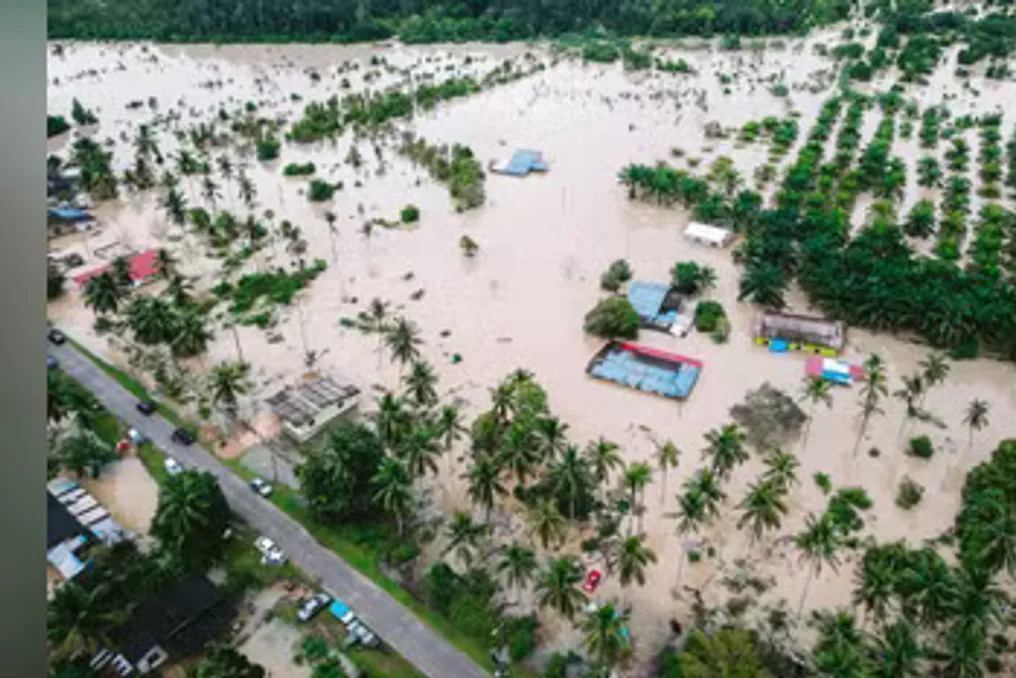
Climate risks are no longer solely an environmental issue; major investors are now studying the probability that reaching critical points in the Earth's climate system will trigger sudden losses in financial markets.
Shift in Risk Assessment Paradigm
For a long time, climate change was viewed as a gradual financial risk. Investors assumed that rising temperatures, increased storms, and changing weather patterns would affect markets over decades, giving governments and companies time to adapt. However, this assumption is beginning to change.
Some of the world's largest pension funds and asset managers are analyzing a different scenario: what will happen if parts of the Earth's climate system cross critical thresholds and cause sharp, irreversible changes. JPMorgan has labeled such scenarios as 'climate black swan' risks. According to a Bloomberg report, institutions like Standard Life and Allianz Global Investors have begun incorporating climate tipping points into their long-term risk assessments.
What Are Climate Tipping Points?
Climate tipping points represent critical levels in Earth's natural systems. Once crossed, they can trigger large-scale, and in some cases irreversible, changes. These points are linked to interconnected systems, including ice sheets, forests, oceans, and permafrost.
Scientists have identified several areas of concern: the ice sheets of Greenland and West Antarctica, the Amazon rainforests, the thawing Arctic permafrost, and the Atlantic Meridional Overturning Circulation (AMOC)—a system of ocean currents regulating global climate. Unlike gradual warming, tipping points can initiate self-sustaining processes. For example, melting ice exposes darker land or ocean surfaces that absorb more heat, accelerating melting. Similarly, large-scale deforestation can reduce precipitation, making forests more vulnerable to further decline.
Studies show that the probability of reaching these points increases as global temperatures continue to rise. A Bloomberg report indicates that the world exceeded the 1.5 degrees Celsius warming threshold for the first time in 2024. Current trends suggest that temperatures could rise significantly over the century if emissions are not sharply reduced.
Reasons for the Term 'Climate Black Swan'
The term 'black swan' is typically used to describe rare, unpredictable events capable of causing serious upheaval. Nevertheless, not all experts believe that climate risks fit the traditional definition of a 'black swan.' The Institute and Faculty of Actuaries argues that many climate threats increasingly resemble 'grey rhinos'—risks with high probability and high impact that are visible but often ignored.
According to the actuarial body, climate risks exist on a spectrum. Some risks, such as the increase in floods and storms, are already measurable and included in financial models. Others, including tipping point scenarios, remain uncertain but require more attention due to potential impact.
Seriousness of Risks for Large Investors
Investors have begun paying close attention to these risks, asking practical questions about how climate tipping points might affect portfolios across real investment horizons, where markets might revalue assets, and where risks are concentrated.
Standard Life plans to begin developing a framework for managing climate tipping point risks next year, including simulations on its £317 billion portfolio to assess the reaction of various assets under extreme climate conditions. Sarah Capnik, Global Head of Climate Advisory at JPMorgan and former Chief Scientist at the U.S. National Oceanic and Atmospheric Administration (NOAA), told Bloomberg that investors are increasingly focusing on what climate tipping points mean for portfolios in real decision-making timelines—when markets may revise prices, where risks are concentrated, and how to plan amid scientific uncertainty but potentially sharp consequences.
A study published in the Journal of Cleaner Production found that financial institutions continue to struggle with assessing climate risks because they are difficult to quantify using standard models. Researchers found that climate risks are often perceived as distant both in time and space, making them less urgent compared to other financial risks. This 'psychological distance,' combined with the uncertainty of future consequences, can lead to an underestimation of their significance.
Impact on Assets and Markets
Climate tipping points can affect financial markets in different ways. Some assets face direct physical risks, while others may suffer from investors revising long-term economic prospects.
According to a JPMorgan analysis presented to Bloomberg, debt markets may be among the first to react if climate tipping points begin to alter expectations regarding economic growth, public finances, and long-term financial stability. Government bonds may come under pressure if countries face the need to increase spending on disaster recovery, adaptation measures, and infrastructure reconstruction amidst slowing economic activity. A weaker fiscal outlook may prompt investors to demand higher yields when holding sovereign debt, leading to increased borrowing costs.
Real estate properties susceptible to frequent flooding, wildfires, extreme heat, or coastal erosion may lose value, especially if insurance becomes more expensive or harder to obtain. Infrastructure assets, such as ports, transport networks, energy systems, and water supply, are also vulnerable, as they are designed for decades of operation. Damage or failure in these assets can affect both public finances and private investments.
Insurance companies face a different set of risks. More frequent and severe weather events can lead to increased claims payouts, forcing insurers to raise premiums, reduce coverage, or exit high-risk regions. Stock markets may also be affected, although the impact is likely to vary by sector.
Why Debt Markets Might Feel the Hit Sooner
Debt markets often react quickly to changes in expectations about a country's ability to meet its obligations. If climate events increase government spending, reduce economic growth, or weaken tax revenues, investors may reassess the risk of holding government bonds. This can push bond yields up, increasing borrowing costs for governments.
Bloomberg reports that according to current JPMorgan analysis, debt markets are likely to take the price hit first before less liquid real assets adapt to changing climate risks. This does not mean there will be an immediate shock in bond markets; rather, investors are trying to understand how climate tipping points might affect asset prices if markets begin to review long-term climate risks more sharply than in the past.
Significance of the Issue Beyond Wall Street
Climate tipping points might seem like an issue only for scientists or large financial institutions. However, decisions made by pension funds, insurers, and sovereign wealth funds often determine the direction of capital flow in the global economy. These institutions collectively manage trillions of dollars in assets. Their investments finance government debt, infrastructure projects, renewable energy, housing, and business. If they begin to view climate tipping points as a significant financial risk, it could influence the allocation of capital between sectors and regions.
For instance, projects in areas considered more vulnerable to long-term climate risks may face higher financing costs or greater investor scrutiny. Governments that need to spend more on disaster relief and climate adaptation may also face increased borrowing costs if investors demand greater compensation for perceived risks.
The insurance industry can also feel the effects. As climate losses rise, insurers may change their approach to risk pricing, adjust policy terms, or reduce coverage in areas prone to recurring extreme weather events. These changes can affect homeowners, businesses, and lenders. A study in the Journal of Cleaner Production notes the unique position of insurers, as they are simultaneously service providers and major institutional investors. Through their investment decisions, they help finance economic activity, and their insurance business plays a key role in helping societies adapt to climate risks. The study argues that improving climate risk assessment is important not only for financial stability but also for supporting the transition to a more sustainable economy.
The Institute and Faculty of Actuaries also insists that organizations should not wait for perfect data before assessing climate risks. Despite ongoing uncertainty, companies should continue to deepen their understanding of how climate risks interact and evolve over time.