Chinese geneticists conducted a study and concluded that the probable origin of the basic lineage of Mycobacterium leprae is South East Asia. This conclusion is based on the DNA analysis of ancient people suffering from leprosy found in the region.
Chinese geneticists conducted a study and concluded that the probable origin of the basic lineage of Mycobacterium leprae is South East Asia. This conclusion is based on the DNA analysis of ancient people suffering from leprosy found in the region.
Researchers have discovered ancient inhabitants of East Asia for the first time who show traces of leprosy. Bacterial DNA was extracted from the teeth of two individuals: one was buried in Xinjiang, and the other in Shanxi province. Analysis of the genome of these and previously published sequences allowed for the hypothesis that the original form of Mycobacterium leprae may have originated in South East Asia, from where it subsequently spread across Eurasia and to the Pacific islands. The results of the study were published in the journal Communications Biology.
Leprosy, also known as Hansen's disease, is a chronic illness classified by the World Health Organization among neglected diseases, despite registering about 200,000 new cases annually. The causative agents of this infection are two types of bacteria: Mycobacterium leprae and M. lepromatosis. The latter species was only identified in 2008 after an unknown pathogen was found in patients from Mexico.
Written evidence indicates that people suffered from leprosy long before the Middle Ages, when leprosaria existed in Europe. For example, Hippocrates, who lived in the 5th–4th centuries BC, described a disease similar in symptoms to leprosy. Nevertheless, the exact initial focus of M. leprae spread across Eurasia has not yet been established. Previously, some scientists suggested that the origin might be Southeast or Central Asia, while others leaned towards Western Eurasia or even Europe.
Chinese scientists, led by Cui Yinciu from Jilin University, presented the first molecular evidence that ancient inhabitants of East Asia had contact with the leprosy pathogen. In the course of their work, they studied bacterial DNA from the remains of 1800 people from various regions of the area. Two cases of leprosy were identified during the screening.
One of the remains was found in Xinjiang in 2017 at the Shihuao monument; radiocarbon dating showed that this person died approximately 1711–1550 years ago. The second case was discovered during the analysis of remains excavated in 2025 at the Danliuzhuangcun monument in Shanxi province. The dating of this sample indicates an age of approximately 2157–2340 years.
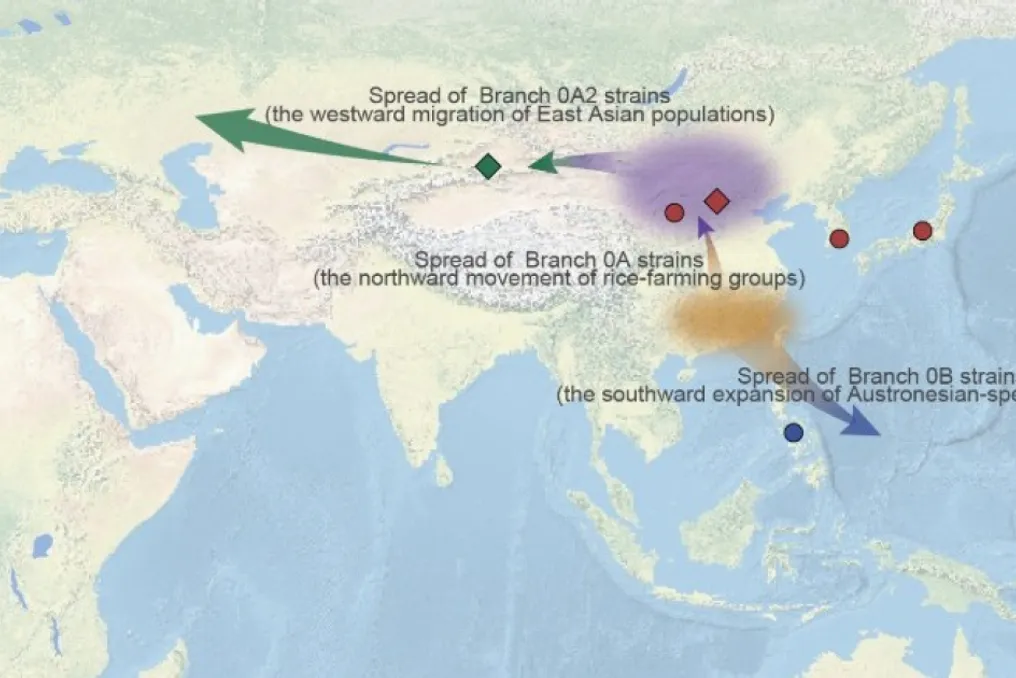
Phylogenetic analysis of recently obtained and previously published DNA sequences showed that both new genomes belong to basal lineage 0. Specialists calculated that the last common ancestor of all known strains existed approximately 4199 years ago (with a 95% confidence interval of 5195–3340 years ago), which is 300 years earlier than previously assumed. Scientists believe that the cradle of M. leprae was in East Asia, possibly in its south. They hypothesize that strains of the future lineage 0B migrated to the Pacific islands along with speakers of Austronesian languages. Another group of strains, forming lineage 0A, first spread to northern East Asia and then further across Eurasia, including the strain found in the ancient person from Xinjiang. However, researchers note that more precise conclusions will be possible after analyzing M. leprae DNA from other important regions, including South East Asia.
As for the American leprosy pathogen, M. lepromatosis, it affected people for millennia. A recent study established that approximately 4300–4200 years ago, adult men infected with this bacterium lived in Chile, representing the oldest confirmed cases of leprosy in the New World.
Researchers managed to identify DNA fragments dating back approximately 50,000 years in an antelope tooth located in southern Africa. This finding significantly contributes to expanding the understanding of the capacity for genetic material preservation in hot climates.
The study involved analyzing over 300 teeth from animals that lived in the last 110,000 years. The results suggest that genetic traces can remain preserved in sub-Saharan Africa for a much longer period than previously estimated.
The investigation, published in the journal Quaternary Science Reviews, focused on bovine fossils and located the oldest material in a specimen of mountain reedbuck, a species of antelope that still exists on the African continent.
The researchers evaluated bone remains of animals that inhabited the area at different past epochs, covering both the Holocene and Upper Pleistocene. Although many of the examined teeth did not have recoverable genetic material, some managed to retain small amounts of DNA.
The oldest fragment was obtained from a partial molar of an antelope of the species Redunca fulvorufula, found in Boomplaas Cave, in southern Africa. Additionally, DNA was identified in the remains of extinct long-horned buffalo, with estimated ages between 12,000 and 21,000 years.
This preservation was notable, given that tropical and subtropical environments generally promote DNA degradation over time. Previously, it was expected that the African climate would hinder the recovery of very ancient genetic material, especially when compared to cold or stable locations.
Despite the importance of the 50,000-year record, the scientists themselves warned that the result must be interpreted with caution. The antelope's genetic material showed a notable difference compared to other records found, and the fossil also presented signs of contamination by human DNA, which was removed during the analysis process.
According to Deon de Jager, a paleogenomics specialist at the University of Copenhagen and the study's first author, the discovery is relevant, but doubts remain about the exact limits of genetic preservation on the African continent. He emphasized that certain scenarios, such as deep caves with constant temperature and high-altitude areas, can create more favorable conditions for maintaining ancient DNA.
Even in small quantities, the recovered DNA provides substantiation for scientists to investigate the evolutionary relationships between various species and populations. Researchers believe that future studies may provide data on lineages, gene flow, and possible interbreeding between animal groups.
The study also opens avenues for a better understanding of the evolutionary trajectory of African animals and, to some extent, human ancestors. However, recovering DNA from very ancient human species is still considered unlikely. Particularly difficult cases include Homo naledi, which disappeared about 240,000 years ago, and Paranthropus robustus, which lived approximately 1 million years ago. According to the researchers, African environmental conditions make locating preserved genetic material from these distant periods extremely complex.
Therefore, the discovery does not negate the challenges of paleogenetics on the continent, but signals that the time span available for studying African history may be more extensive than previously thought.
Paleogeneticists were able to sequence ancient DNA extracted from a sample discovered in Africa. This DNA was found in the tooth of a mountain redunca that lived in the southern part of the continent about 50 thousand years ago. The results of this study are presented in a scientific publication in the journal Quaternary Science Reviews.
Over the last decade and a half, paleobiologists have made significant progress in analyzing DNA preserved in the remains of ancient animals and humans. This progress was marked by Svante Pääbo being awarded the Nobel Prize in Physiology or Medicine in 2022. Studies demonstrate that under suitable conditions, such as permafrost, DNA can survive for over a million years.
In regions with hot climates, DNA molecules are generally subject to rapid degradation. Because of this, very few ancient genomes from Africa older than ten thousand years have been known until now. Examples include data obtained from North Africa, where the DNA of several people who lived approximately 15–14 thousand years ago was successfully read. Furthermore, in 2024, researchers presented the oldest genome from South Africa, belonging to an individual who died about ten thousand years ago.
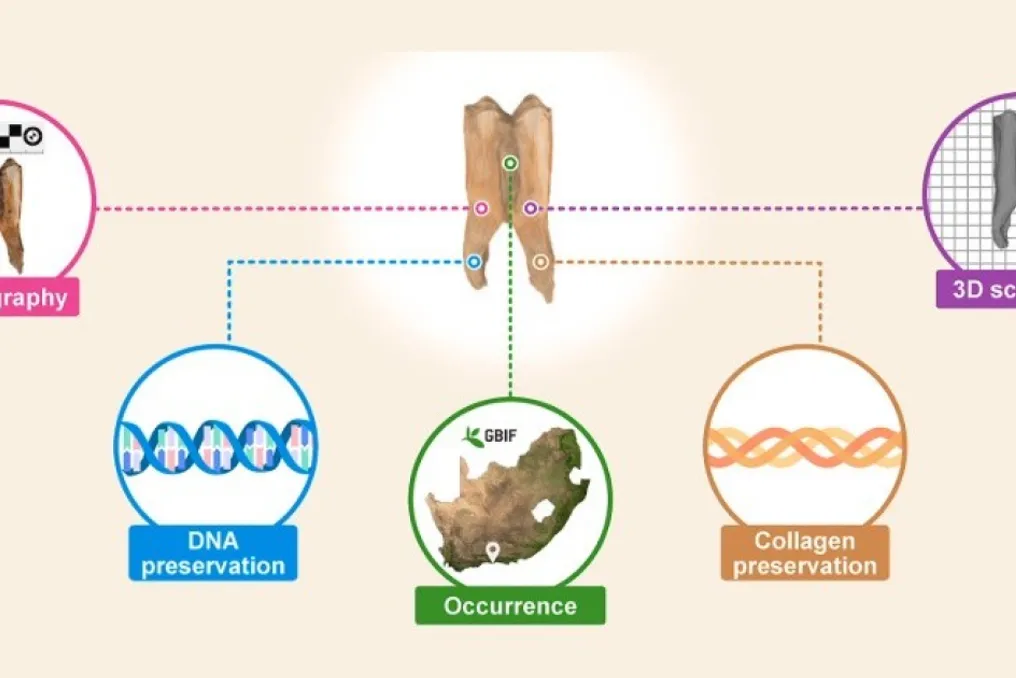
A team of scientists from Denmark, Canada, the USA, and South Africa, led by Elin Lorenzen from the University of Copenhagen, conducted a study aimed at examining the preservation of endogenous DNA and collagen in the bones and teeth of wild animals. These samples were extracted from six discovery sites in South Africa. A total of 320 samples were collected, which paleontologists classified as belonging to six species of ungulates inhabiting the late Pleistocene and Holocene. The oldest of these samples was approximately 110 thousand years old.
Researchers tested the DNA preservation in 144 samples and found that it was sufficient to determine the animal's species status in 65 cases. In 62 of these 65 cases, paleogeneticists confirmed the classification of species or genera made by paleontologists. However, in two cases, bones initially attributed to reduncas (Redunca sp.) turned out to be the remains of antelope (Pelea capreolus). A tooth from the Bumplaas cave was also studied: paleontologists assumed it belonged to a large redunca (R. arundinum), but paleogeneticists identified it as the remains of a mountain redunca (R. fulvorufula).
The last sample is particularly significant because, according to the scientists, its minimum age is 50 thousand years, making it the oldest African genome to date. In addition, the team successfully sequenced DNA from three other finds dating back to the late Pleistocene. These finds consisted of teeth from extinct buffalo Syncerus antiquus, found in Nelson Bay Cave. The age of two of these teeth was estimated at 21–23.5 thousand years, and the third at 12–14.1 thousand years. The remaining 61 samples with preserved DNA belong to the Holocene epoch, meaning their age does not exceed 11.7 thousand years (the average age was 3.1 thousand years).
Recent investigations have shown that in rare cases, Pleistocene period finds may contain not only DNA but also RNA. The oldest RNA was sequenced from the mummified tissues of the mammoth steppe yak Yuki, which died in the territory of modern Yakutia about 40 thousand years ago. Separate attention should be paid to data from Taiwan: paleontologists, after studying a fossilized vertebra aged 400–800 thousand years, concluded that large pythons, reaching almost four meters in length, inhabited Taiwan during the Middle Pleistocene. Pythons are currently not found on the island, and the largest modern local snakes rarely exceed three meters.