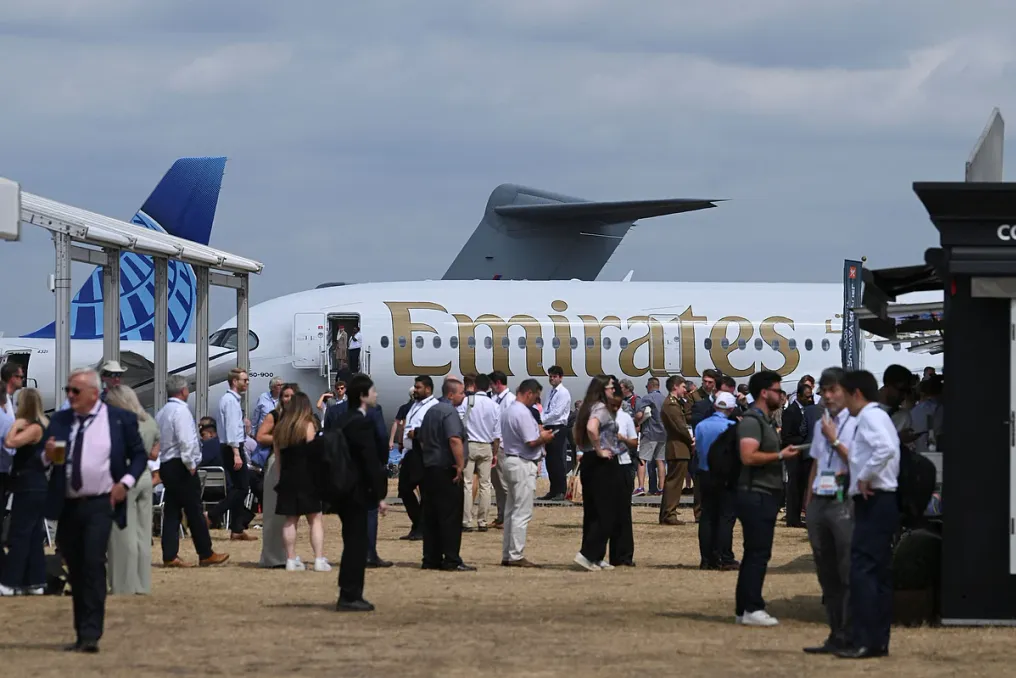
Representatives of the regional aviation business, including Emirates President Tim Clark, stated on Tuesday that the Middle East aviation sector continues to operate while attempting to dispel concerns caused by the regional conflict.
Regional Aviation Situation
At the Farnborough Airshow on Tuesday, Tim Clark told Reuters that Emirates is flying with a 90 percent load factor, and premium cabins are fully booked. He noted that while the situation, however bad it may be at the moment, remains manageable, the company's operations can continue.
Geopolitical Backdrop and Industry Impact
Against this backdrop, the US struck targets in Iran for the tenth consecutive day, while Iran attacked US facilities in Bahrain, Kuwait, and Jordan on Tuesday, undermining the fragile truce signed last month.
Last week, the European flight safety regulator extended the warning to avoid airspace in the region until July 29. Furthermore, Air France-KLM suspended flights to Riyadh (Saudi Arabia) and Dubai until July 27 on Monday.
The traffic flow of Middle Eastern carriers has been declining since the war between Israel and the US against Iran began on February 28, and some airlines have reduced capacity to hedge against rising costs.
Optimism Among Industry Leaders
Nevertheless, at Farnborough, regional leaders emphasized that business in Middle Eastern aviation is developing successfully. Paul Griffiths, CEO of Dubai Airports, stated: 'The closer you are to the center of operations in the Gulf, the more normal things seem to you.'
Aviation analyst John Strickland pointed out that the region has experienced many crises previously, but it is unlikely that airline profits will remain unaffected. He told Reuters: 'Of course, it will affect net profit, it is having an impact. They will want to close down as much as possible to avoid losses from costs in difficult times and return to profitability.'
Development Plans and Traffic Recovery
Tim Clark also added that the carrier has no plans to postpone orders, and ambitions to open a new airport in the UAE in 2032 remain in effect. Griffiths confirmed that the new Dubai airport is still scheduled to open on time.
Mark Nichols, Partner and Co-Chairman of the Global Aviation Sector at DLA Piper, noted that many major regional carriers have already received significant aircraft orders in recent years. Therefore, their participation in the exhibition reflects strategic priorities and the maturity of their fleet planning, rather than any changes in confidence or growth ambitions.