Following the conclusion of the 2026 FIFA World Cup final match, which Spain won, celebrations were marred by a tense clash between athletes. At the center of this fight were Argentine player Leandro Paredes and Spanish defender Eric Garcia.
Following the conclusion of the 2026 FIFA World Cup final match, which Spain won, celebrations were marred by a tense clash between athletes. At the center of this fight were Argentine player Leandro Paredes and Spanish defender Eric Garcia.
Spain defeated the defending champions Argentina 1-0 after extra time, securing their second FIFA World Cup title. The match ended with a scuffle near the center of the field amid growing tension among the players.
Earlier, tensions flared when Argentina was forced to play with ten men after midfielder Enzo Fernandez was sent off late in regular time for a tackle on Pau Cubarsí. Lionel Scaloni's team also received six yellow cards. The tension persisted even after the final whistle, as Spanish substitutes ran onto the field to celebrate.
Video footage shows Argentine defender Nahuel Molina seemingly swinging his arm towards Spanish captain Rodrigo during the celebration. Rodrigo stopped him and engaged in a verbal exchange, after which Eric Garcia intervened to calm the situation. The confrontation then intensified.
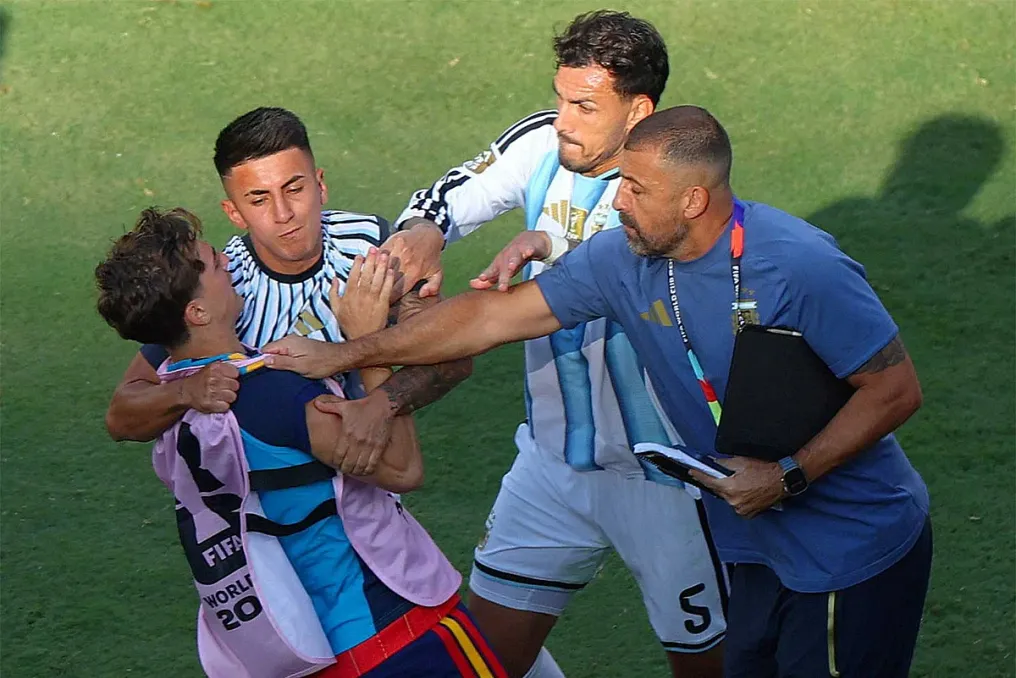
Paredes allegedly grabbed Garcia by the neck and pushed him while players from both teams gathered around. Argentine coach Lionel Scaloni attempted to intervene to separate the players and call for calm, but the conflict spread across the pitch.
According to circulating videos, the incident escalated into a brawl involving players, substitutes, and coaching staff from both teams before officials and teammates intervened to restore order.
While one clash was ongoing, another started nearby. Gavi of Spain got into a conflict with Thiago Almada of Argentina, prompting Paredes to intervene. Television captured Paredes grappling with Gavi, bringing him to the ground, grabbing his bib, and pressing it against his face.
Despite these confrontations, post-match scenes became more amicable. Several Spanish players hugged Lionel Messi, and head coaches Lionel Scaloni and Luis de la Fuente exchanged a long embrace in the middle of the field after the match ended.
During the game, Spain beat the defending champions Argentina 1-0 after extra time, thanks to a decisive goal by Ferran Torres in the 106th minute, scored following a cross from Nico Williams. Despite 12 saves, Argentine goalkeeper Emiliano Martinez could not stop Torres's goal. Spain dominated possession and created most of the chances, while Argentina failed to register any attempts in regular time and was reduced to ten men after Enzo Fernandez received a second yellow card late in regulation time. Spain's victory concluded their undefeated campaign in the World Cup and added the 2026 title to their triumph at Euro 2024.
During the match, Lamine Yamal and Pau Cubarsí, both aged 19, became the fourth and fifth teenagers to play in a FIFA World Cup final. They joined Pelé (17 in 1958), Giuseppe Bergomi (18 in 1982), and Kylian Mbappé (19 in 2018), all of whom played for the winning side.
Argentine captain Lionel Messi set a new record as the oldest outfield player to appear in a FIFA World Cup final at the age of 39 years and 25 days, surpassing Gunnar Gren of Sweden, who participated in the 1958 final at the age of 37 years and 241 days. The 2026 final marked Messi's third World Cup final appearance, following 2014 and 2022. He is only the second player to reach this milestone, after Cafu of Brazil, who played in the finals of 1994, 1998, and 2002.
According to FIFA statistics, a ranking of the best footballers of the 2026 World Cup was compiled. This ranking takes into account players' effectiveness in developing attacks and creating scoring opportunities.
All field players who participated in the tournament were evaluated based on three aspects: attacking, creative, and defensive metrics, with scores ranging from 0 to 10.
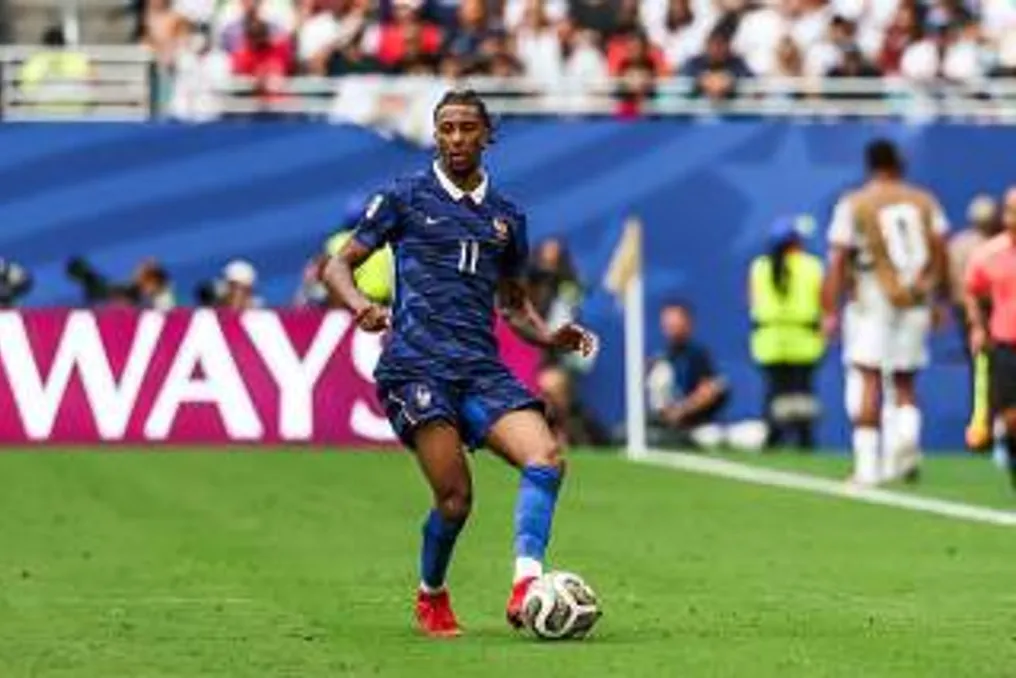
France national team winger Michael Olise took first place in the creativity metric, scoring 8.29 points. Thanks to this result, Olise also became the tournament's top assist provider, making 7 assists during the 2026 World Cup.
Lionel Messi ranked second in the creativity rating with a score of 8.26 points, and Kylian Mbappé placed third with 7.84 points.
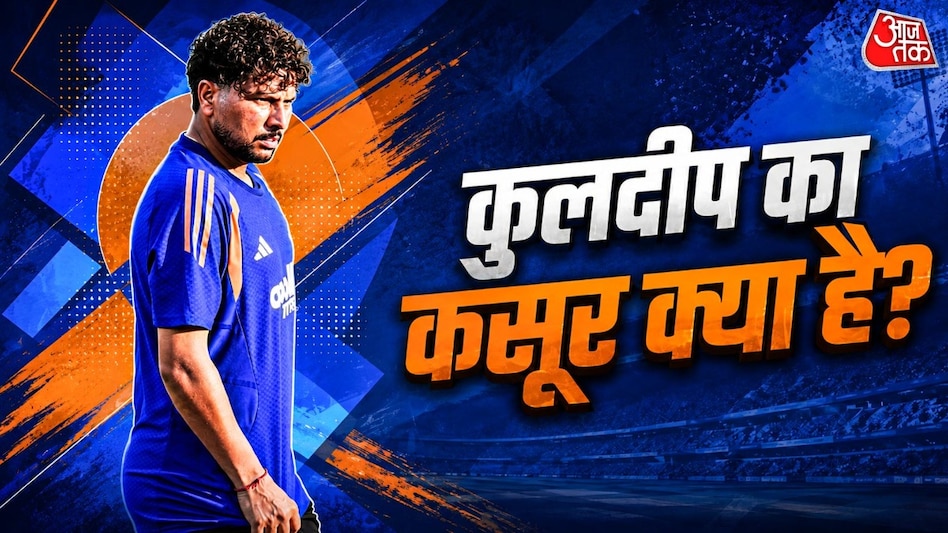
The careers of some athletes are determined not only by statistics but also by a long wait for their chance. Kuldeep Yadav, who debuted in international cricket in 2014, is approaching 32 years old. Over these twelve years, he has spent significantly more time waiting for a game than playing, which is reflected in his statistics: only 50 first-class matches and 136 List A matches.
The recent ODI match at Lord's reignited this discussion. Despite the Indian squad including four tail-enders and the pitch being deemed favorable for spin, suggesting Kuldeep Yadav's participation, it did not happen. A natural question arises: if he cannot make the starting lineup even under conditions where he should be given a chance, when will that happen?
Kuldeep's performance is difficult to assess. Since his ODI debut, he has taken more wickets than any other spinner in the world. His average and economy surpass those of veterans like Adam Zampa from Australia and Adil Rashid from England. In Tests, his average hovers around 22. Thus, the statistics do not indicate that Kuldeep is a player who should be dropped from the team.
Previously, when the team featured world-class all-rounders like Ravichandran Ashwin and Ravindra Jadeja, who could bat and bowl, Kuldeep's absence was an understandable consequence of the squad composition. However, the situation has changed. Today, Kuldeep often loses out to players who have failed to secure a spot in either batting or bowling. This calls into question the selection policy of the Indian team.
Lately, the Indian team has shown a tendency to favor players capable of performing both batting and bowling roles. This strategy sometimes works in T20, where there are four overs and 20 overs for batting. Nevertheless, ODIs and Tests are different sports requiring performances over 50 or 90 overs. Under such conditions, one specialized bowler can have a greater impact than a semi-professional all-rounder.
The 2023 World Cup was a clear example. After Hardik Pandya's injury, India decided to move away from extra batting depth and give a chance to a specialist bowler like Mohammed Shami. The result was obvious: Shami became one of the tournament's main winners. This showed that under pressure, the team relied on highly specialized players.
The decision at Lord's was particularly unexpected. The pitch conditions were favorable for Kuldeep: dry grass and expectation of spin. Yet, India fielded four tail-enders, and Kuldeep was one of the most experienced bowlers in the team. Nevertheless, the team management opted for new fast bowlers, leaving Kuldeep out of the squad. This deepens the question about the management's intentions regarding Kuldeep.
An interesting point is that selectors constantly include Kuldeep in the team, indicating they consider him one of the country's best spinners. However, when forming the starting XI, the management does not show confidence in him. If this happens regularly, it suggests not only a problem with one player but also a divergence in vision between the selectors and the team management.
Perhaps the management believes that Kuldeep does not meet the standard of the bowlers who performed well in the 2023 World Cup. If so, the responsibility for addressing his technical shortcomings lies with the coaching staff. If they believe he is not yet ready for the game, he should be sent to domestic cricket so he can regularly bowl. The worst option is to keep him in the squad for every series but leave him on the bench for the entire tour.
This discussion goes beyond Kuldeep Yadav. It concerns the very philosophy of selection in Indian cricket. Will the Indian team rely on highly specialized players, or will it continue to seek squad balance through all-rounders possessing only 'pieces and parts' of skills?
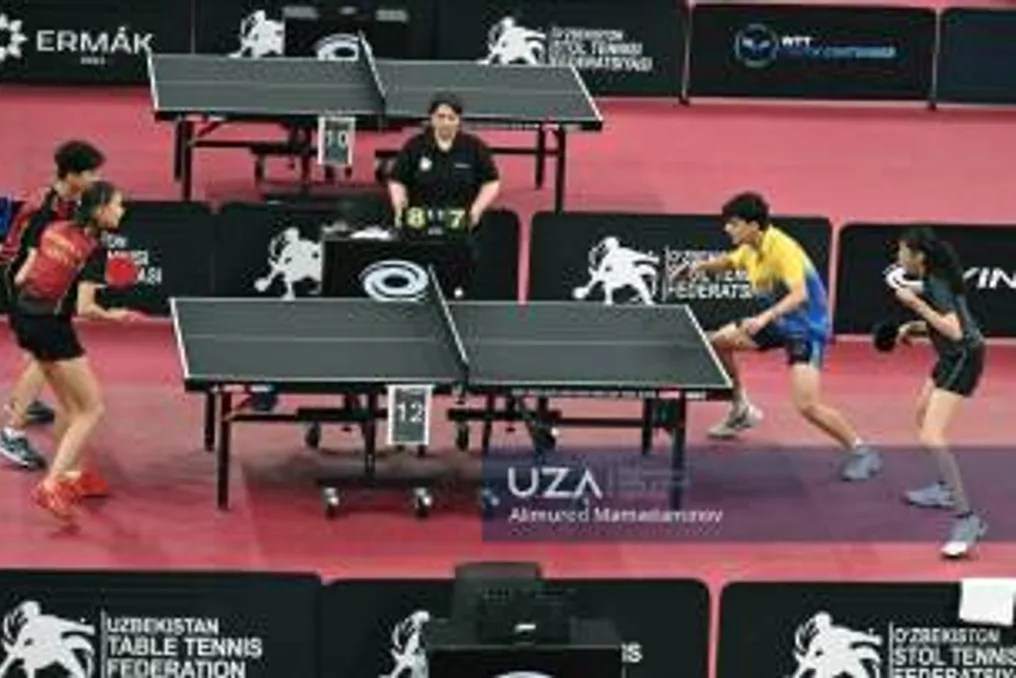
}))The international table tennis tournament 'WTT Youth Contender Tashkent' is taking place in the 'Olympic Village' of the capital. The competitions are characterized by intense matches.
More than 300 talented young players from 22 countries participated in this prestigious competition. Athletes compete against each other, striving to win victories and earn points for the international ranking.
The tournament is organized at a high level, meeting international requirements and standards. Necessary conditions have been created for all participants, and matches are held in various age categories. During the competition, young athletes demonstrate their skill, technical preparation, and sporting competitiveness.
This international tournament, which is being held from July 19 to 22, is of great importance as it contributes to enriching the competitive experience of young athletes, increasing their potential for participation in world arenas, and popularizing table tennis in the country.