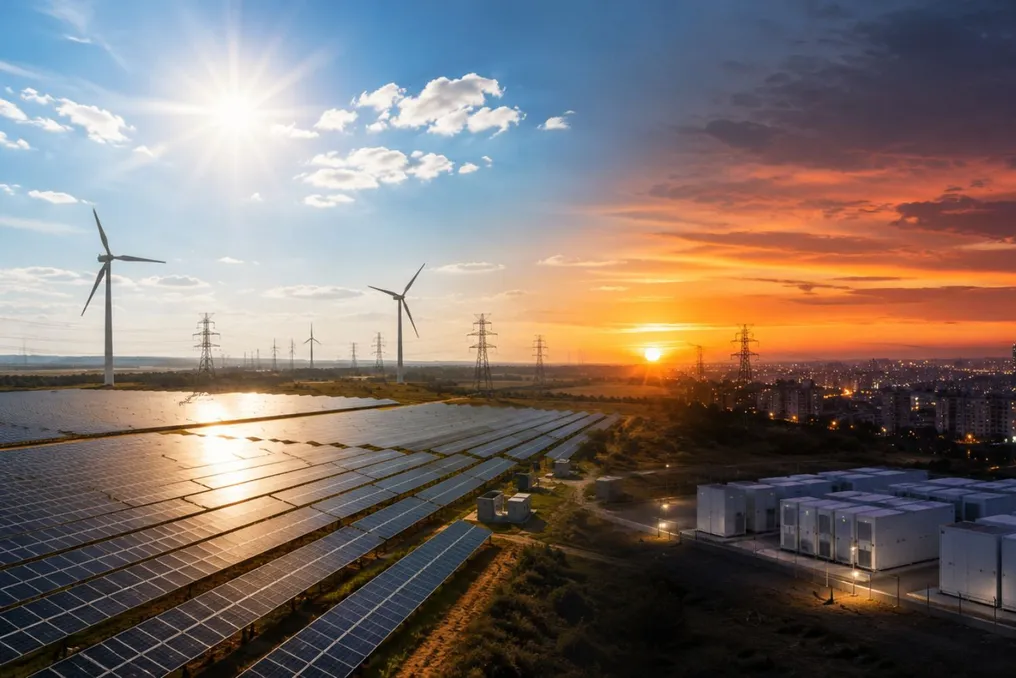
In mid-July 2026, India's power system reached a new milestone: the share of clean energy sources, including hydro and nuclear generation, accounted for 50.02% of total consumption at 221.5 GW, according to the Ministry of Power's MERIT platform. This marked the second consecutive year that clean energy exceeded half the load at a specific point in time, although this period lasted only a few minutes before coal once again dominated.
Achievements in the Energy Sector
The overall generation picture shows progress: as of May 31, 2026, India's total installed capacity reached 542.3 GW, with renewable sources accounting for 282.7 GW, significantly outpacing thermal generation at 250.8 GW. The country surpassed the 50% non-fossil installed capacity threshold in 2025, five years ahead of the target set at COP26.
The Problem of Peak Evening Demand
However, peak demand reveals a more complex picture. On May 21, 2026, India recorded a record peak of 270.8 GW, where renewables, including hydropower, supplied only 34% of this volume. According to data from the Institute of Economic and Financial Analysis of Energy, fossil fuels constituted nearly 69% of the share in April. The problem is exacerbated by the fact that demand peaks in India occur in the evening, when cooling system loads remain high, and solar energy, which operates actively at noon, is already absent.
Solutions for Evening Deficit
Even the largest renewable energy park, located in Chavda in Kutch, which is expanding to 30 GW by 2029, has faced this issue. The Gautam Adani group installed an energy storage system there in May 2026 with a capacity of 3.37 GWh, marking the largest deployment in one location outside of China. The company plans to increase this volume to 50 GWh over five years.
There are three ways to eliminate the evening deficit: storing daytime surplus energy for nighttime use, generating energy at night using wind, hydro, or nuclear power, or reducing the deficit itself by shifting consumption to daytime hours. Currently, India is primarily focusing on the first solution.
Development of the Energy Storage Market
The cumulative operational capacity of battery storage in India reached 8.5 GWh in the first half of 2026, representing an 11-fold increase in one year. The central electricity authority estimates that India will require 411.4 GWh of storage by 2031–2032, and 888 GWh by 2035–2036. Policy has also changed: the viability gap funding scheme approved in September 2023 was scaled up, and the Ministry of Power now requires that solar energy tenders include an adjacent two-hour storage system equal to 10% of the solar capacity.
Potential of Demand Flexibility
The third option—demand modification—is the most economical and is in the initial stages of implementation. Shifting consumption to daytime, such as running factory equipment at one PM instead of nine PM, allows for reducing the evening peak without the need to build new capacity. The demand flexibility market allows households or businesses to receive payment for agreeing not to use electricity during peak load hours, similar to how power plants are paid for generated energy. Implementing this requires an aggregator that bundles these commitments into a package understandable to the grid.
In the US, such aggregated capacity ranges from 30 to 60 GW, achieved through regulation. In India, the most ambitious initiative is the Tata Power program in Mumbai, aimed at reducing peak load by 75 MW. However, since most consumers pay a fixed rate regardless of the time of day, they lack the incentive to manage their consumption timing, which hinders market development.