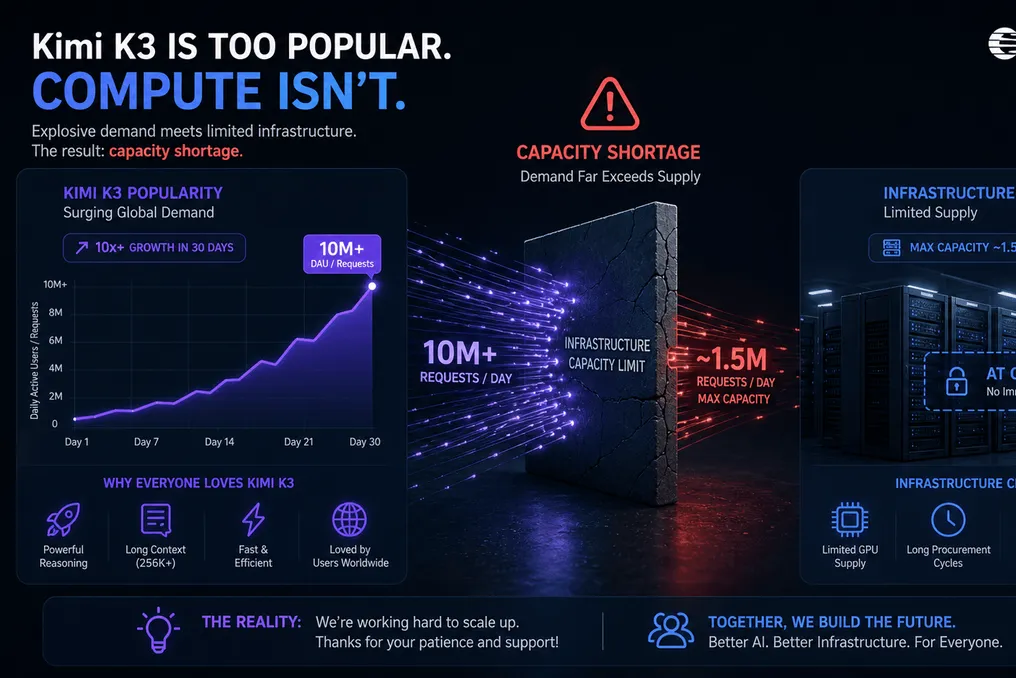
Moonshot AI was forced to temporarily halt the acceptance of new consumer subscriptions for Kimi just three days after the globally recognized release of the K3 model, as demand exceeded available computing power.
Moonshot AI was forced to temporarily halt the acceptance of new consumer subscriptions for Kimi just three days after the globally recognized release of the K3 model, as demand exceeded available computing power.
The company announced the immediate suspension of new subscriptions due to a severe shortage of computational power. Moonshot AI stated that all existing computing resources would be directed towards serving current subscribers, thereby guaranteeing the preservation of all benefits for existing users. The company plans to gradually resume accepting new subscriptions as additional computing power comes online and is actively working to expand its infrastructure.
The release of Kimi K3 generated widespread international resonance, including positive comments from Elon Musk and high rankings in various benchmarks. The model, with 2.8 trillion parameters and a context window of 100 million tokens, immediately attracted the attention of global developers. For instance, Vercel CEO Guillermo Rauch published testing results showing that K3 ranked first in frontend coding evaluations. Demand for the model surpassed Moonshot's existing infrastructure within 72 hours of the public release, leading to a supply-demand imbalance and necessitating the suspension.
Furthermore, Moonshot announced a restructuring of its subscription model to better align the distribution of computing resources with user needs. After operations resume, core KIMI features, such as Kimi Web, Kimi App, and Kimi Work, will be separated from Kimi Code. This will allow for more precise allocation of computing power to specific tasks. This segmentation reflects the contradiction between K3's universal capabilities as an advanced model, superior in many areas, and the practical reality that different use cases—coding, document analysis, creative work—require significantly different profiles and computation intensity.
The suspension highlights a broader structural problem facing Chinese companies in the field of artificial intelligence as they strive for advanced development. The K3 model requires 2.8 trillion parameters and utilizes an MoE architecture with 896 experts, and inference at this scale demands significant GPU computational power per request. Although Moonshot provided substantial computing resources to launch K3, the model exceeded all usage forecasts so significantly that the infrastructure could not keep up with the growth. The company did not provide timelines for full capacity restoration but noted that new computing equipment is being deployed as quickly as possible.
This development sends mixed signals to the Chinese AI industry. The positive view is that advanced Chinese models have achieved real global demand, as professional developers and enterprises are willing to pay a premium for access. However, there is also a warning sign: the domestic computing infrastructure, despite rapid progress in deploying superclusters and developing GPUs, still faces bandwidth limitations that restrict the practical scale of providing AI services. Since Kimi K3 and other advanced Chinese models compete for global users, the bottleneck may not be the model's capability itself, but the availability of computing resources, which adds urgency to already aggressive programs for building AI infrastructure in China, both in domestic GPU production and data center construction.
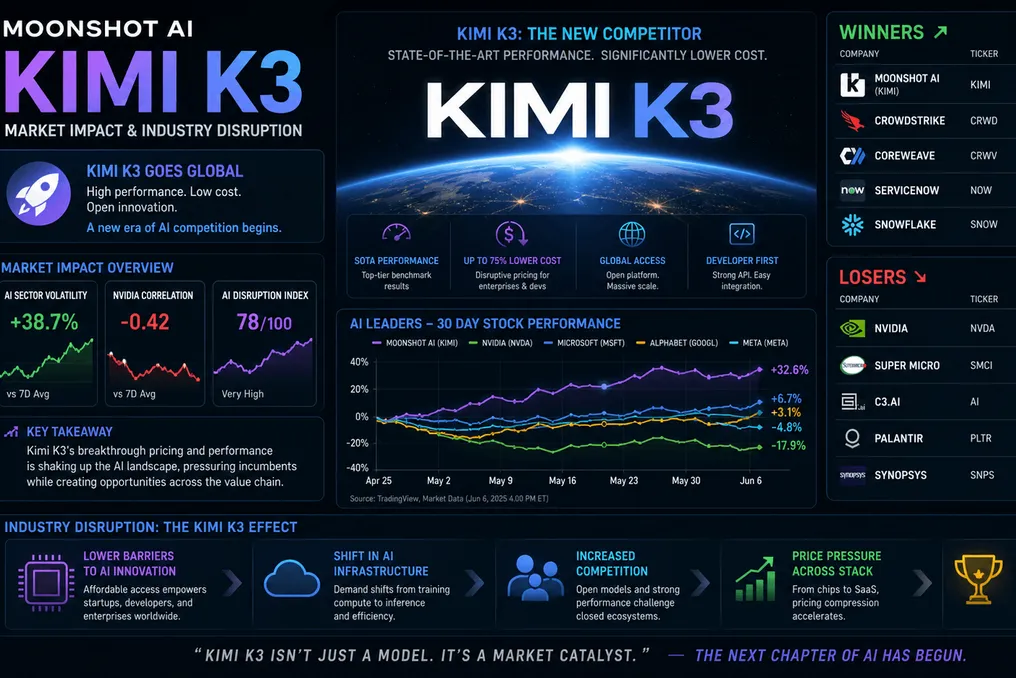
The release of Moonshot AI's Kimi K3 model has triggered a global reassessment of stocks in the artificial intelligence sector. Analysts call this the second shock following DeepSeek, forcing a revision of assumptions about the AI stock market, as the 2.8 trillion parameter model demonstrated that Chinese teams are capable of creating advanced AI solutions at significantly lower costs compared to Western companies.
According to IG market analyst Tony Sikamora, the announcement led to a loss of $314 billion in expected value for private companies OpenAI and Anthropic. Investors began reviewing the competitive dynamics of the foundational AI model market and questioned the effectiveness of US export controls on advanced chips in curbing AI progress in China.
The Chinese semiconductor ecosystem emerged as a winner. SMIC shares rose by more than 5% as increased competition in AI models is expected to stimulate further infrastructure spending. The subsequent announcement of Alibaba Qwen3.8 Max reinforced this trend, causing the ChiNext Composite index to rise by 3.6%.
Portfolio manager Gary Tan of Allspring Global Investments noted that the main beneficiaries remain companies involved in the AI infrastructure layer. China's focus on open-source AI will accelerate the adoption of domestic advanced models, which will require more computing resources and increase demand for basic hardware, especially networking equipment and memory chips.
Memory chip manufacturers are clear winners. Despite the high efficiency of the 896-expert MoE sparse architecture, Kimi K3 still requires about 1.4 TB of memory even after low-precision compression, sustaining constant demand for SK Hynix, Samsung Electronics, and Chinese memory producers.
AI agent and software developers are also benefiting, as cheaper advanced models reduce application development costs and speed up their deployment in coding, customer service, and industrial processes.
Model developers have been losers, facing a sharply deteriorating competitive environment. Zhipu AI, previously considered a leading developer of open models in China, saw its Hong Kong-listed shares drop nearly 40% over two trading days, reflecting market concerns about model-level competition. The announcement that K3 weights will be fully open on July 27th will allow enterprises to run the model independently, without reliance on cloud services, intensifying price pressure across the entire model creation value chain.
Even high-performance chip manufacturers like NVIDIA and AMD face renewed scrutiny regarding the premium pricing they set due to scarcity.
The combination of Kimi K3 and Alibaba Qwen3.8 Max over several days demonstrates that competition in advanced AI models has moved beyond US laboratories. Morningstar analyst Malik Ahmed Khan expressed skepticism about a direct causal link to the sell-off of large technology companies, arguing that American enterprises will not abandon existing cloud providers for Chinese open-source models due to security and regulatory compliance requirements. Nevertheless, the competitive pressure on model pricing and the confirmation of alternative approaches to efficiency represent sustainable changes in the AI investment thesis, requiring a finer distinction between companies benefiting from building AI infrastructure and those whose business models depend on maintaining the scarcity of advanced models.