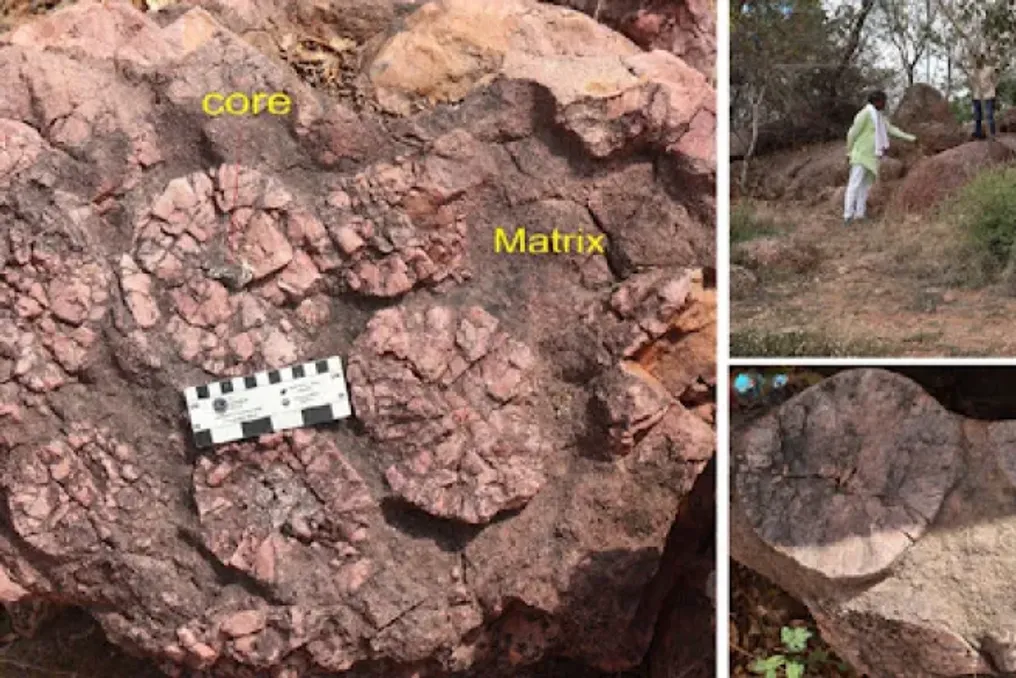
An international group of geologists has presented a new study that sheds light on a rare and visually impressive rock formation in central India. This formation serves as a highly accurate time capsule reflecting the early history of our planet.
Discovery and Age of the Rock
The research focused on a small outcrop near the village of Kutavali in the Madhya Pradesh district. It was determined that the Pichhore orbicular granite is approximately 2.56 billion years old. This makes it the second oldest known specimen of this type globally, surpassed only by a similar formation in Western Australia.
Scientific Participants and Context
The work was conducted by scientists from several institutions, including Banaras Hindu University, UNICAMP (Brazil), Indian Institute of Technology (IIT) Kanpur, Japan Advanced Institute of Science and Technology (JAIST), Indian Institutes of Science Education and Research (IISER) Berhampur, and the company AllGeo Solutions Pvt. Ltd.
This study provides insight into the chaotic magmatic processes that formed the Earth's continental crust during the Neoarchean period, which spans from 2.8 to 2.5 billion years ago. This period was critically important as the planet's surface began to stabilize, forming the continents we know today.
Uniqueness of Orbicules
The rock's special value lies in its orbicules—mysterious spherical structures embedded in the granite. They resemble cricket balls or concentric tree rings. Some of these orbicules reach a diameter of up to 30 centimeters and consist of a central core surrounded by multiple mineral shells, such as quartz and feldspar.
According to researchers, the orbicules are evidence of a sudden, brief release of thermal energy, known as a thermal pulse, within a prehistoric magma chamber. It is hypothesized that these structures formed when water-rich, high-potassium magma underwent sudden overheating, possibly due to the injection of hotter, darker magma from the Earth's interior, after which it cooled rapidly. This process, known as undercooling, triggered intense, rhythmic crystallization that built outward from central points, creating characteristic layered shells before the remaining molten rock solidified.
Dating Methods and Old Rocks
The team used the U-Pb zircon dating method. Zircons are extremely durable crystals that function as natural clocks because they capture a small amount of uranium upon formation. Over billions of years, this uranium decays into lead at a constant rate. By measuring the ratio of uranium to lead in these tiny grains, the team was able to precisely determine the moment of granite crystallization.
However, the zircons revealed something deeper than just the granite's age of 2.56 billion years. Some crystals were inherited, meaning they survived from even older rocks that were melted down to create the new magma. These older grains date back 3.5 billion years, proving that the Earth was already recycling its oldest crust to form new continents during the Neoarchean period.
Significance for Regional Geology
The new research deepens the understanding of the Bundelkhand Craton, an ancient geological block that constitutes a significant part of central India. Although the Pichhore rocks were documented as early as 2004 and recently recognized as a national geo-cultural heritage site, they had never been dated with such precision. By applying modern isotopic analysis, specifically studying Neodymium isotopes, the team confirmed that the magma did not originate directly from the Earth's mantle but was the result of melting existing continental crust.
This confirms that the region billions of years ago was a dynamic continental margin, similar to modern coastal zones where tectonic plates interact and are recycled.
Challenges and Need for Protection
Nevertheless, researchers note that the rock is poor in zircons, requiring the processing of nearly six kilograms of rock to extract only ten usable zircon grains. Although these ten grains were sufficient to establish a reliable age, scientists noted that a larger sample size in future studies could reveal additional age populations, potentially uncovering more information about the 3.5-billion-year-old rock sources incorporated into the Pichhore granite.
Currently, the Pichhore site is threatened by human activity, particularly the expansion of local agriculture, which endangers this 2.5-billion-year chronicle. By demonstrating its scientific uniqueness on a global scale, the researchers have provided the necessary basis for advocating for the protection and preservation of this site. Understanding the stabilization of the Earth's crust—how it became strong enough to support life and ultimately humanity—is fundamental to our knowledge of planetary evolution. It reminds us that the ground beneath our feet is the result of a multi-billion-year cycle of recycling, and places like Pichhore remain sole witnesses to this turbulent and creative past.