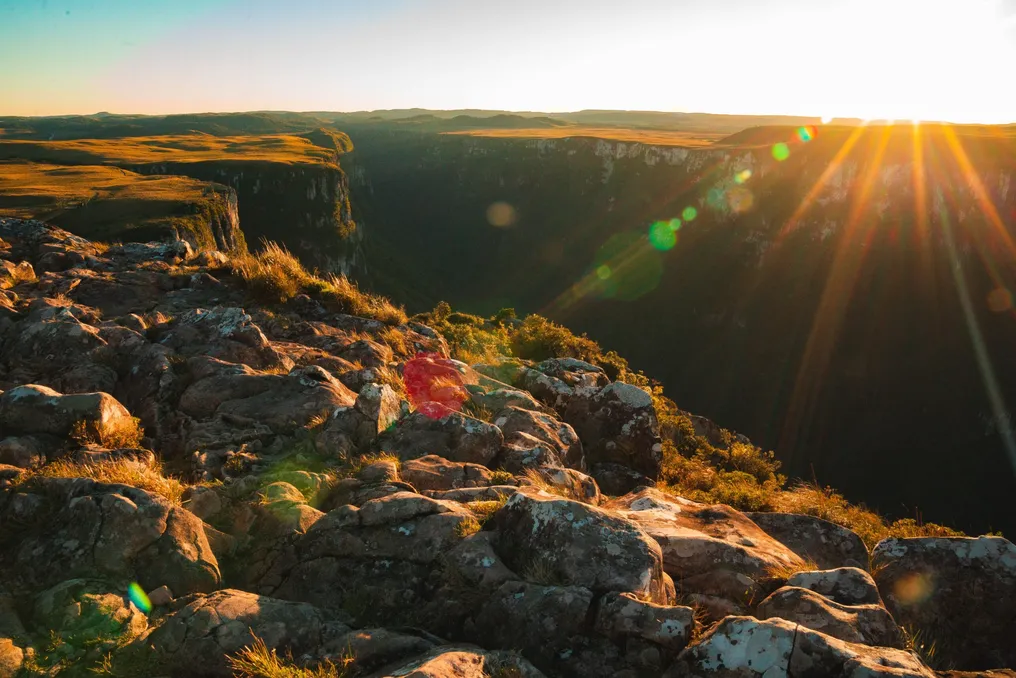
The Serra Geral National Park, located in Cambará do Sul, has started offering a new activity called Sunrise in Fortaleza. This tour allows visitors to contemplate the sunrise in Cânion Fortaleza, starting approximately two hours before dawn.
Participants will be taken to an altitude above one thousand meters above sea level to observe the first lights of the day illuminating the imposing basalt cliffs. The activity takes place on Thursdays and Sundays, with approval from ICMBio and conducted by duly accredited local guides. The organization of this experience is the result of a collaboration between the concessionaire Urbia and local tourism operators.
The ticket for this tour grants the visitor two extra accesses to the Serra Geral and Aparados da Serra parks, valid for a period of up to seven days after the first visit. Under clear sky conditions, it is possible to see views of beaches located in southern Santa Catarina and northern Rio Grande do Sul, as well as spot balloons crossing the horizon during sunrise.
Additionally, the zipline attraction in Cânion Fortaleza has been reactivated, after being deactivated in 2024 due to low tourist flow in the park.
The Serra Geral National Park is situated on the border between Rio Grande do Sul and Santa Catarina and features remarkable landscapes, blending high-altitude fields, trails, and large rock formations formed over millions of years. Its focal point is Cânion Fortaleza, recognized as the largest natural canyon in Brazil in terms of volume and depth. This canyon spans 7.5 kilometers and has sections exceeding 1,1 thousand meters in altitude, characterized by wall-like cliffs and panoramic views.
The park also offers several trails with different difficulty levels, such as Borda Sul, Quebra Cangalha, Pedra do Segredo, and Alto do Mirante, in addition to the Arroio Tigre Preto waterfall. Nearby, the Aparados da Serra National Park displays other beauties, including Cânion Itaimbezinho, famous for its almost vertical cliffs and easy trails to viewpoints. Among the most popular paths are the Vértice, Cotovelo, and Camisas trails, which offer views of the Andorinhas and Véu de Noiva waterfalls.
For those seeking a greater challenge, the Rio do Boi Trail, located in Praia Grande (SC), allows traversing the interior of Cânion Itaimbezinho following sections of the riverbed, passing through natural pools and waterfalls. Access to this route is regulated by ICMBio and requires advance reservation and accompaniment by a registered guide.
The location of the activity is the Serra Geral National Park, specifically in Cânion Fortaleza, near the end of Highway CS-012, in Cambará do Sul, Rio Grande do Sul. The tours take place on Thursdays and Sundays, starting about two hours before sunrise. The cost to enter the national park starts at R$ 107, which guarantees three accesses within a seven-day period. For the sunrise experience, prices must be checked with agencies accredited by Urbia, since the ticket already includes two additional accesses to the parks.

Making homemade Soji balls allows you to enjoy the sweet taste of traditional recipes. This dish requires a number of ingredients, including 165 grams of semolina, 110 grams of blanched almonds, 80 grams of coconut fiber, 200 grams of dry milk, 2 teaspoons of ground cardamom (elaichi), a quarter teaspoon of nutmeg, 100 grams of melted ghee, and one can of condensed milk.
Optionally, toasted sesame seeds and extra coconut fiber can be added.
The first step is to fry the semolina, blanched almonds, and coconut fiber for ten minutes until they are slightly golden and fragrant. After that, they should be removed from the heat and transferred to a medium bowl. Then, add the dry milk, spices, melted ghee, and condensed milk to this mixture.
The mass must be thoroughly mixed until uniform and allowed to cool completely. Once the mixture has cooled, it should be portioned into small mounds about the size of three teaspoons. These portions are shaped into balls, which are then rolled in coconut fiber or sesame seeds.
The finished balls can be stored at room temperature in an airtight container for five days. The recipe yields twenty balls.
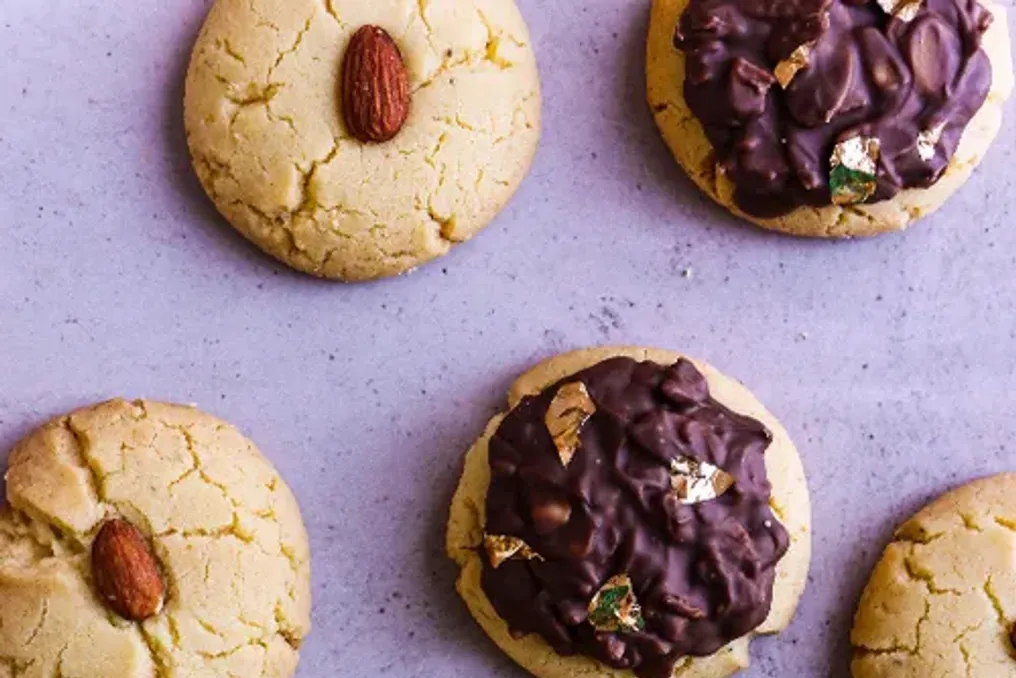
To prepare Naan Katai, you need to prepare the ingredients. The base requires 227g of room temperature ghee, 165g of powdered sugar, 2 tablespoons of semolina, 325g plus 2 tablespoons of cake flour, 1 teaspoon of baking powder, 1 teaspoon of baking soda, 2 teaspoons of ground cardamom, almonds, and chocolate glaze.
Preheat the oven to 180°C. Prepare a baking sheet by lining it with parchment paper. Using a hand or planetary mixer on medium speed, beat the ghee and sugar mixture for 1–2 minutes until it becomes light yellow, airy, and fluffy.
In a separate bowl, sift the cake flour, baking powder, and baking soda. Add this dry mixture to the ghee and sugar mixture and mix slowly until combined; the dough should be crumbly.
Take 1.5 tablespoons of dough, form a ball, gently flatten it with your palms, and place it on the prepared baking sheet. Place a whole almond on top of each piece and bake for 20 minutes.
After baking, store the cookies in an airtight container for up to two weeks.
To make the glaze, place the chocolate in a bowl and heat it in the microwave in short intervals of 30 seconds, stirring constantly. Once the chocolate has melted, let it cool for five minutes. Then add the chopped almonds and mix until the nuts are completely coated with chocolate.
Once the cookies have cooled, apply a small amount of chocolate-coated almond pieces to the top of each item, using the back of a spoon to distribute the glaze evenly. After the chocolate hardens, decorate it with gold leaf. Store the finished product in a closed container for up to two weeks.
In June of this year, as part of the project 'Youth and Women as Ambassadors of Sustainable Tourism in Karakalpakstan,' implemented with financial support from the European Union, the Konrad Adenauer Foundation, and the nationwide movement 'Yuksalish,' the Public Association 'DMO Karakalpakstan' held three-day training seminars in the cities of Nukus, Muynak, and the Khujayli districts.
Thirty-three young men and women participated in these events, gaining knowledge and practical skills in sustainable tourism, local initiative development, social entrepreneurship, project preparation, and tourist product creation. An important part of the training program was turning participants' ideas into practical projects. Participants presented both individual and team projects aimed at promoting the tourism sector.
All submitted projects were evaluated by independent experts, mentors, and the team of the Public Association 'DMO Karakalpakstan' based on established criteria. Projects that scored the highest were recognized as winners, and each of them is provided with support of 2.5 million soums for the purchase of equipment and furnishings.
Based on the competition results, the commission determined the following mini-subsidies:
For Muynak district: The projects 'Qirdagi kema,' aimed at creating a guesthouse in a natural area in national style to demonstrate hospitality and national values to local and foreign tourists, and 'Muynak travel media,' targeting the wide promotion of the region's tourism potential using modern media and popularizing it on the international stage, were selected.
For Khujayli district: The innovative initiatives recognized were the project 'Smart Karakalpakstan Tourism Hub,' aimed at expanding the tourism opportunities of the Republic of Karakalpakstan and the Khujayli district through digital technologies and increasing tourist flow, and the project 'Bir hotira - ming hikoya ustaxonasi,' dedicated to cultural tourism, telling stories about the national culture, crafts of Karakalpakstan, and the tragedy of the Aral Sea.
For the city of Nukus: The projects 'Aralaroma soap,' aimed at expanding the range of tourist souvenirs by producing natural soap from local plants and ecological products, and 'Arbashi bread,' whose goal is to create a new brand of souvenirs for tourists through modern, ecological, and nationally stylized packaging of traditional Karakalpak bread, were selected.
Furthermore, the project 'Shege qishlogidagi uy mehmonxonasi' by participant Aziza Atamuratova from the Muynak district was highly praised by experts. The Public Association 'DMO Karakalpakstan' decided to provide additional support for this initiative from its own funds, considering its prospects and the author's initiative.
This contest became an important initiative contributing to turning the ideas of youth and young women into practical projects, as well as developing local tourism and creating new tourist products and services.