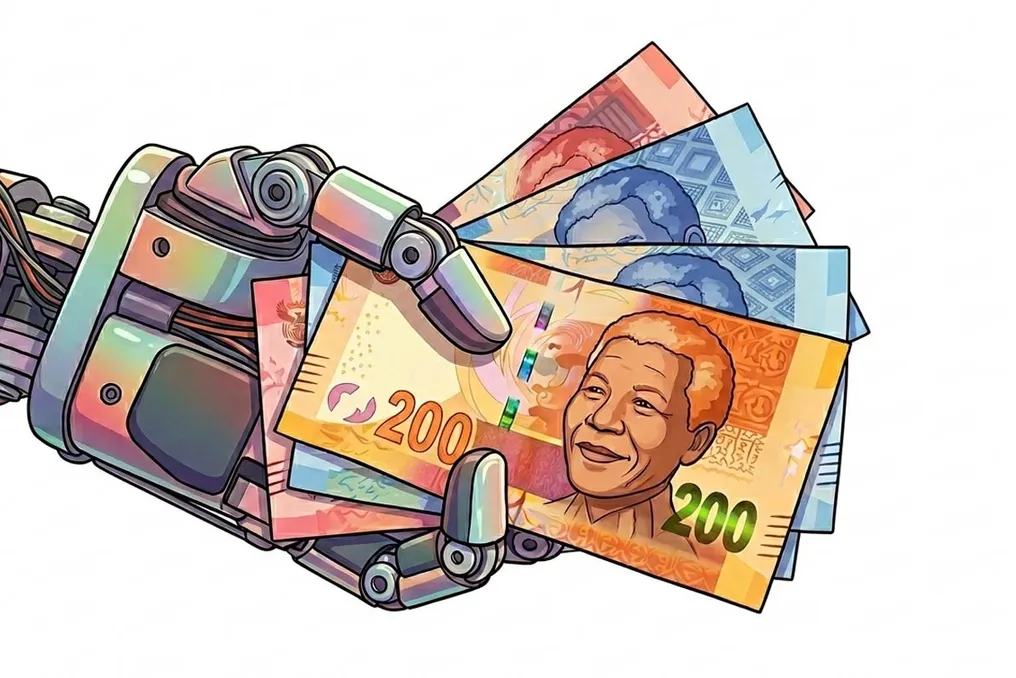
Three major South African banks—FNB, Absa, and Nedbank—have joined the list of partners for a new consortium. This consortium is working on creating a dollar currency for a machine-driven economy and is supported by companies such as Visa, Mastercard, Stripe, and BlackRock.
Similar stories
Popular
The Payment Problem for AI
These banks have joined the most ambitious attempt to solve a problem that the internet has ignored for thirty years: machines can perform almost any task except making payments. Although artificial intelligence agents are capable of independently researching suppliers, collecting financial data, and planning complex logistics chains, when money needs to be transferred, the internet relies on human presence—through card numbers, one-time PINs, subscription logins, and checkout pages.
The x402 Technological Solution
Two recent announcements clarified how this barrier is being overcome. The first is the open payments protocol x402, based on the HTTP 402 status code, which means 'Payment Required.' This code was reserved in web specifications back in the 1990s but was never used. It was launched by Coinbase in May 2025, and Cloudflare joined in September of the same year when both firms announced the creation of the x402 Foundation. Thus, x402 transforms this inactive code into a critical mechanism for machine-to-machine data exchange.
The mechanism is simple: when an AI agent requests a paid API, dataset, or article, the server responds with a 402 code containing the price. The agent assesses this cost against its budget, signs a microtransaction using a stablecoin—usually USDC from Circle—attaches payment confirmation, and repeats the request. The entire operation is completed within a single HTTP cycle without the need for account creation, subscription, or human involvement.
The Emergence of Open USD
Tuesday marked the start of the x402 Foundation operating under the auspices of the Linux Foundation, gathering 40 members, including Visa, Mastercard, American Express, Stripe, Google, and Amazon Web Services. Usage data demonstrates the difference between this economy and the one created for humans: over the last 30 days, the protocol processed about 75 million payments totaling $24 million USD, with the average payment being only $0.32. These amounts are still insignificant compared to the $40 billion moved by Visa alone in a day, yet no card network can profitably process a $0.32 transaction. The x402 protocol is designed for payments that card systems cannot support.
However, the communication protocol is only half the battle. For agents to conduct transactions at an enterprise scale, they require a neutral and unimpeded currency for settlement. Until now, this mostly meant USDC, issued and controlled by a single company, Circle, which charges multi-tiered fees for large volumes. This gap is what the Open Standard aims to fill. A consortium of over 140 companies, including Visa, Mastercard, Stripe, American Express, BlackRock, Coinbase, Google, and Cloudflare, announced on June 30th the release of Open USD (OUSD)—a dollar-backed stablecoin designed as a common infrastructure.
Issuing and redeeming OUSD is free regardless of volume; revenue from reserves goes to participating partners to facilitate adoption, and governance is managed by a council formed from participants, not a single issuer. The coin launch is scheduled for the end of the current year. Open Standard founder Zach Abrams stated: 'This is a stablecoin built for the internet economy and developed by the companies that are building it.'
The Link Between x402 and OUSD
Open Standard explicitly lists 'agent commerce'—the ability for agents to 'instantly execute programmatic payments'—among its main target scenarios, alongside payments, money transfers, and trading. When considering x402 and OUSD together, they appear not as two separate announcements, but as two layers of the same technological structure: one moves messages, and the other moves money.
If you are familiar with the story of a mega-consortium launching a global currency, it is likely the Libra project, presented by Facebook in 2019, which had a similar composition of participants—Visa, Mastercard, and Stripe were among the founders. However, the project collapsed under regulatory pressure, and the payment giants left within months. After being renamed Diem in an attempt to gain credibility, it sold its assets and ceased operations in early 2022.
Two things have changed. First, Meta is not at the center this time: the Open Standard structure does not allow any single company to control it, which was Libra's original sin in the eyes of regulators. Second, there is now a stablecoin law in the US—the Genius Act, signed in July 2025—which provides a legal framework for fully reserved regulated dollar tokens, something Libra never had. The same firms that left Libra are now building its successor within regulatory norms, not outside them.
The Presence of South Africa
Alongside FNB, Absa, and Nedbank, the pan-African exchange center Yellow Card, which operates in South Africa, is part of Open Standard. Standard Bank, Capitec, Discovery Bank, and others are not yet members. The banks' participation is not accidental. Visa has already included South African banks in its Agentic Ready program, and local institutions are actively investing in applying agentic AI across all their operations.
Membership in Open Standard gives developers and South African fintech companies direct access to create agents capable of executing autonomous cross-border micropayments in a stablecoin integrated with local banking infrastructure. Such payments can settle in seconds on the blockchain, rather than days through correspondent banks and SWIFT, although central bank foreign exchange control rules will still govern rand conversion on both sides. The field for development is favorable: Africa is already among the world's fastest-growing markets for stablecoin adoption.
Demand Readiness and Expert Opinions
The demand side is also ready. According to the DHL E-Commerce Trends Report 2026, 56% of online shoppers in Sub-Saharan Africa—the highest percentage among all regions globally—stated that they are likely to allow AI to make purchasing decisions or make purchases on their behalf within the next five years, nearly double the global average of 29%. Local stablecoin pioneers agree that this trajectory will hold. Simon Dingle, who helped launch ZARP, South Africa's first rand-pegged stablecoin, told TechCentral: 'Agent commerce is currently in its infancy, but we expect rapid growth in the coming years.'
He added: 'It is easy to imagine that the volume of agent payments will surpass the volume of traditional systems over time, as more financial activity becomes automated, especially in over-the-counter foreign exchange, remittances, trading, and other large-scale enterprises.'
Distinction Between Technologies
Dingle noted that 'bank accounts and traditional payment channels were not designed for machine intelligence, let alone the regulatory barriers that create friction in traditional systems.' He emphasized that a machine cannot open a bank account, but it can instantly set up a crypto wallet and begin making transactions with stablecoins like USDC and ZARP using protocols like x402.
Nevertheless, he drew a distinction between 'crypto-native stablecoins, such as ZARP or USDT, and other instruments that use the same name and part of the same technology for entirely different purposes in essence, which reintroduce much of the friction of traditional finance into the digital payments space.' In such cases, he said, '‘crypto’ or ‘stablecoin’ become little more than marketing jargon or an attempt at regulatory arbitrage.' He concluded that true stablecoins exist in the open: 'You will find real stablecoins on open public networks like Ethereum and Solana, and participate in ecosystems where they do not compete with their distribution channels.' Open Standard, for its part, stated that OUSD will initially operate on public blockchains, including Ethereum, Solana, and Coinbase's Base.
Farmers from the state of Punjab, who were heading to Delhi for a new protest action, were detained at the Shambhu border, located between Punjab and Haryana. Authorities erected barricades and placed concrete blocks to prevent their advance toward the country's capital.
Planned Event
A four-hour 'Kisan Mahapanchayat' was planned to be held at the Kisan Ghat memorial, which is dedicated to the late Prime Minister Charan Singh, a well-known leader of the farmers' movement.
Reasons for Farmers' Protests
The protests by farmers in Punjab are linked to the proposed trade deal between India and the United States. This temporary agreement was announced following a phone conversation between Prime Minister Narendra Modi and US President Donald Trump in February. The farmers demand the complete cancellation of this trade agreement.
The primary concern for the farmers is the inclusion of the agricultural and dairy sectors in the proposed agreement. They fear that unlimited imports of cheaper products from the US, such as corn, soybeans, cotton, and dairy products, could lead to a decrease in domestic crop prices, resulting in financial losses, especially for farmers in Punjab and Haryana.
Demands and Leaders' Concerns
According to farmer leader Sarwan Singh Pander, who led the protesters, they are also concerned about the possible import of genetically modified (GM) crops and agricultural products into India. Furthermore, they reiterated an old demand for a legal guarantee of the Minimum Support Price (MSP).
Commenting on Union Minister Piyush Goyal's statements regarding the proposed agreement, Pander told ANI: 'Piyush Goyal says there will be no compromises on the dairy and agricultural sectors, but it seems the deal is already done.' He continued: 'The White House press release mentions cotton, soy, corn, dried fruits, apples, pears, and other agricultural products under the 'Broad-based Trade Agreement'. 'Broad-based' covers everything—it is a comprehensive trade agreement. Therefore, I believe Piyush Goyal is not telling the truth to the country. The India-US trade deal seems inevitable.'
The Republic of Uzbekistan has signed the OECD and Council of Europe Convention on Mutual Administrative Assistance in Tax Matters (MAAC). The signing ceremony took place on July 15, 2026, at the OECD headquarters in Paris, according to the Tax Committee.
Details of the Signing and Participation
The document was signed on behalf of Uzbekistan by Nodir Ganiev, the Ambassador and Plenipotentiary Representative of Uzbekistan in France. Fabrizia Lapecorella, Deputy Secretary General of the OECD, was also present at the ceremony.
The Tax Committee noted that joining this Convention is the result of many years of efforts to harmonize national legislation with international standards. As part of the preparation, specialists conducted a legal analysis, agreed on the necessary package of documents, organized interaction with OECD experts and member states, and completed all necessary legal and organizational procedures. Following these steps, member states invited Uzbekistan to join the document in accordance with Article 28.
Significance of Membership in the Convention
Currently, the Tax Committee is undergoing a Peer Review by the OECD Global Forum on Transparency and Exchange of Information for Tax Purposes. The agency emphasized that joining MAAC strengthens the country's position within this assessment and confirms its commitment to international standards of tax transparency.
The MAAC Convention unites over 150 countries and jurisdictions, providing a legal basis for various forms of administrative assistance in tax matters without the need to conclude separate bilateral agreements. Currently, Uzbekistan exchanges tax information with 55 states based on bilateral double taxation avoidance agreements. After completing internal procedures and the Convention coming into force—expected on January 1, 2027—the volume of such cooperation is expected to increase significantly.
Potential Benefits for the Country
Participation in the Convention is expected to strengthen the fight against hiding foreign income and assets, tax fraud, illegal profit outflow, money laundering, and corruption. Furthermore, the document creates a legal framework for implementing the automatic exchange of financial account information (CRS), crypto assets (CARF), Country-by-Country Reporting (CbCR), and other international standards developed under the BEPS initiative.
The Tax Committee also indicated that joining MAAC will contribute to increased tax revenues through international information exchange mechanisms, enhanced investment attractiveness due to compliance with global transparency standards, and protection of taxpayer rights through unified confidentiality standards. The agency stated its intention to continue working on the implementation of the Convention, preparing for international tax information exchange, and further improving tax administration in line with international practice.
Minister of State for Commerce and Industry, Jitin Prasada, reported that Production Linked Incentive (PLI) schemes have contributed to attracting actual investments worth over 2.40 trillion rupees and creating more than 1.415 million jobs by the current year's March.
Results of PLI Schemes
In a written response to Lok Sabha, it was stated that thanks to these schemes, total exports exceeded 15.2 trillion rupees since their launch, reflecting India's growing integration into global value chains. Prasada stated that as of March 31, 2026, the PLI schemes provided actual investments exceeding 2.40 trillion rupees and generated employment for over 1.415 million people (direct and indirect).
Investment Structure
According to data presented by the minister, the largest volume of investment was received in the high-efficiency solar photovoltaic module sector (64,873 crore rupees). This was followed by pharmaceuticals (45,158 crore rupees), automotive industry (44,326 crore rupees), specialized steel (23,896 crore rupees), and large-scale electronics manufacturing (20,580 crore rupees) by March.
Other Government Initiatives
In a separate reply, the minister informed that as of June 30 of the current year, under the Startup India Seed Fund Scheme, 219 active incubators were selected with a total approved funding of 945 crore rupees, of which 650 crore rupees has already been disbursed to the incubators.
Indian Investments Abroad
Furthermore, Prasada mentioned that over the last five years (2021–2026), Indian overseas investments in the USA amounted to $15.9 billion. In the last financial year, this amount exceeded $4 billion, and in 2024–25, it reached $3.44 billion.
Foreign Direct Investment in Retail
Responding to the question, the minister clarified that according to FDI policy, 100% foreign direct investment is permitted through the automatic route in single-brand retail, whereas 51% FDI is allowed through the approval route in multi-brand retail (MBRT) subject to certain conditions.
He also reported that the cumulative inflow of FDI in the single-brand retail segment from April 2021 to March 2026 reached $1,528.66 million. Meanwhile, investments in this sector decreased to $179.25 million in 2025–26 compared to $486.66 million in 2021–22. Similarly, cumulative FDI in the multi-brand sector amounted to $34.38 million for the period from April 2021 to March 2026, increasing to $9.7 million in 2025–26 compared to $7.47 million in 2021–22.