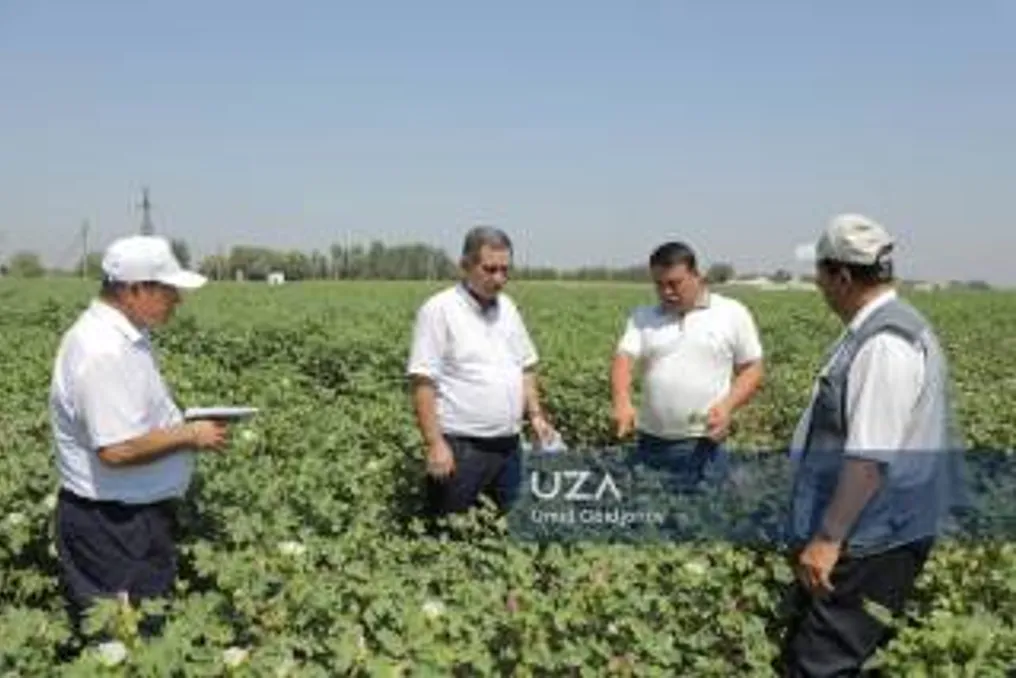
During a practical roundtable and exhibition held for farmers in the Boyovut district of Syrdarya region, issues such as maintaining cotton yield under abnormal heat, implementing water-saving technologies, effectively utilizing the Shenzhou technology from China, and achieving high yields from repeat plantings were discussed.
Participants and Goals of the Event
The event was organized at the initiative of the Republican Council of Farmers and its Syrdarya regional branch, based at the Syrdarya scientific experiment station located at the National Center for Knowledge and Agricultural Innovation, on the territory of the 'Hasanboy–Khusanboy' farm. Specialists from the Republic Council of Farmers, its regional and district branches, the Syrdarya Agro-industrial Services Center, the Quarantine and Plant Protection Department, the Veterinary and Livestock Development Department, scientists, leading farmers, and representatives of the agricultural sector took part in it.
The meeting discussed reforms aimed at modernizing the country's agriculture, the wide implementation of scientific and technological achievements in production, the rational use of land and water resources, the cultivation of export-oriented agricultural products, as well as the continuous improvement of farmers' knowledge and qualifications.
The Importance of Innovations in Climate Conditions
It was emphasized that the key factor in achieving high yields under changing climate conditions, water scarcity, and severe heat is the widespread application of innovative technologies, timely execution of scientifically based agrotechnical measures, and strict adherence to specialists' recommendations. Therefore, the seminar continued not only with theoretical discussions but also with practical field sessions.
Specialists provided scientifically grounded recommendations on applying the Shenzhou technology in cotton farming, expanding drip irrigation systems, effective use of microfertilizers, monitoring crops using agrodrones, and reducing the negative impact of abnormal heat.
Statistics and Farmer Support
It is reported that this year 75,220 hectares of cotton have been sown in the Syrdarya region, of which 50,000 hectares have implemented a drip irrigation system based on Shenzhou technology. This is of great importance for ensuring sustainable plant development, prudent use of water resources, and increasing yield.
The event was opened by Ilhomjon Alimov, the regional representative of the Fund for Farmer Support under the Republican Council of Farmers of Uzbekistan. He noted that large-scale reforms in the agricultural sector, the introduction of science and innovation, improving farmers' qualifications, and their financial support are sustainable directions of state policy. Alimov also stressed that the Fund carries out systematic work in this area; specifically, 6.4 billion UZS has been allocated for supporting farmers, dehqan farms, and other agricultural enterprises in the Syrdarya region in the first half of 2026: 5.1 billion UZS for the purchase of agricultural machinery and equipment, and 1.3 billion UZS for forming working capital for farms.
Cotton Farming Advice
Doniyor Tozhiboev, a researcher at the Syrdarya Agro-industrial Services Center, pointed out that July is the most critical period for cotton yield formation. He stated that under the current abnormal heat, it is extremely important to preserve every boll. It is necessary to maintain soil moisture at 60–70%, carry out watering, cultivation, and weeding on time. At this stage, one of the most important factors is the correct and timely use of microfertilizers. Fertilizers rich in humus, iron, and other microelements positively affect the full formation of bolls and improve crop quality.
According to Tozhiboev, achieving a noticeable increase in yield is possible by fully implementing eight important agrotechnical recommendations developed by the Ministry of Agriculture and industry scientists. Participants were also presented with a joint application from the Ministry of Agriculture and the Republican Council of Farmers for farmers and dehqans.
Recommendations and Practical Tips
Within the framework of the seminar, the meaning of the joint appeal from the Ministry of Agriculture and the Republican Council of Farmers to farmers and dehqans was conveyed. It was noted that this year 889.5 thousand hectares of cotton are grown in the republic, of which 305.2 thousand hectares are using the Shenzhou technology. Special attention was paid to the fact that the second half of July and the first ten days of August are a critical period determining the fate of the cotton, and every farm must immediately organize watering, cultivation, weeding, and plant protection according to the 'Dolzarb – 20 days' plan.
Zayniddin Faizullaev, a specialist from the Republican Council of Farmers, informed farmers about modern cotton farming technologies and explained the advantages of using the Etefon preparation starting from August 1st. He clarified that Etefon is not a herbicide but a modern agrotechnological agent that ensures simultaneous ripening and boll opening. Its application within the established deadlines and doses improves crop quality, increases harvesting efficiency, and promotes simultaneous cotton ripening.
Specialists from the Syrdarya Quarantine and Plant Protection Department gave practical advice on combating pests and diseases in cotton farming. Currently, the fight against pests such as spider mites, aphids, and thrips is being conducted using chemical and biological methods. It was also reported that there are sufficient stocks of special preparations to mitigate the negative effects of abnormal heat in the regions.
Conclusion and Farmer Experience
During the seminar, farmers received comprehensive answers to their questions from specialists and exchanged views on the practical results of scientific recommendations. Omon Kholgulov, head of the 'Hasanboy–Khusanboy' farm, emphasized that such practical seminars become a true school of experience for farmers. He noted that the president constantly emphasizes the possibility of achieving high results by relying on science, and they learn from scientists and specialists. The farmer said that this year the abnormal heat further highlighted the importance of every recommendation. On his 100 hectares of land, 60 hectares are planted with wheat, and 40 hectares with cotton using Shenzhou technology. The released areas were sown with millet as a secondary crop. The knowledge gained at the seminar will be an important guide for achieving a high yield.
At the end of the event, participants familiarized themselves with practical instructions on growing cotton, effective use of microfertilizers, application of water-saving technologies, and combating pests and diseases at the cotton field exhibition. Specialists answered all the farmers' questions, once again clarifying the importance of timely execution of scientifically based agrotechnical measures under the slogan 'Treat your cotton additionally and increase your yield.' It was emphasized that every agrotechnical measure performed on time and scientifically lays a solid foundation for an abundant future harvest. The synchronization of science, innovation, and best practices with agricultural development creates a solid basis for sustainable growth, achieving high yields from every hectare, increasing farmers' income, and strengthening national food security.