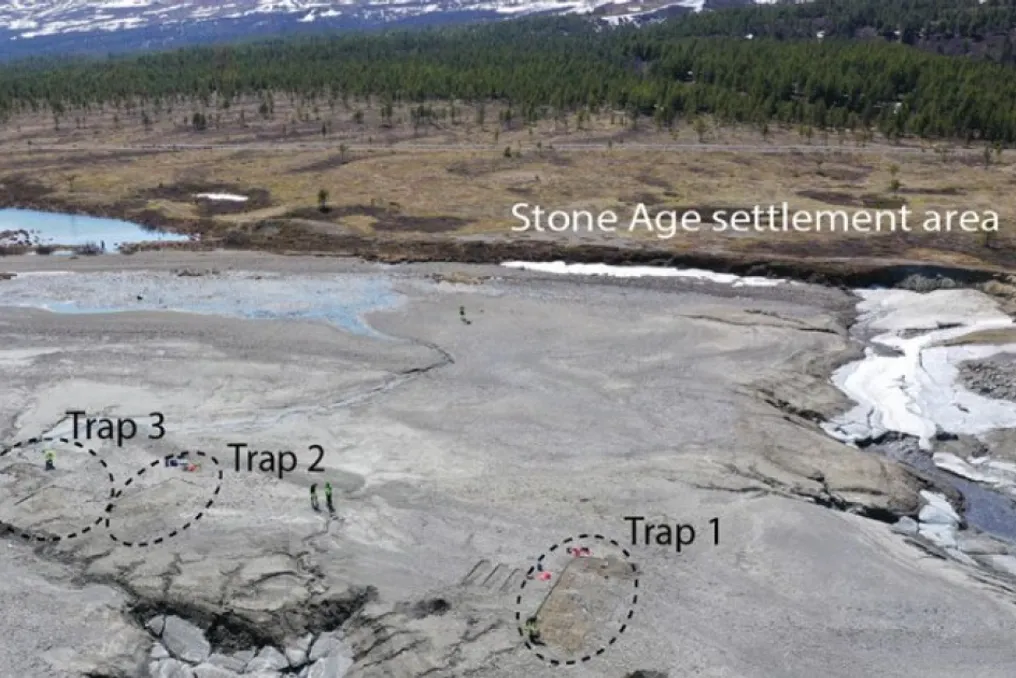
Norwegian archaeologists have presented data on extremely ancient fishing traps found in a mountain lake. The research confirmed that the age of the two earliest of these traps reaches approximately 7000 years. Scientists concluded that since there was no fish in the lake after the glacier retreated, it could not have gotten there naturally; therefore, humans must have stocked this Kumzhey reservoir, a practice that continued for millennia.
Historical Context of the Region
Around 8000 BCE, the interior territories of Southern Norway were freed from glacial cover. Following this event, not only wild animals but also Mesolithic hunter-gatherers and fishermen arrived in the newly opened lands. This period in the region lasted until approximately 3900 BCE. At that time, hunters likely traveled to the inland areas primarily in search of large animals such as moose and reindeer. Many mountain lakes and rivers that had recently been freed from ice did not contain fish.
The Study of Lake Tesse
One such body of water was presumably Lake Tesse, located at an altitude of about 850 meters above sea level. According to historical records, the stream flowing out of the lake hosted about 25 species of fish. Lake Tesse exclusively contained brown trout (Salmo trutta). Before the lake was converted into a reservoir in the 1940s due to the construction of a hydroelectric power plant, up to nine tons of this fish were harvested annually. Previous archaeological findings indicated that trout had been caught in Tesse since ancient times.
One clear piece of evidence for this was an object discovered in 2022 by amateur archaeologist Reidar Marstein. He found a fishing trap on the bottom of Tesse during a low water level, which preliminary estimates dated to about 7000 years old. In 2023, professional archaeologists conducted detailed surveys in this area. Their results were presented in an article by Axel Mierum from the University of Oslo and his Norwegian colleagues.
Dating Methods and Findings
During the work, scientists recorded five fishing traps, one of which was fully excavated. It was determined that pine was mainly used to make the traps, with birch and willow being used less frequently. Using radiocarbon dating and dendrochronology, the age of four traps belonging to different eras was established. Two traps date back to the Late Mesolithic, around 5000 BCE, while the other two date to the Neolithic period, around 3850 and 2700 BCE.
Hypothesis of Intentional Stocking
Such early fishing traps in the Scandinavian mountains had not been documented before. Although evidence of fishing on the shores of Lake Tesse during the Mesolithic era is known, the question arose as to how the brown trout ended up in the water body, given the presence of natural barriers. The article's authors consider the most probable hypothesis to be that Mesolithic hunter-gatherers intentionally stocked the lake by moving trout (possibly in special containers) from their natural habitats. Researchers believe that such activity can be regarded as an early form of production agriculture, implying long-term planning, as achieving a sufficient quantity of fish required a lot of time.
It is worth noting that in 2025, another group of researchers discovered evidence of stocking a high-altitude lake in Catalonia, but this occurred much later—in the early Middle Ages, around the 7th century CE. Notably, in the case of Catalonia, brown trout were also introduced into the lake.