Paleontologists have presented a description of the oldest representative of the carnivorous marsupial family (Dasyuridae). This species, named Miyumba chrisdickmani, inhabited the state of Queensland about 18.24 million years ago, at the beginning of the Miocene.
Characteristics of the new species
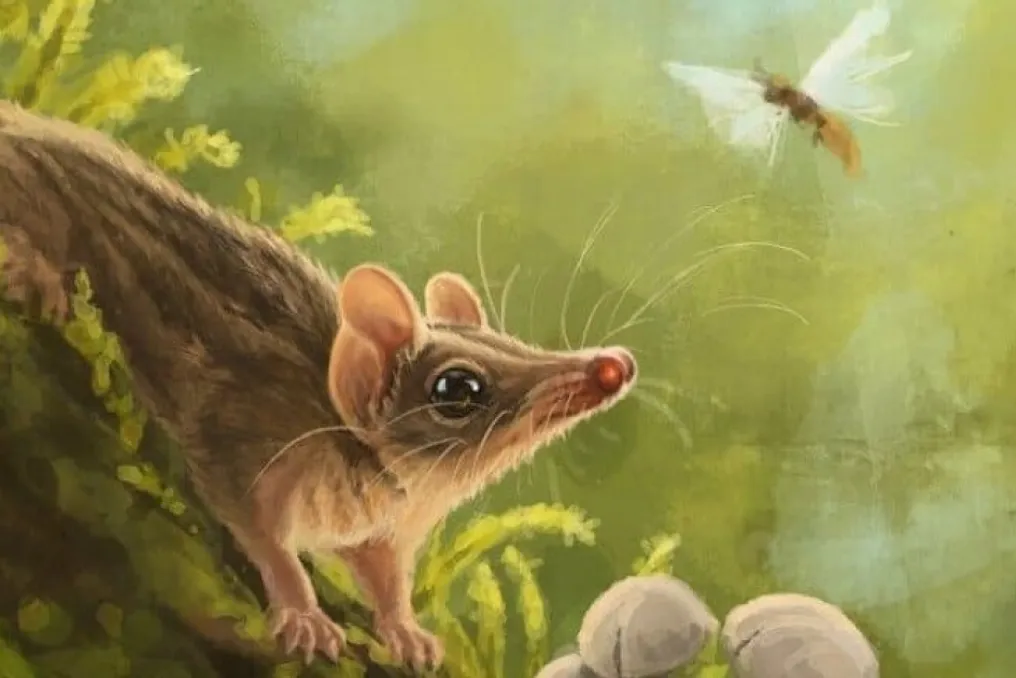
Miyumba chrisdickmani was a very small mammal, weighing approximately between 23 and 33.5 grams. It hibernated and fed on insects and various invertebrates. According to data published in the journal Australian Zoologist, scientists had previously been unable to find reliable representatives of Dasyurids in geological layers older than 5.3 million years.
The Carnivorous Marsupial Family
The family Dasyuridae includes about 70 species, existing or extinct in the past, and is found in Australia, as well as on the islands of Tasmania and New Guinea. Known representatives include Tasmanian devils (Sarcophilus harrisii), spotted quolls (Dasyurus), and antechinus mice (Antechinus). Larger and medium-sized species of this group feed on carrion and vertebrates, while smaller species specialize in hunting insects and other invertebrates.
Discovery in Queensland
According to modern scientific models, this group of Dasyurids appeared in the early Miocene, around 18 million years ago. However, in fossil records, its representatives only appear for the first time in the early Pliocene, about 5.3 million years ago. A team of paleontologists led by Timothy Churchill from the University of New South Wales managed to describe the first undisputed representative of Dasyurids from pre-Pliocene deposits.
Jaw Study
The focus of the scientists was seven samples of lower jaws containing teeth—premolars and molars. These finds were discovered at the UNESCO World Heritage site of Riversleigh, located in northwestern Queensland, Australia. The age of these remains has been determined to be 18.24 million years, corresponding to the early Miocene. Churchill and his staff concluded that the owner of these jaws belonged to a previously unknown species and genus in the order of carnivorous marsupials, based on the structure of the molars. Additional analysis allowed it to be classified within the family of carnivorous marsupials as a clade that is sister to all other members of the family. The new species has been named Miyumba chrisdickmani. The genus name comes from the Australian word waanyi, which denotes the area around Riversleigh, and the specific epithet is dedicated to ecologist Christopher Dickman for his contribution to the study of modern dasyurids.
Ecological Niche and Evolution
Calculations showed that M. chrisdickmani weighed only 23.3–33.5 grams, comparable to the smallest extant carnivorous marsupials, such as antechinus mice and sminthopsis mice (Sminthopsis). The authors suggest that representatives of this species lived in the humid tropical forests covering northern Australia in the middle and early Miocene, and judging by their size, hunted insects and other invertebrates, resembling modern New Guinean marsupial mice (Murexia).
Revision of Evolutionary Concepts
By integrating M. chrisdickmani into the evolutionary scheme of the order of carnivorous marsupials, Churchill and his co-authors also established that another presumed pre-Pliocene representative of the Dasyurid family, Mayigriphus orbus, indeed belongs to this group. This species lived in Riversleigh in the early late Miocene and, like M. chrisdickmani, was very small, weighing about 20 grams. It is assumed that M. orbus was an early representative of the subfamily Sminthopsinae, which is adapted to arid open landscapes.
New Chronology of Origin
Thanks to the discoveries of M. chrisdickmani and the recognition of M. orbus as a member of the family, previous ideas about the origin of Dasyurids have been corrected. According to the updated reconstruction, Dasyurids appeared at the end of the Oligocene or beginning of the Miocene, approximately 23.2 million years ago, five million years earlier than previous estimates. Initially, these species inhabited humid tropical forests, but later some of their descendants managed to adapt to other environments, including deserts and savannas.
Other Paleontological Finds
In the context of paleontology, three new fossils of Obdurodon insignis—a toothed ancestor of platypuses—were also described. These finds were made in the Namba formation of South Australia during the Late Oligocene and date back to about 25 million years ago. Analysis of the scapulocoracoid showed that O. insignis likely closely resembled extant platypuses and possessed good swimming skills. Researchers believe that these animals inhabited a large lake or lake system alongside many freshwater inhabitants, including small dolphins. The results of this study were also published in the journal Australian Zoologist.