Following the WAIC 2026 conference, it became clear that the main rivalry in the AI phone industry lies not in the capabilities of the models themselves, but in the entry points of operating system agents, the level of system permissions, and control over service distribution outside super-app ecosystems.
Factors of Competition in AI Phones
The conference demonstrated that all major manufacturers, including Honor, Nubia, and StepFun, presented concepts for agent phones that already meet basic functional requirements. However, as revealed during extensive discussions with industry experts, the real battle is focused on four key aspects: obtaining regulatory approval, the ability to reliably perform user tasks, access to system permissions, and control over the next-generation service distribution gateway.
Regulatory Barrier and Task Execution
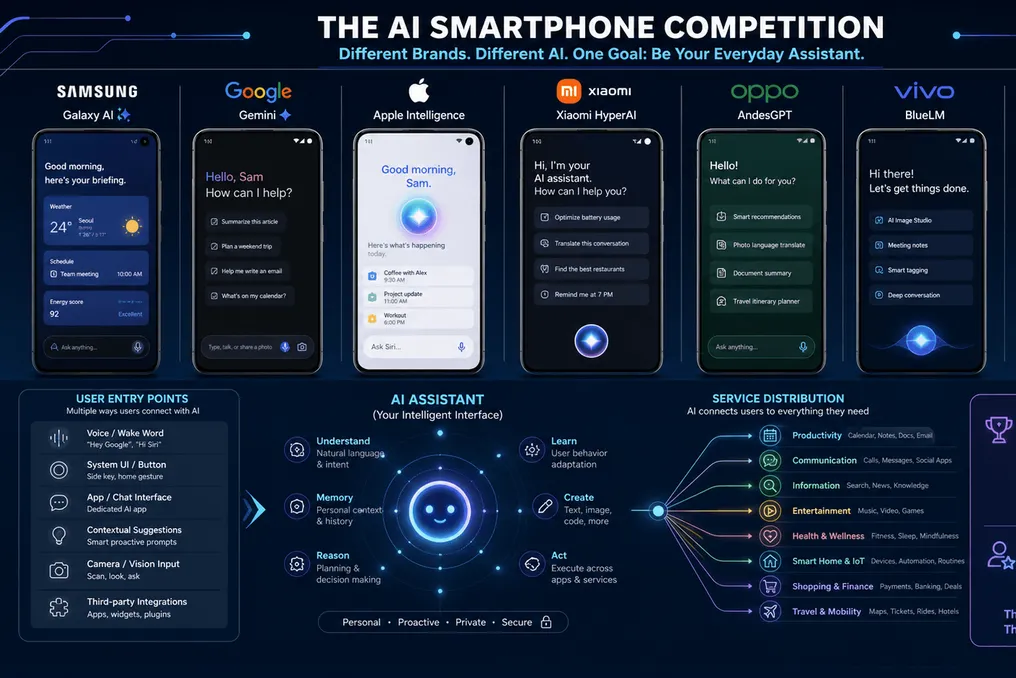
The regulatory aspect acts as the entry ticket. On July 15, seven phone models received approval to apply in China, including Apple Intelligence, OPPO AndesGPT, Huawei Assistant, vivo BlueLM, Xiaomi HyperAI, Samsung Galaxy AI, and Nubia Doubao. The mere filing of an application is a necessary condition, not a competitive advantage. The true competition begins after this approval: can the AI agent reliably interact with system functions, perform cross-application tasks, and manage payment, privacy, and accountability issues without user intervention?
Task execution distinguishes marketing claims from production readiness. ZTE Nubia President Ni Fei described the industry's transition from high-level AI, which merely answers questions, to low-level AI, which immediately provides completed tasks. The category of agent smartphones requires understanding user intent, task decomposition, utilizing the phone's ecosystem and internet capabilities, and delivering a final result. This fundamentally differs from chatbots, which only provide recommendations. For example, ordering coffee without knowing the user's preferences, delivery location, or payment method is a function, not an agent action. True agents remember preferences between sessions and execute actions without step-by-step guidance.
Differences in System Permissions
The most apparent difference between phone manufacturers is the gap in obtaining system permissions. Honor has the ability to open its own phone settings, such as calendar, alarm, schedule, weather, and geolocation, as atomic skills that the AI model can directly invoke. Performing cross-application tasks remains a more complex challenge, requiring cooperation via APIs or simulating clicks from third-party applications. This means that modern AI phones are in a transitional phase: system-native skills truly possess agent properties, while the integration of third-party applications still depends on interface-level cooperation or screen parsing. Companies controlling the OS level gain a structural advantage in creating agents that feel native and reliable.
Service Distribution Strategy
The deepest strategic question relates to the battle for service distribution. If agents can directly understand user needs, filter available services, and complete transactions, super-apps transform from entry points into backend providers. This is a problem of redistributing the value chain, not a technological one. Current demonstrations show that AI phones can order food from Luckin, search on Qunar, and watch Douyin. However, the key question is not whether the AI can open an app, but whether the AI will suggest an independent coffee shop near Luckin. Control over recommendations is a war for the entry point, which will determine whether AI phones become the next platform or remain a thin layer over existing application structures.