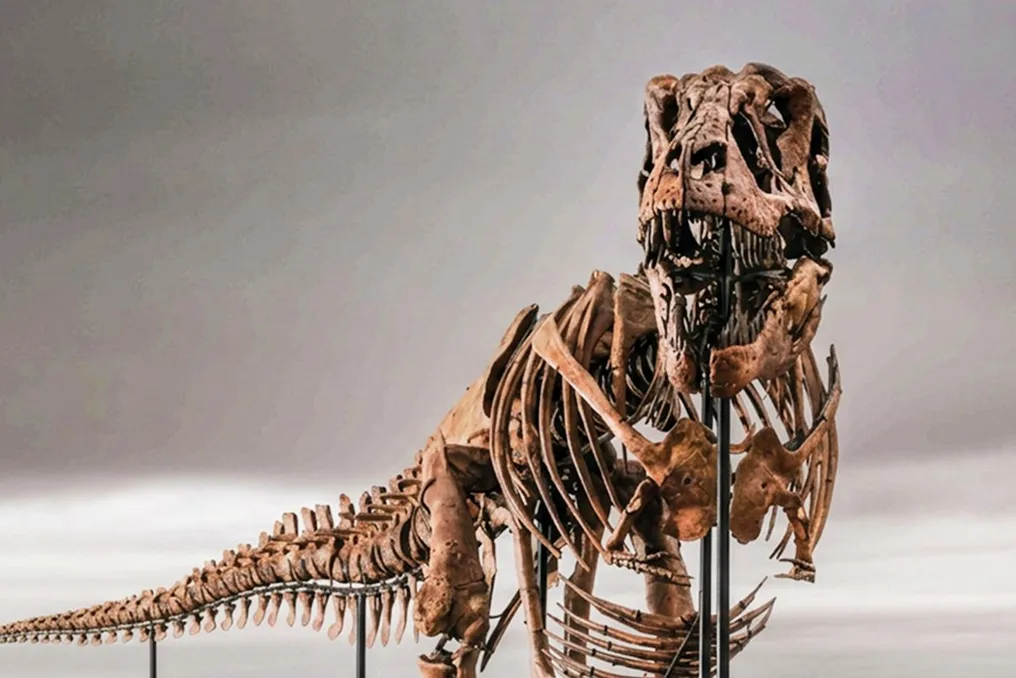
A fossilized Tyrannosaurus rex skeleton, known as "Gus," was auctioned for US$ 50.1 million in an auction held in the United States, setting a new price record for fossils. This specimen, excavated between 2021 and 2023, is considered one of the most complete ever discovered.
Details of the Gus Fossil
Approximately 11.5 meters long, the "Gus" fossil was found in the American state of South Dakota. The fragments were discovered after farmer Gary "Gus" Licking, the landowner, randomly found teeth and bones, which led paleontologists to the site. The excavation revealed 183 T. Rex bones, corresponding to about 61% of the total bones of a complete skeleton, or 75-80% of the bone mass.
Sotheby's, which managed the auction, detailed that the skeleton exhibits several pathologies, including bite marks from a tyrannosaurid on the skull and post-cranial parts, indicating fights or necrophagy. Consolidated fractures were also observed in several ribs, signs of injuries sustained during the animal's life. The estimated age of the fossils is 67 million years.
The Auction and Competition
The auction took place at Sotheby's headquarters in New York and lasted ten minutes. With this sale, Gus surpassed the stegosaurus "Apex," which held the title of most expensive dinosaur fossil since 2024, when it was sold for US$ 44.6 million. The identity of the buyer, who placed the bid by phone, remains unknown.
Scientific Concerns Over Commercialization
Members of the scientific community expressed criticism regarding the commercialization of the specimen, warning that such practices can compromise scientific advancement. The American Society of Vertebrate Paleontology issued a statement arguing that newly discovered fossils of scientific importance should be kept under the custody of public institutions to ensure future research. Scientists point out that when these finds move into private collections without guaranteed access, the chances for research, education, and scientific dissemination can be drastically reduced.
Ben Miller, curator at the Field Museum in Chicago, opined that although the skeleton might end up in a museum, the real risk lies in the high values that incentivize harmful behaviors, such as illegal looting of fossils from public or indigenous lands. He emphasized that while in countries like Brazil and Mongolia fossils are inalienable national heritage, in the US, private owners hold possession of fossils excavated on their properties.
Institutional Position
Cassandra Hatton, head of the science and natural history department at Sotheby's, told AFP that the United States is the only country where fossils like this are considered private property, allowing the landowner to have the right to sell them.