The tenth edition of the International Arbaeen Theatre Festival will feature a wide range of live performances along the pilgrimage route, emphasizing the significance of art as a spiritual and cultural service.
Announcement and Festival Composition
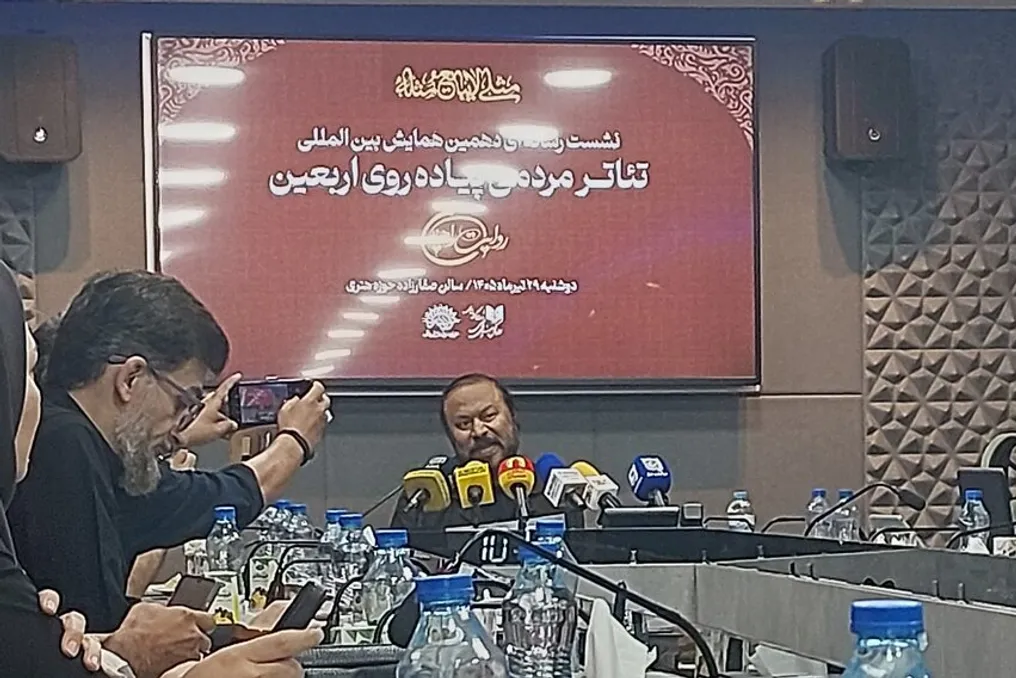
This was announced during a press conference held at the Arts Bureau in Tehran on Monday. Attendees included festival secretary Kurosh Zarei, executive secretary Seyed Mostafa Motorchi, and members of the press.
Kurosh Zarei stated his commitment to improving the quality of the annual event. He reported that out of numerous applications received from various Iranian cities, 13 theatrical works were selected. These pieces cover different genres, including Tazieh (Iranian passion play), Nakkali (traditional narration), street theatre, and puppet theatre.
Venues and Support
The performances are scheduled to be shown at ten key points along the Arbaeen walking route, as well as in the cities of Najaf and Karbala from July 25 to August 5. Furthermore, the festival will deploy a mobile Mukeb to deliver theatrical performances directly to pilgrims.
Zarei noted a significant change in institutional support this year: for the first time, the General Directorate of Performing Arts of the Ministry of Culture and Islamic Guidance is participating. The Cultural and Artistic Organization of the Tehran Municipality has also joined as a partner.
Participation Conditions and International Aspect
A notable feature of the festival is the cultural oath taken by the participating artists. Zarei clarified that all creative groups agreed to participate without receiving payment, viewing their presence as a spiritual offering. Nevertheless, the best group will be presented with a special gift at the closing ceremony.
Addressing logistical difficulties, the festival secretary pointed to a significant increase in transportation and logistics costs in Iraq, which requires support from various collaborating institutions to ensure the viability of the event. He also highlighted the distinct nature of the Iranian productions: while many programs along the route are recorded by Iraqi troupes, all Iranian groups perform live on stage.
Regarding international participation, Zarei explained that there will be no foreign groups in the tenth edition. He explained that although high-quality international applications were received in previous years, the current submissions did not meet the required technical and artistic standards.
He added that the goal is to establish a presence among theatre figures of the Islamic world to expand theatrical communication and interaction between Islamic nations. Forming such a network can pave the way for collaborative creation, experience exchange, and joint production of dramatic works, thereby strengthening the theatrical potential of the Muslim world.
Repertoire Update and Language Restrictions
Motorchi, for his part, noted that the festival's repertoire is updated annually to reflect current events in the Islamic world. He emphasized that the current edition represents a quantitative leap in terms of the number and distribution of venues compared to the previous nine editions.
Although plays were previously staged at the festival in English, Turkish, and Arabic, performances this year will be limited to Persian and Arabic due to regional military conditions and financial constraints. He expressed the festival's long-term aspiration to create works that resonate with pilgrims of all languages and cultures, fostering global artistic connection on the path to Karbala.
Significance of the Arbaeen Pilgrimage
Every year, hundreds of thousands of Iranians travel to the Iraqi city of Karbala to commemorate the sacred day of Arbaeen at the shrines of Imam Hussein (AS), the third Shia Imam, and his brother, Hazrat Abbas (AS). This pilgrimage is one of the largest peaceful gatherings in the world, attracting millions of devotees from around the globe to the heart of Iraq.
Arbaeen, which is observed this year on August 4, marks the end of the 40-day mourning period following the martyrdom of the Imam and his loyal companions on Ashura. Beyond rituals of grief, this event serves as a profound demonstration of unity and brotherhood, as millions of people from different segments of society gather in a shared expression of faith. The route to Karbala transforms into a landscape of hospitality, where volunteers provide food and shelter, reflecting the selfless values taught by the Imam himself.