ZTE has once again won the WAIC SAIL Star award thanks to its OEX supernode, which features a zero-cable design, the ability to connect 128 Graphics Processing Units (GPUs) in a single rack, and a comprehensive artificial intelligence infrastructure covering cloud supercomputers and Nubia agent phones.
OEX Supernode Technologies
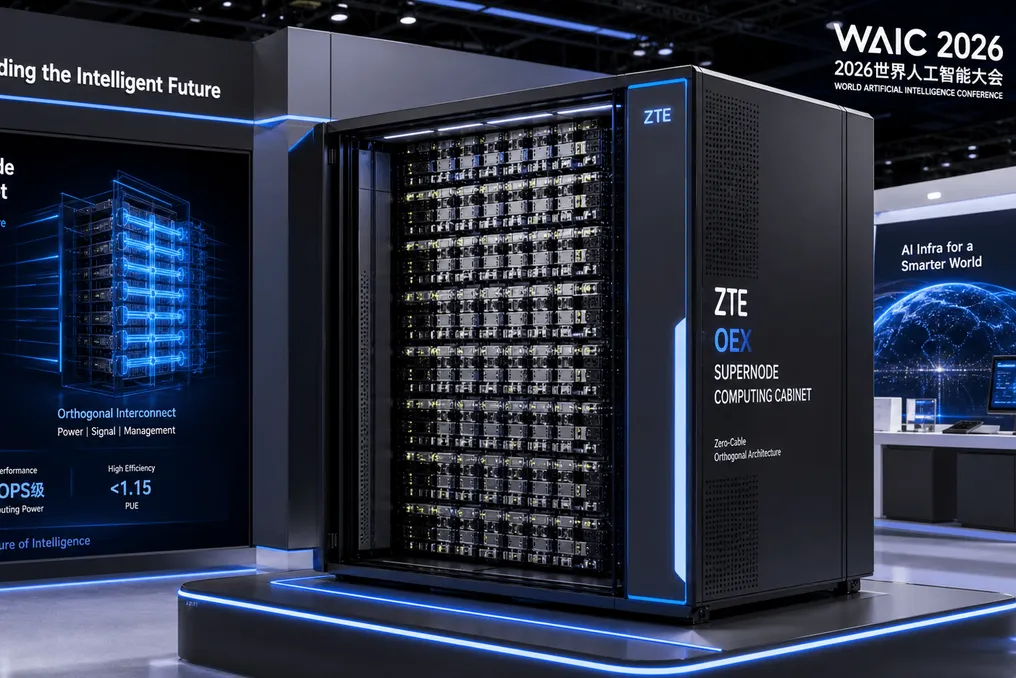
The OEX supernode received the WAIC SAIL Star award for the second consecutive year. It solves the complex engineering challenge of connecting hundreds of GPUs at the scale of data centers while minimizing cable complexity, signal loss, and latency. Thanks to its orthogonal design, where computing racks and switching racks are connected vertically, the OEX supernode provides full interconnectivity for 128 GPUs in a standard rack without internal cables or a rear panel. This significantly reduces signal paths, lowers connection costs, and simplifies maintenance compared to traditional designs.
The architecture allows scaling up to 16,000 GPUs. ZTE developed proprietary chips for in-rack switching that simultaneously support the CLink protocol, overseen by China's Ministry of Industry and Information Technology (MIIT), and Broadcom's SUE protocol. This ensures GPU compatibility independent of the specific chip supplier, preventing vendor lock-in. The five-chip co-probing technology, which includes a Central Processing Unit (CPU), internal server interconnect, inter-rack communication, network card, and DPU, allows the system to dynamically select optimal configurations for different types of GPUs and workloads, making the OEX supernode a flexible platform adaptable to the rapidly evolving domestic GPU ecosystem.
Presentation at WAIC Exhibition
ZTE's exhibition at WAIC was divided into four zones: AI Infrastructure, AI Applications, AI Smart Home, and AI Agent Smartphone. These zones presented a unified concept of AI—from computational power generation to end-user consumption. The infrastructure zone showcased the OEX supernode alongside the AIDC computing power cooperation architecture and the computing network structure.
The applications zone demonstrated the NewStart AIOS operating system, designed for industrial, home, and personal scenarios, as well as the Co-Claw agent corporate platform. This platform is used internally by ZTE to build an AI-managed organization and is replicated for the industrial, railway, mining, metallurgical, and energy sectors.
Smart Home and Agent Smartphones
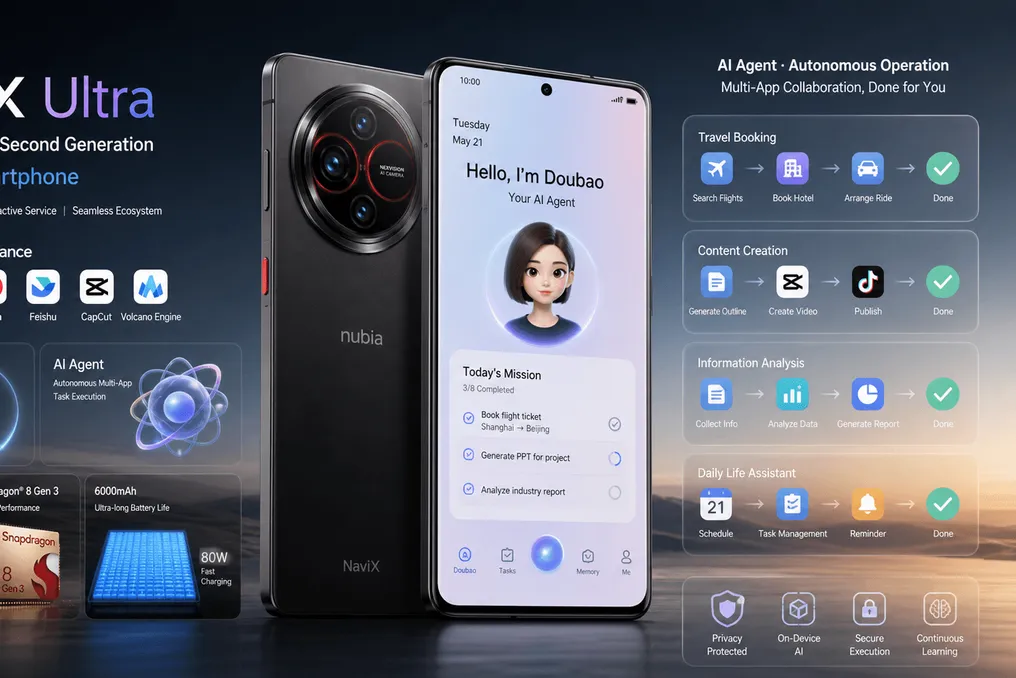
In the smart home zone, ZTE's products for home terminals were displayed, maintaining global market leadership for five consecutive years with over 100 million annual shipments, including 3 million AI-enabled devices. The agent smartphone zone featured the Nubia NaviX Ultra—the world's first production-ready agent smartphone, developed in collaboration with Doubao from ByteDance, which debuted at WAIC. Ni Fei, President of Nubia at ZTE, emphasized that the agent phone category represents the lower half of AI, performing tasks rather than just answering questions, which requires thorough engineering verification of all user pain points, native OS integration, stable manufacturing experience, and privacy assurance.
Additional ZTE Announcements
In addition to the exhibition, ZTE announced achievements in medical AI: generating medical reports with a tenfold increase in efficiency, creating HTA reports in 1–5 minutes, and assisting in cardiovascular disease diagnosis with 96% accuracy based on 10,000 clinical cases. Three humanoid robots were also presented: Xingzai, weighing 30 kg for commercial services; the heavy-duty Xinqing for industrial manufacturing; and the wheeled Xinwang. All operate on the Star Core automotive chip with the dexterous Xingqiao hands, achieving precision below 0.2 mm.