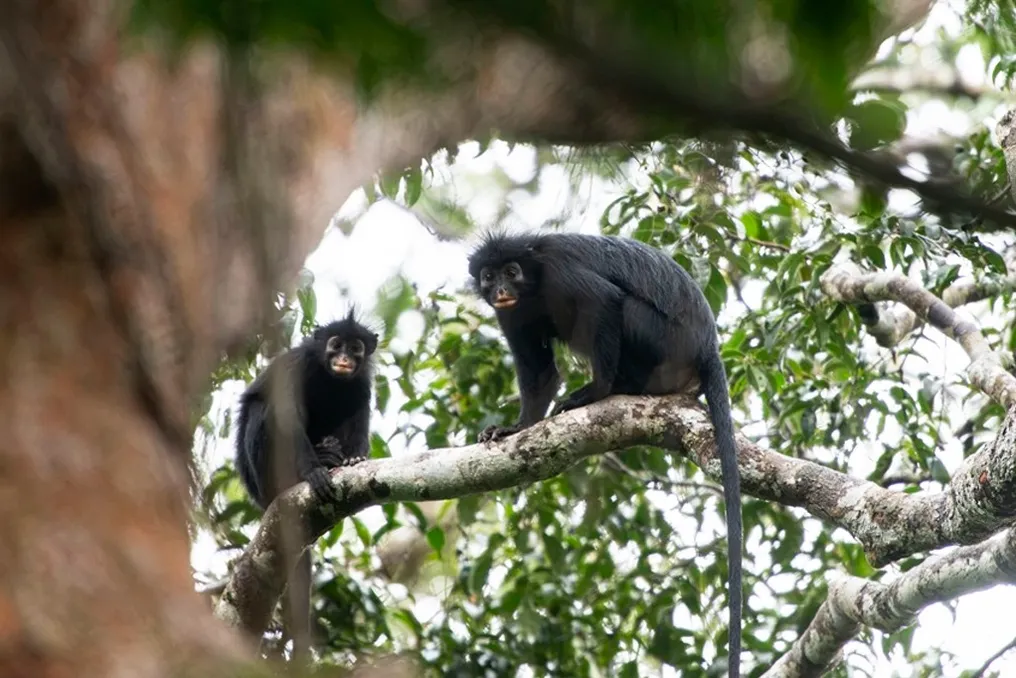
A new and rare monkey species, named Colobus congoensis, was formally described by scientists after years of research in one of the most biodiverse areas of Central Africa. This primate, known locally as Likweli by the Balanga people, has a notable characteristic: its deep croaking resembles the sound of a frog.
Discovery History
The identification of this novel animal occurred after prolonged investigations. The first record of the monkey dates back to 2008, when researchers from the Lukuru Wildlife Research Foundation were on an expedition in the forest that is now part of Lomami National Park. At that time, a blurry photo of a black-furred monkey in the tree canopy was captured, raising suspicions about its uniqueness.
The animal remained unknown for ten years. In 2018, researcher Jean Pierre Kapale led a new patrol and obtained a clear photograph of the monkey, characterized by dark, disheveled fur, a very long tail, and pale markings around the mouth. This triggered a deeper investigation, resulting in seven additional photographs in the following months, which confirmed it was the same individual seen in 2008.
Field Research and Observations
The searches extended until 2022, covering humid forests located between the Lomami and Congo (Lualaba) rivers, a biologically crucial region in Central Africa. A total of 114 observations were made in an area of approximately 1,700 km², comparable to the municipality of São Paulo.
Researchers consulted residents of 52 local villages regarding primates they recognized. The description of the rare species was provided in only eight of these villages. Among the Balanga, the name was Likweli, while in the Mituku communities, it was called kasaba nkoni, which means something like 'that which shakes the branches.'
Scientific Analysis and Classification
Field observations indicated that the primate possessed four fingers on each hand, including small thumbs, suggesting it might belong to the subfamily of colobines, known for being social frugivorous monkeys. To prove its novelty, genetic tests were conducted in the laboratory using specimens seized from hunters by the National Park guards.
Genetic tests confirmed that the species belongs to the genus Colobus and revealed a relationship with Colobus satanas, which lives about 1,200 km away, in central-western Africa. The two species are believed to have diverged evolutionarily approximately four or five million years ago, coinciding with the similarity of their vocalizations.
Additionally, morphological analyses of the skull, teeth, and face helped confirm the new species. Scientists named the new monkey Colobus congoensis, in honor of the Congo Basin where it was found.
Physical Characteristics and Conservation
The Colobus congoensis is an animal covered in dark fur, which can appear shiny depending on the light. Its face features dark coloration, prominent facial contours, and intense black eyes, giving it the appearance of a mask. It has a long tail, large ears, and weighs just over 5 kilograms, making it lighter than other members of the genus Colobus.