Families from Abu Dhabi are transforming social assistance programs into sustainable commercial enterprises by utilizing traditional Emirati crafts. Initial temporary financial support can become the foundation for a family business.
Community Fair and Economic Development
This concept is at the heart of the 'Community Market,' organized by the Abu Dhabi Department of Social Support (ADSS). Twenty-one beneficiary families participate in this fair, showcasing a wide range of goods: from handmade and crocheted items to chocolate and specialty coffee, aiming to secure a stable income instead of complete reliance on financial aid.
The three-day fair, held at Nabdh Al Falah Center and running until July 19th, is the first series of an initiative that ADSS plans to make a regular part of its broader economic empowerment program. Kassem Al Hashimi, Executive Director for Beneficiary Affairs at ADSS, noted: 'We provide temporary financial support, but we also offer programs that help beneficiaries achieve economic self-reliance.'
Approach to Entrepreneurship
According to Al Hashimi, the program was launched in response to growing interest among beneficiary families. Participants were selected and trained, and now they are displaying their achievements. He emphasized that in the initial phase, the program intentionally covers diverse activities—from food products and crafts to artistic items—to allow everyone to showcase their skills, with specialization developing later.
Al Hashimi clarified that the program's goal is long-term movement toward financial independence, not immediate sales assessment. He added that while the focus is currently on exhibition, close collaboration with these families will continue in the future to further develop their competencies.
Modern Interpretations of Traditional Crafts
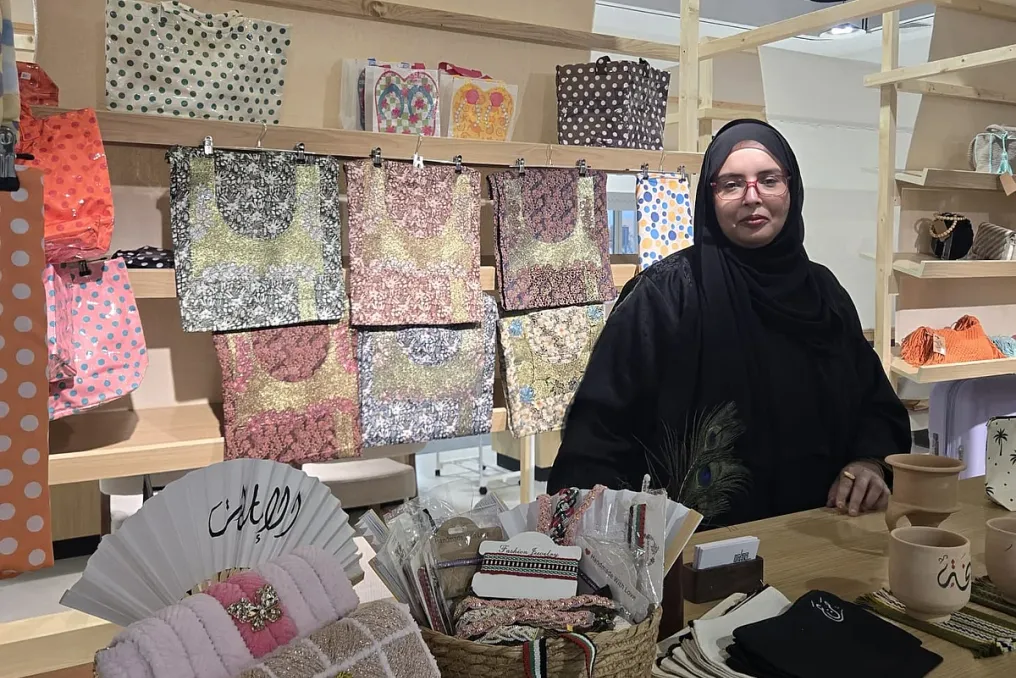
Among the entrepreneurs is Mariam Al Nuaimi, founder of Rowayb. Her stall combines Arabic calligraphy with traditional Emirati Sadu weaving in modern design. Initially studying geospatial information systems, Al Nuaimi began learning calligraphy seven years ago and then expanded her scope to crafts about four years ago. What started as requests from friends and relatives for personalized gifts gradually turned into a business.
Today, she handwrites on ceramics, fans, medals, and other surfaces, and also transforms traditional Sadu weaving into vibrant bracelets, keychains, and accessories. She noted that although older women usually handle Sadu, she wanted to present it in a modern form using different colors appealing to youth. Her business is less than a year old, but it is already attracting attention due to the fusion of heritage and modern design. She thanks the social support authority for providing the opportunity to exhibit her work free of charge after obtaining a home business license, mentioning that her daughters, aged 15 and 11, also help her.
Crochet as a Form of Therapy
At a neighboring stall, crochet has become more than just a business for 45-year-old Amna Al Mehairi—she calls it therapy. The founder of Amoon Crochet shared that she struggled with concentration issues throughout her life and stopped working in 2018 after a difficult divorce while raising four children, including a son with autism.
The situation changed about a year ago when she and her daughter-in-law, who had survived cancer, decided to learn crochet. Amna said she wanted to bring joy to her daughter-in-law. In one year, the hobby turned into a business producing colorful bags, children's blankets, and accessories made from premium Egyptian cotton, which she imports herself due to the inability to find the desired quality in the local market. However, according to her, the biggest change happened on a personal level. 'It taught me to focus. It reduced my anxiety and anger. It gave me good company, people who are always learning something useful.'
She now views crochet as a form of therapy that helped restore self-confidence while creating a source of income. She also hopes that more people will begin to understand the true value of handmade items, pointing out that people often do not see all the effort involved in selecting materials, designing, and creating every stitch by hand.
From Job Seeking to Daily Orders
Suhail Al Mazroui began entrepreneurship after months of unsuccessful job searching. Unable to find employment, he decided to create his own opportunity by opening a small cafeteria in Al Ain, where he sold burgers and fast food. However, the business did not take off. He realized that people crave food reminiscent of home. He made the difficult decision to completely abandon the initial concept and relaunched the venture under the name Suhail Mahashy, specializing in stuffed grape leaves, cabbage rolls, and other traditional dishes.
This risk paid off almost immediately. Daily orders increased from approximately 10–15 as a fast-food establishment to 50 or even 60 after switching to homemade traditional meals. He concluded that sometimes you need to change direction instead of giving up, and now hopes to expand operations beyond Al Ain.
Family Brand of Homemade Sweets
Chocomail is a prime example of a family enterprise. What started as homemade chocolate prepared in the family kitchen grew into a brand available in Adnoc Oasis stores across the UAE, and is now also available in Qatar and recently expanded into Saudi Arabia. Co-founder Mohammed Al Hosani explained that the business arose not from a formal business plan, but from a series of family gatherings. 'We all sat together like one family. Everyone contributed ideas.'
One relative, without formal culinary training, possessed an exceptional talent for developing and tasting chocolate recipes, while another family member regularly traveled to Switzerland and Belgium to study new flavors and techniques, bringing ideas back to the UAE. Al Hosani stressed that it was a 'true family effort.' Even choosing a name took weeks until a favorite emerged from nearly twenty options—Chocomail. The concept is inspired by handwritten letters: the chocolate is packaged in vintage envelope-shaped boxes designed like postage stamps, serving as a nostalgic nod to times when messages arrived by mail, not phone.
Initially, the chocolate was produced at home and sold online without a commercial license. 'When demand grew, we realized we needed to formalize it,' said Al Hosani. Six years later, the company has its own production facility in Abu Dhabi and supplies products to ADNOC Oasis stores from Fujairah to Al Seef, continuing to develop new flavors and packaging.
Innovations in the Floral Business
Nearby, 15-year-old Saif Al Jadi proudly presented the newest addition to the family business—colorful toys, keychains, and custom accessories printed on a 3D printer. The idea came during a trip with his mother, Samira Al Blushi, to China. While she was looking for new floral designs and gift ideas for her flower shop, Lemas Flowers, Saif was fascinated by rows of 3D printers creating intricate models. 'I saw this idea there and wanted to do the same.'
Upon returning to the UAE, he acquired a 3D printer and spent months learning how to design, modify, and print items, from miniature airplanes to personalized car accessories and decorative elements. The Community Fair became the teenager's first public exhibition. His mother noted that entrepreneurship has always been part of her life: she started arranging bouquets in primary school, winning school competitions before fulfilling her childhood dream of opening her own flower shop right after middle school. For the last 15 years, she has managed Lemas Flowers in Al Ain, regularly visiting China in search of new ideas and products. 'I took Saif with me, and he found something completely different. Now we help each other.'