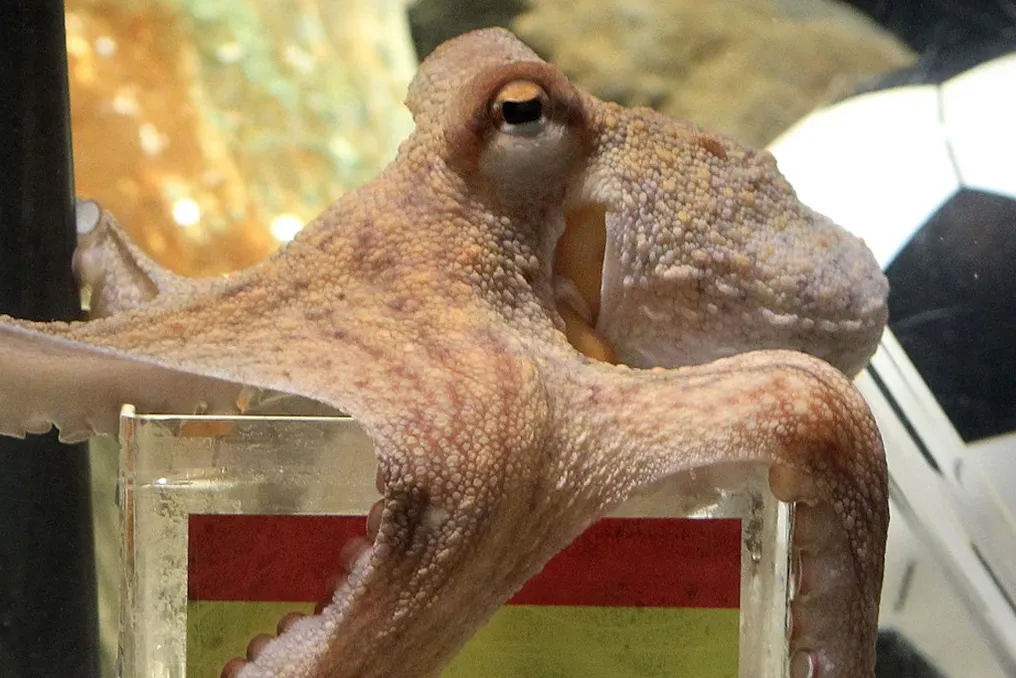
Researchers discovered that a structural modification in ribosomal molecules, the cellular machinery responsible for protein production, allows shallow-water octopus species to generate proteins with significantly fewer defects and toxic aggregates.
Researchers discovered that a structural modification in ribosomal molecules, the cellular machinery responsible for protein production, allows shallow-water octopus species to generate proteins with significantly fewer defects and toxic aggregates.
Almost all biological processes depend on proteins. These include enzymes that catalyze vital reactions, antibodies that defend the organism against invaders, hormones that communicate between cells, as well as substances like collagen and elastin that provide structure to tissues.
The synthesis of these complex molecules occurs inside cells through ribosomes. These constantly work weaving chains of amino acids, which, after folding, transform into functional proteins. However, occasionally, defective batches are produced, resulting in the entanglement of misshapen proteins into toxic aggregates.
Although this problem can occur in any organism, octopuses demonstrate stricter quality control. A new study points out that certain octopus lineages possess a unique genetic mutation that enables much more precise protein synthesis, with a drastic reduction in errors. This adaptation is thought to have emerged about one hundred million years ago, coinciding with the development of a more sophisticated nervous system in these animals.
The research was conducted by scientists from Harvard University and is available on the bioRxiv platform as a preprint, awaiting peer review for publication in the journal Current Biology. The mutation was located in RNA molecules, specifically in a gap in ribosomal RNA (rRNA), which organizes protein assembly in the ribosome.
The fundamental process of protein manufacturing is universal: DNA stores the instructions, which are transcribed into messenger RNA (mRNA) and carried to the ribosomes for synthesis. rRNA acts by connecting amino acids. While many parts of rRNA are identical across all species, this is not the case for certain octopuses.
The discovery occurred incidentally during a routine test with RNAs. When analyzing the RNA of the shallow-water species *Octopus bimaculoides*, a student of biologist Amy Si-Ying Lee, who coordinated the study, observed an unusual division in the ribosomal RNA band, unlike what would be expected in other living beings.
Since ribosomes are made of proteins and RNA, the instruction for this alteration must be in the DNA. The team managed to identify the mutation in the genes responsible for rRNA division, which occurs in the central core of the ribosome, at the point where each amino acid is linked to its instruction. Despite this, the ribosome maintains its functionality.
To determine the function of this breakage, researchers introduced the same mutation into *Escherichia coli* bacteria, which resulted in a noticeable improvement in precision. The error rate of bacterial ribosomes was halved, and the key lay in quality control: octopus ribosomes are more selective about which proteins to discard and have lower tolerance for incorrect amino acids incorporated during synthesis.
Additionally, the mutation facilitates the correct processing of mRNA sequences that have undergone editing. Cephalopods, such as octopuses, edit their own RNA more than any other known creature, allowing adaptations to different temperatures without altering the DNA. However, this RNA editing increases the risk of defective proteins; the rRNA breakage helps mitigate this risk.
By examining other species, scientists found this characteristic in more than 15 types of shallow-water octopuses, but not in any of the 12 deep-sea octopus species. This suggests that the rRNA breakage arose alongside an evolutionary split more than one hundred million years ago, when octopuses divided into Incirrata (shallow-water lineage with a complex nervous system) and Cirrata (deep-water with simpler nervous systems).
Researchers speculate that this change in the ribosome could have been beneficial for species with expanding brains, preventing toxic protein aggregates that could damage neurons. However, it is not yet possible to confirm whether brain development was the cause of this newly discovered genetic mutation.
Despite the passion for V6 engines and the characteristic sound of combustion vehicles, physics demonstrates the superiority of electric cars due to their remarkable efficiency. Electrified vehicles have become more attractive, presenting lower operational costs per kilometer traveled, more accessible maintenance, reduced emissions, silent operation, and exceptional torque.
Batteries are evolving, becoming lighter, offering greater autonomy, and decreasing in cost, largely thanks to Chinese production. Although some advocate for maintaining the internal combustion engine in luxury sports cars, such as those made by Ferrari, Porsche, or Aston Martin, the electric vehicle is not behind in terms of performance, delivering torque equal to or superior to traditional engines.
However, the author argues that the main focus should not just be on performance, but on efficiency. The inefficiency of the internal combustion engine is glaring: it wastes between 60% and 70% of the energy contained in the fuel through friction and heat, in addition to generating environmental pollution.
In contrast, the electric motor manages to deliver between 90% and 95% of the energy it receives to the wheels. While current Otto or Diesel engines convert only 30% to 40% of the chemical energy from the tank into mechanical energy, the difference is substantial. Furthermore, Chinese companies, such as BYD and Dongfeng, are achieving efficiencies in gasoline engines considered unattainable, with 46% and 48%, respectively.
Although there are barriers to the total adoption of electric vehicles, such as battery cost and weight, temperature sensitivity, and charging points, these difficulties are being overcome rapidly. The author points out that the third phase of electric vehicles began just over ten years ago, but the first models circulated in the late 19th century, even before gasoline cars.
The electric vehicle only lost the competition to liquid fuel due to battery range limitations, a problem that persists today. Historically, women rejected the arrival of the gasoline car because they lacked the strength to operate the engine with a hand crank and disliked the smell of exhaust. Despite taking almost 150 years to consolidate, the electric vehicle became irreversible, mainly due to its incomparable thermal efficiency.
Many companies prefer to rent AI-based solutions instead of building their own business assets. While most enterprises can track AI expenses, few can accurately determine the return on investment.
According to Paul Domanski, founder of the AI system developer Cape Town Domanski.AI, the lack of quantitative measurement of results has been the biggest problem in the AI industry. Instead of selling standard subscriptions or generic training, Domanski launched the In-Seat AI methodology. This methodology installs custom-developed AI systems directly into existing employee roles, allowing organizations to restore production capacity, retain institutional knowledge, and, crucially, own the created AI systems and intellectual property.
Paul Domanski states, 'Too many companies are renting AI instead of building business assets.' He explains that their model is simple: 'We embed AI into people, not replace them. Repetitive work is automated while human judgment remains under full control. Most importantly, the client owns the AI workflow we built specifically for their business.'
The financial implications of this approach are measurable. In one early example, it was found that one repetitive workflow consumed between 128 and 240 person-hours annually in a seven-person organization. Using an average annual employment cost of R600,000 per employee, this equates to approximately R37,000 – R69,000 in annual costs for one routine business operation.
Domanski.AI focuses not on replacing staff but on freeing up that time to perform higher-value tasks. This allows experienced employees to concentrate on revenue generation, strategic decision-making, and client interaction, rather than engaging in routine administrative work. Unlike traditional AI consultants or software vendors, Domanski.AI transfers ownership of each custom-developed AI system to the client. The business continues to use the preferred AI platform, but the workflow architecture, business logic, institutional knowledge, and role-specific information remain the client's intellectual property, not another vendor's subscription product.
Domanski emphasizes that AI is transforming from an operational expense into a long-term business asset because companies do not have to rely on someone else's proprietary systems to access their own organizational knowledge. The methodology has already been tested in real-world scenarios. During a four-hour implementation workshop with Mack Brands, an AI system built on the company's own files generated a customized distributor presentation of 10–15 slides. This system successfully rejected intentionally introduced false information through evidence verification mechanisms and allowed the team to create a second AI operational agent during the same workshop.
Emma Kendrick Cox, Global Marketing Director at Mack Brands, noted: 'By lunchtime, three managers in my department had already asked Paul to conduct individual sessions to build AI around their own workflows.'
A second example involved LiquidGold, a three-person direct-to-consumer business. After a 72-minute remote implementation, a marketing process that had stalled for two years was transformed. The company received a functioning Facebook ad scheduler, numerous ad copy options, campaign images, video content, and a complete campaign deployment checklist, with ad variations being generated in less than five minutes.
Domanski carefully distinguishes between measurable performance and exaggerated AI claims. He states: 'We do not promise miracles. We measure the workflow time before and after implementation, correction rates, quality improvements, and whether the recovered capacity is redeployed into productive work. These are metrics that executives and CFOs can verify.'
The process begins with a four-hour Foundational Workshop, where Domanski works with leadership teams to identify high-value repetitive workflows, create a functional AI prototype using the company's own data and processes, and develop an implementation roadmap. Organizations moving to full-scale deployment receive a credit for participating in the workshop as part of the implementation program.
Although the first documented implementations focused on marketing and creative teams, the methodology applies to any repetitive, knowledge-intensive workflow in finance, HR, operations, customer service, compliance, and sales. According to Domanski, as South African organizations move beyond AI experimentation, the competitive advantage will increasingly belong to those enterprises that can demonstrate measurable productivity gains and retain ownership of the systems generating that productivity. He concludes: 'The future will not belong to the companies buying the most AI subscriptions. It will belong to those who own the intelligence embedded in their own business.'