There is excitement in Haryana surrounding the train, dubbed the 'Paani waali train' (water train), which marked the beginning of India's journey into hydrogen transport. The city of Jind is decorated with hundreds of banners featuring images of Prime Minister Narendra Modi and ministers from the central and Haryana governments, while local roads have recently been beautified and repainted.
Inauguration of the First Hydrogen Train
The renovated Jind station, which hosts vibrant cultural performances, is bustling with crowds eager to ride the 'Namo Green Rail'—India's first hydrogen train. Local residents note that previously, the train on the Jind-Sonipat route (89 km) was not a popular choice, even though the ticket cost was only a quarter of the bus fare (25 rupees versus 100 rupees).
Technical Specifications and Operation
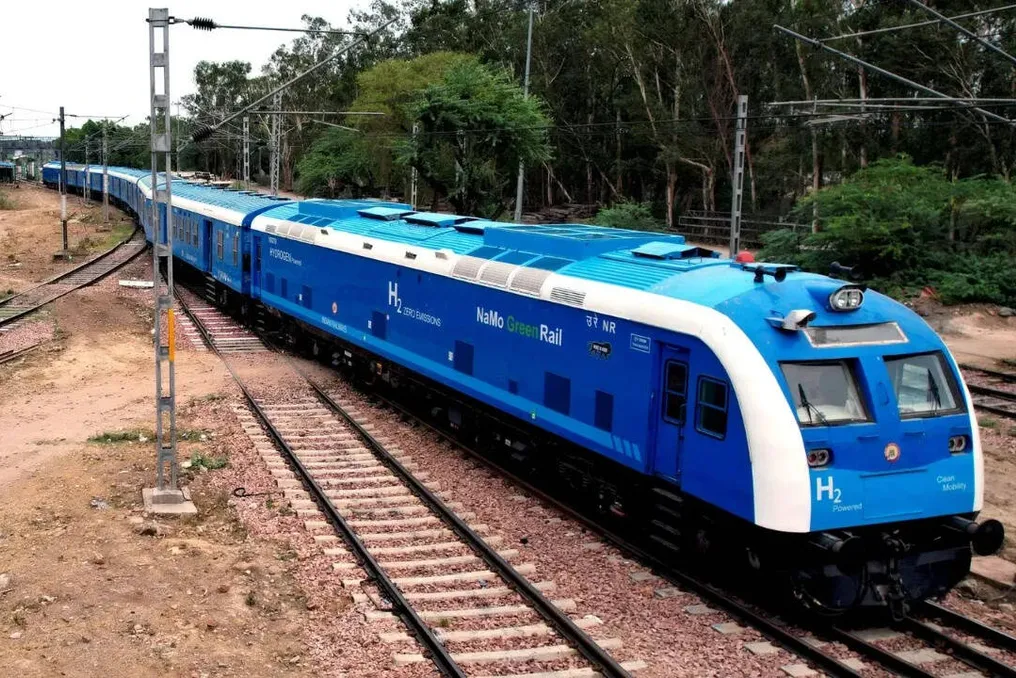
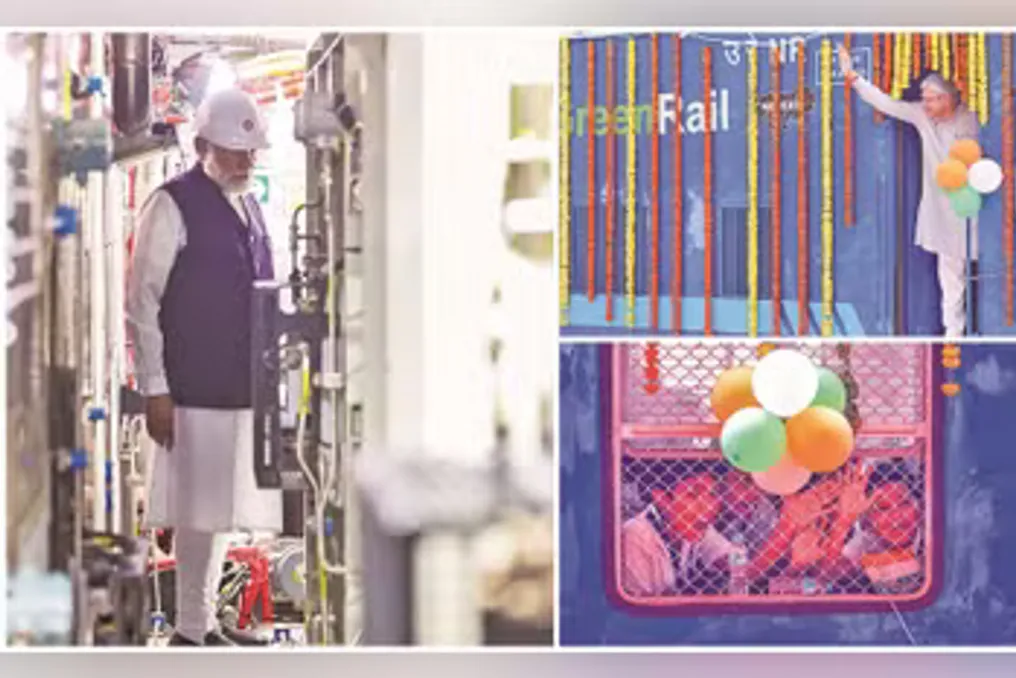
The bright blue, 10-car train is adorned with flowers and tricolor balloons bearing the inscriptions 'Hydrogen Powered' and 'Namo Green Rail'. According to railway information, it is equipped with a small power plant in the form of a proton exchange membrane fuel cell. Hydrogen stored in cylinders is mixed with oxygen from the surrounding air inside the fuel cell, generating electricity for the traction motors. Only water vapor remains as a byproduct of the train's operation.
The locomotive driver Chandrakant Kumar and all train staff are dressed in new uniforms. They completed two weeks of training courses in Chennai and at the Shakurbasti depot in Delhi, where they studied the technical aspects of the train. According to Kumar, refueling at a nearby hydrogen plant takes four hours. This plant can store about 3000 kg of hydrogen, which is supplied through two independent dispensers at a regulated pressure of 350 bar.
Range and Safety
Kumar specified that on the Jind-Sonipat route, two round trips can be made with a full tank, which contains about 220 kg of hydrogen in each power car. By his rough calculation, the train covers about 360 km on 440 kg of hydrogen, achieving a maximum speed of 75 km/h. Nitin Parekh, one of the launch managers, explained that the 75 km/h speed is due to the permitted speed restrictions on the tracks, although the train could travel up to 110 km/h if the tracks allowed it.
Since hydrogen is flammable, the railways have implemented safety systems certified by international agencies. Kumar assured that in case of a leak or safety issue, the engine automatically shuts down—a protective mechanism built into the train.
Prospects and Economic Issues
After receiving the green light from Prime Minister Modi, the train slowly departed from the platform, showing passengers unconditioned carriages on a sunny day. In his address in the city, Modi stated that the current journey is 90 km long, but there are huge opportunities for expansion in the future. He emphasized that research into ways to reduce costs and increase efficiency will continue.
Modi also noted that with the growth of the hydrogen economy, the storage facility will become a source of employment for the local population. However, residents point out that at the initial stage, only railway employees and related specialists are working there, and local employment is currently minimal.
Views of Residents and Experts
Despite generally smooth operation, by the time it arrived at Pandu Pindara station, the newly painted seats began to peel, leaving a dark blue-black layer of paint and rubber on passengers' clothes. Residents hope that this notoriety will bring prosperity to Jind.
Sandeep Kumar, who managed to board the train with his family, believes this represents the future of rail mobility. He notes that Jind has seen development over the past two weeks due to the visit, although agricultural income in the region is declining, and there is a need for an industrial zone.
Experts agree that cost issues must be resolved to advance the clean mobility economy. Kuljit Singh from EY India believes the technology is viable, albeit more expensive than electric counterparts. Scaling this technology requires the creation of specialized hydrogen storage infrastructure and adherence to strict safety protocols. He added that the government should provide subsidies and integrate this with initiatives to procure green hydrogen in India so that hydrogen can play a significant role in India's transition to clean transport.