Last Friday, Xi Jinping positioned Beijing as a defender of a new world order in the field of artificial intelligence. During a prestigious Chinese technology conference, he actively promoted open-source technologies and challenged US influence regarding the regulation of this rapidly evolving industry.
Address at WAIC Conference
Speaking at the opening ceremony of the World Artificial Intelligence Conference (WAIC) in Shanghai, Xi called on countries to take advantage of the 'rare and historic opportunity' of open AI. He also pledged support to developing nations in advancing AI capabilities, warning against the threat of 'new historical injustices' due to unequal access to this technology.
These statements represented the clearest articulation of China's ambitions to shape global AI governance. Xi presented his open-source models as a public good for the entire world, positioning Beijing as an alternative to Washington at a critical juncture in the race for technological leadership.
Vision for Global Cooperation
Comparing the significance of AI to the invention of the steam engine and electricity, Xi outlined his vision wherein China would share AI technologies and experience with Global South nations while leading global efforts to establish standards for this new technology. His initiative with the AI coalition was presented as a competitor to the international initiative led by the US, known as 'Pax Silica,' aimed at securing global AI supply chains and critical minerals, although Xi avoided direct mention of Washington.
AI Competition and Security
Xi's comments came amid the rapid progress of Chinese open-weight AI models against the proprietary systems of American companies such as OpenAI and Anthropic. On Friday, the Beijing-based startup Moonshot AI unveiled Kimi K3, which was named the largest open-source AI model by parameter count. This occurred a month after the US government abruptly withdrew advanced Anthropic AI models due to safety concerns.
Furthermore, Xi insisted that AI systems must remain under human control, urging countries to create early warning and emergency response mechanisms to manage AI risks. He also emphasized the need for measures to prevent loss-of-control scenarios, warning about the dangers of autonomous AI systems that might evade human oversight and control.
China's International Partnership
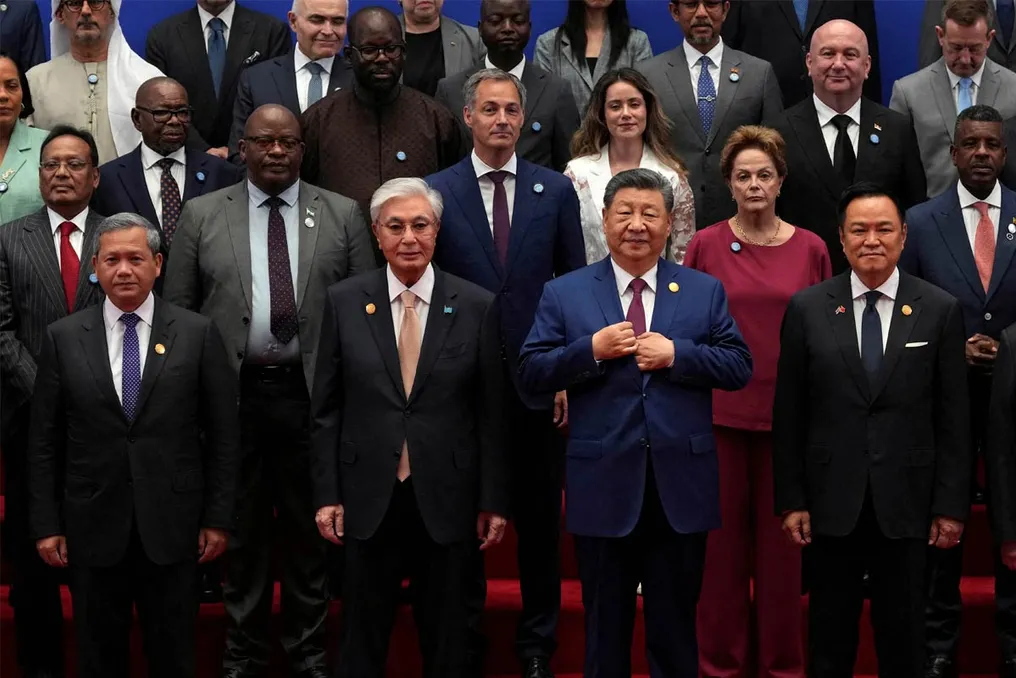
Xi stated that the China AI Cooperation Organization, established in China and adopted by 29 member states on Thursday, marks a 'milestone in the development of global AI' and meets the demands of Global South countries for more active participation in AI governance. Moreover, Xi announced that China would provide AI training and develop AI cooperation centers with BRICS, ASEAN, Latin America, and the African Union countries, thereby aligning China's diplomatic initiatives in AI with major Global South blocs where China already holds significant influence.
George Chen, Head of Digital Practice at the consulting firm The Asia Group, noted: 'Xi's message is clear: China does not intend to follow anyone, neither in AI technologies nor in standards. Instead, China intends to lead the world in both aspects.' He added that Xi's message is a statement that can also be viewed as a warning—China will not allow anyone to dictate how it uses AI.
Prospects of Geopolitical Rivalry
The event, running from July 17 to 20, takes place against the backdrop of Washington and Beijing preparing for the first bilateral government-level negotiations on AI under the administration of US President Donald Trump. This transforms WAIC from an industry exhibition into an early test of how China plans to compete for influence in global AI regulatory rules. Last week, the two powers presented competing concepts during the UN AI dialogue, where US representatives argued that excessive regulation could slow innovation, while China promoted its low-cost open-source models as a tool to reduce global inequality in AI access.