During a rainy morning while Chintu was at home, his heart and mind offered completely different answers to the same question. His heart urged him to stay and enjoy the puddles, while his mind reminded him that it was a school day. This seemingly simple dilemma sparked a lively discussion among over 140 students at Saraswati Inter College in Loni, Ghaziabad, who participated in an interactive critical thinking session.
Learning Format and Initiative
This exercise was part of the Times Critical Thinking Championship (TCTC), an initiative by TOI inspired by the Times Foundation. This program aims to implement inquiry-based learning in schools across the country. Instead of a traditional lecture, the session transformed the classroom into a platform for reflection and debate. To illustrate the situation, three students were invited onto the stage, playing the roles of Chintu, his heart, and his mind.
Developing Analytical Skills
As the trainer presented various scenarios and questions, students actively raised their hands, offering diverse opinions and defending their choices. Each answer served as a starting point for deeper discussion. Students explored the differences between facts and opinions, assumptions and conclusions, and discussed how decisions are made under the influence of evidence, logic, and perspective. The focus was not on finding a single 'correct' answer, but on encouraging questioning, analysis, and justification of thoughts.
The interactive format helped many students better grasp these concepts. Eighth-grade student Vaishnavi noted: 'We learn so much from these classes because they are so interactive.' She added that by using critical thinking, one can find a solution to any problem because there are multiple ways to approach a task.
Audience Engagement Methods
Initially, the children were hesitant, and the front rows remained empty. However, this shyness gave way to enthusiasm after a warm-up round that included eye-hand coordination exercises, which made the students laugh, participate, and gradually become accustomed to the trainer. Then, the trainer used another trick: he wrote '2025' on the board. Instantly, many hands shot up, and the students shouted: 'It's 2026.' This deliberate 'mistake' was intended to spark curiosity, and it worked. This was followed by a continuous stream of questions, observations, and counterarguments from the students, turning the classroom into a living discussion instead of a one-sided lecture.
Rajiv Mishra, who conducted the session, explained that such an approach helps maintain interactivity. He stated: 'It is a way to make the session interactive. Students must express themselves and communicate with me. Only then do they not get bored and can understand the concepts better.' According to Mishra, no session is the same because the teaching method depends on the situation, age, and class of the students, although the goal remains unchanged—to make them think, rather than just telling them the answers.
Educators' Views and Practical Application
The impact of this approach is also noticeable for the school's teachers. School Director Rocky Kaushik emphasized that before drawing any conclusions, students must learn to ask questions, study facts, and apply their own logic. These classes promote the development of this process in an engaging manner. In addition to improving analytical abilities, they also strengthen self-confidence and communication and presentation skills, as students learn not only what is taught but also how it is presented.
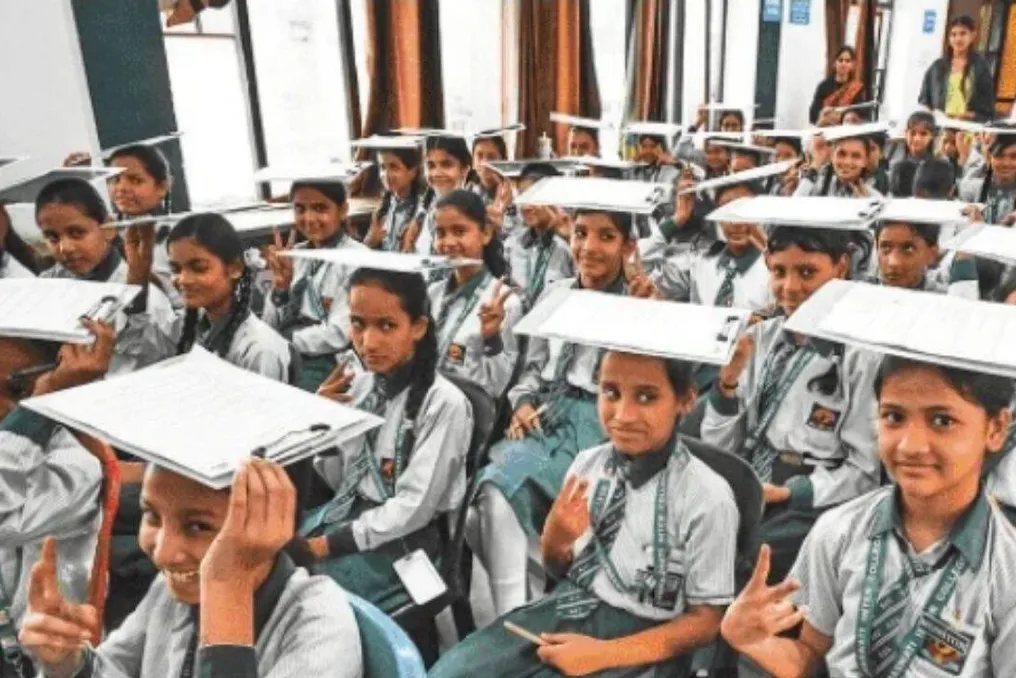
At the end of the session, students were given a worksheet with ten scenarios for questions written in Hindi and English. This assignment required them to apply the learned concepts: distinguishing between facts and opinions, identifying assumptions and conclusions, and using reason rather than instinct to arrive at an answer. The class, which had previously been full of discussion, fell silent as students leaned over their papers. After a few minutes, they took turns placing their boards on their heads—a playful signal understood by both the trainer and the class—that the work was complete.
Manasi Saxena, an English teacher and program coordinator at the school, noted that these classes stand out because they move away from the routine classroom format and encourage participation. She added that the students really like them because they are interesting and interactive. For many students, the takeaway went beyond the worksheet. Sixth-grader Navya said: 'We must think rationally before believing or making any decision.' Citing the common superstition about a flipped slipper leading to a fight, she added: 'People say if a slipper is upside down, there will be a fight. But if there is no evidence, it's just a superstition.' Another student, Ishika, reported that the session taught her to look at everyday situations in a new light.