Celestial Return is a story RPG that stands out for its cyberpunk setting and strong narrative component, making it recommended for those who appreciate games with a lot of reading. Although it is available at an affordable price, players might feel discouraged by the limited paths the title presents.
Game Setting and Story
The plot unfolds in the decaying city of Netherveil City, where neon-lit streets hide mysteries and unexplained deaths. The player takes on the role of Detective Howard, equipped with a worn badge and assisted by a conscious rose named Rose. He begins an investigation that leads him through various locations, including bars, sewers, and cemeteries, addressing themes such as the importance of art and resistance under an oppressive regime.
Celestial Return Details
This story RPG falls into the cyberpunk noir genre. It was created by Metaphor Games and released by Shoreline Games on July 14, 2026, initially only for PC via the Steam platform, costing US$ 14.99. Versions for PlayStation, Xbox, and Nintendo are expected to arrive in early 2027. The main campaign is concise, spanning three chapters and requiring between four to six hours to complete on the first playthrough.
Similar to Disco Elysium, the game prioritizes extensive dialogue and conversational investigation over physical action. However, Celestial Return innovates by replacing traditional dice rolling with its own system, which constitutes both its strength and its complexity.
Visual Style and Sound Immersion
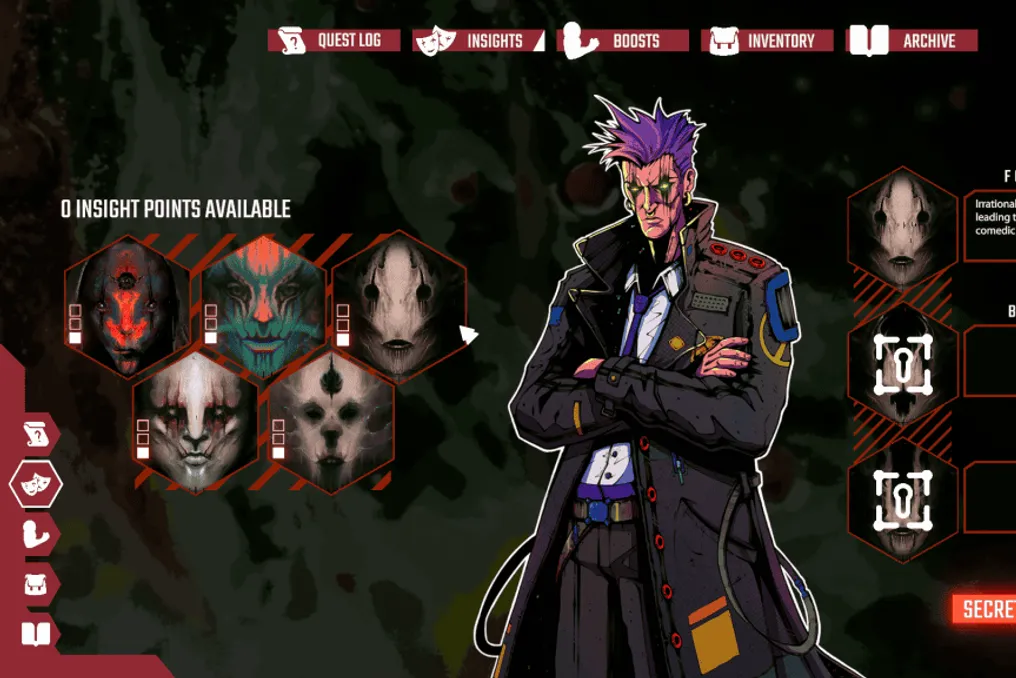
The general consensus points to the art direction as a major asset. The hand-drawn style blends elements of manga and American comics, referencing works like Akira and Berserk. The strategic use of shadows and intense blacks enhances the feeling of the city's weight. The producer guaranteed that no image was generated by artificial intelligence, highlighting the care put into the scenery and portraits.
Complementing the immersion, the soundtrack and noir atmosphere are extremely effective. The music, which covers noir jazz, electronic, and metal, harmonizes with the dirty tone of the city, maintaining engagement even during the slower moments. For those new to story RPGs, the game serves as an accessible introduction to a genre often intimidating due to its textual density.
Dice Mechanics and Tension
The core mechanic gives personality to the game, as the dice function not only as a rolling tool but also as a resource and currency. Each die used is permanently consumed, and options to replenish them are restricted, creating continuous tension. The player must weigh whether to spend a die immediately to gain information or save it for a crucial moment, giving weight to every decision.
Weaknesses: Softlocks and Bugs
Paradoxically, the most serious problem arises from the successful mechanic itself. The scarcity of dice can lead the player into softlock situations, forcing them to load old saves or restart the game if no other alternative exists. This structure recalls Sierra adventures from the 90s, where an initial mistake could compromise the rest of the experience, which can be frustrating in a six-hour campaign.
Furthermore, the save and load system has occasional glitches, such as saves that won't open or buttons that respond slowly. While these issues do not completely destroy the experience, they weigh heavily on a game so dependent on narrative. However, Metaphor Games has been releasing fixes at a rapid pace, suggesting that these setbacks will be mitigated with updates.
Narrative and Immersion Limitations
Despite similarities to Disco Elysium, the narrative disappoints by being significantly more linear than expected. Even after passing dice checks, the story frequently converges on the same outcomes, diminishing the impact of having invested resources in certain choices. The endings also show little distinction from one another.
There are also minor immersion flaws, such as the repetition of textual structures and the inappropriate use of the term 'Uber' instead of specific vocabulary from the game's universe. The visual aspect, although praised, exhibits inconsistencies, notably in the character Howard, who appears in different ways in the menu, on the map, and in the dialogue portrait.
Conclusion and Final Thoughts
Celestial Return is a promising debut, despite presenting flaws. The artistic quality, established atmosphere, and dice concept justify playing, even in the face of possible freezes and save bugs that require patience. For experienced genre players, these negative points are irritating.
The biggest difficulty lies in the language, as the game currently lacks Portuguese translation. For a title so focused on narrative and intense reading, the absence of Portuguese support makes the experience tiring, unless the player has advanced or native English. For those starting out in story RPGs and tolerating reading in English, the immersive setting and the consequence-signaling dice mechanic make the game a hard invitation to overcome, even if the consequences affect progression more than the narrative itself.
Purchase Information and Requirements
Currently, the game can be purchased on Steam for R$ 26.39, with a 20% launch discount valid until 07/28. It is important to note that the only available language is English, and the gameplay mode is exclusively single-player campaign, with no multiplayer support. The age rating is 16 years. Additionally, an Artbook is available for separate purchase on Steam.
Minimum requirements to run the game on PC include a Windows 10 64-bit system, a dual-core 1.8 GHz processor, 8 GB of RAM, and a graphics card with integrated graphics, with an installation size of 8 GB.