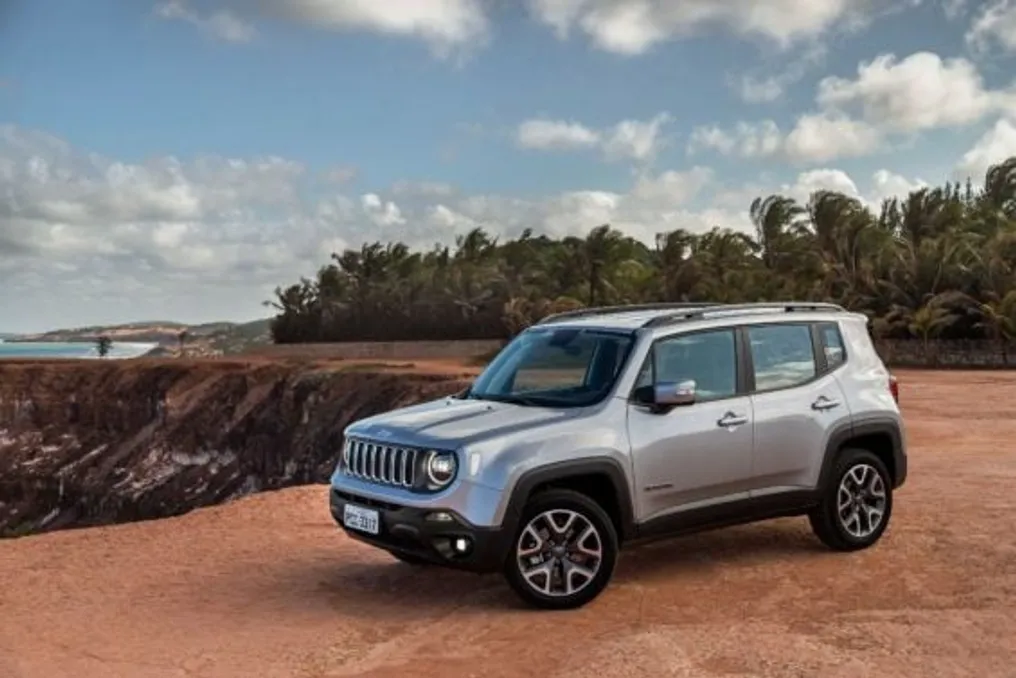
The Jeep Renegade 1.8, a compact SUV that was one of the best-selling in its category, is still considered a viable option in the used market, even in the naturally aspirated versions that frequently receive negative reviews.
Renegade History and Market
This vehicle generates diverse opinions, often being criticized for being weak, unable to handle rough roads, or suffering from potholes. Although criticism of the E.torQ engine is recurrent, market data shows that the Jeep Renegade, even with the 1.8 flex engine, achieved strong market penetration.
The SUV began its journey in 2015, after being presented at the Geneva Motor Show in 2014. It was manufactured in Goiana (PE) and offered a variety of engines from the start, including flex and turbodiesel. Jeep launched the Renegade in Brazil in March 2015, competing with models like the Honda HR-V and Peugeot 2008.
Evolution and Performance
After undergoing a restyling in 2018 and launching several special editions, the model accumulated 500,000 units produced over seven years, with about 90% of these sales coming from the 1.8 flex engine. When it reached this milestone, the Renegade discontinued the naturally aspirated 1.8 E.torQ engine and the 2.0 turbo, migrating to the 1.3 GSE turboflex across the entire line.
In terms of performance, the Renegade 1.8 flex offers basic power for urban use, with 139/135 hp and 19.2/18.7 kgfm of torque at 3,750 rpm. Its accelerations are considered honest and its behavior predictable, without a sporty focus, with a 0 to 100 km/h time exceeding 11 seconds.
However, the mechanical assembly presents challenges, as the E.torQ engine is described as rough and vibrating. The main hurdle is the six-speed Aisin automatic transmission, which exhibits hesitation between third and fifth gear, causing interruptions in acceleration and hindering take-offs, leading some drivers to prefer sequential mode.
Fuel Consumption and Vehicle Dynamics
The reputation for high fuel consumption is partially justified by the car's more square design, which affects consumption, especially on highways. According to the Inmetro cycle (2019 table), the 1.8 flex presents moderate efficiency: 6.7 km/l on ethanol in the city and 8.1 km/l on the highway; with gasoline, it reaches 9.5 km/l in the city and 11.0 km/l on the highway.
In contrast to the engine, the Renegade's dynamics are praised. Despite being tall and narrow, it provides a sense of security. The independent suspension on all four wheels is competent, keeping the SUV stable on highways and firm in curves. The steering is direct and efficient, complemented by disc brakes on all four wheels.
Comfort and Interior Space
Although interior space is not the Renegade's strong point, the driving position is ergonomic and elevated. The rear seat is better suited for two adults. A notable positive point is the suspension system, which absorbs road irregularities well, handling potholes and unpaved sections adequately.
The interior finish also receives attention, featuring soft and rubberized surfaces, well-fitted materials, and a modern look. The trunk, with 320 liters in older versions, has always been considered small for the category, although it reached 385 liters in the most recent version with a temporary spare tire, still limiting the transport of large luggage.
Version Suggestions and Maintenance
For those seeking the best cost-benefit in the 1.8 model, the Renegade Sport 1.8 2018/19 MT is suggested. This five-speed manual model allows for better extraction of the engine's potential and generally has a more accessible price in the used market, ranging between R$ 72 thousand and R$ 76 thousand (KBB Brazil Reseller Price), in addition to having stability and traction controls, a rearview camera, and a 5-inch Uconnect multimedia center.
Alternatively, the Night Eagle 1.8 AT 2017/18, based on the Longitude, is recommended for those who prefer an automatic transmission. This special edition costs between R$ 75 thousand and R$ 80 thousand (KBB Brazil) and includes items such as dual-zone automatic climate control, tire monitoring, and multimedia with native GPS.
Maintenance Costs and Common Problems
Maintenance for the 1.8 engine is classified as regular, and parts are easy to find. Estimated costs include: front brake pad set between R$ 220 and R$ 330; spark plug set between R$ 300 and R$ 420; fuel pump between R$ 780 and R$ 1,000; oil change kit (5 liters 5w30 + filter) between R$ 370 and R$ 490; rear shock absorber (pair) between R$ 630 and R$ 820; rear bumper between R$ 560 and R$ 800; and right headlight between R$ 470 and R$ 650.
The most reported problems by owners involve electrical failures (such as in windows, fog lights, and multimedia) and issues with the automatic transmission, especially the heat exchanger, whose repair can be costly. Leaks of transmission and cooling fluids are also recorded. It is important to note that the line had seven recalls over the years, covering electronic control unit software, airbag modules, parking brake cable, relays, and rear calipers, making it crucial to check the service history.