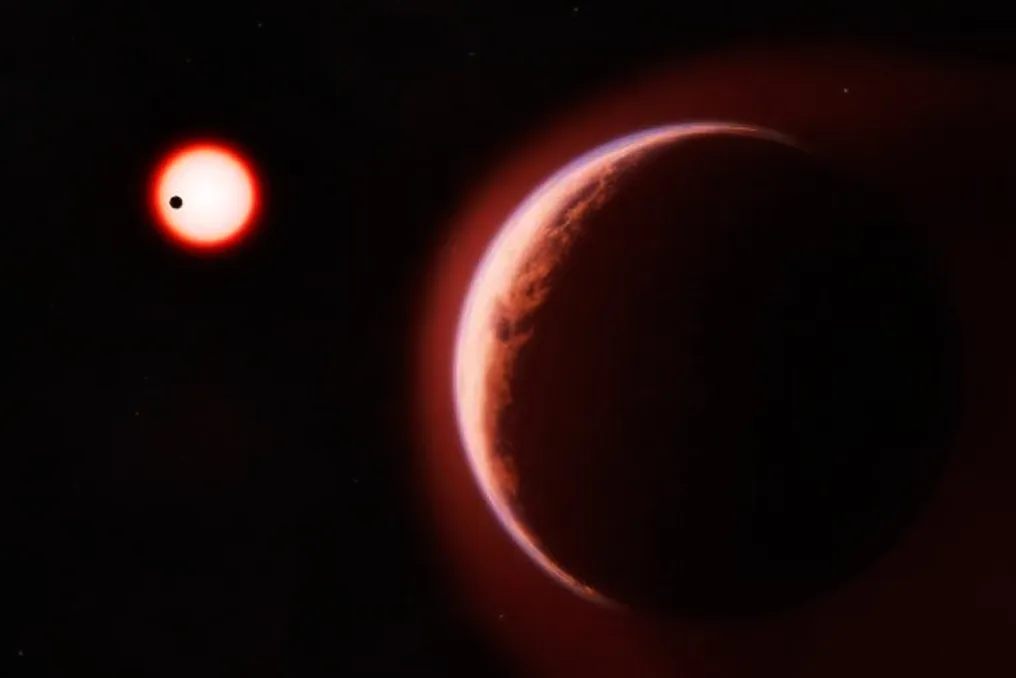
Researchers announced the first confirmation of an atmosphere on a rocky planet located in the habitable zone of a different star. This advance represents a significant milestone in the search for worlds with the potential to host life.
Search for Habitable Worlds
For decades, scientists have dedicated efforts to identifying planets with conditions favorable for the emergence of life, searching for celestial bodies with characteristics analogous to Earth. Although habitable zones have been mapped in various stellar systems and over six thousand exoplanets cataloged, none until now had gathered the complete set of terrestrial requirements.
For known life to thrive, a planet must possess a rocky structure, exhibit liquid water on its surface—which implies a moderate temperature—and, crucially, be capable of retaining an atmosphere. This gaseous layer is vital as it regulates the climate, protects the surface from radiation, and sustains the conditions necessary for biological existence.
Discovery of LHS 1140 b
The situation changed with the detection of a rocky planet with an atmosphere in the habitable zone of another star. This achievement was made by researchers from Harvard University and published in the scientific journal Science on July 16. It is important to note that although no life has been found on the planet, the essential elements for its emergence have been identified.
The object studied is the exoplanet LHS 1140 b, which was discovered in 2017. It orbits a red dwarf, located approximately 48 light-years from Earth, within its habitable zone. Red dwarf stars are notorious for emitting intense radiation and destructive flares, but the specific star in this system proved to be less active, allowing the planet to conserve its gaseous layer.
Detection and Analysis Methods
Atmospheric detection was made possible by the use of a theoretical model created by Collin Cherubim, the lead author of the study. This model projected the composition of the planet's atmosphere, suggesting that LHS 1140 b possessed an upper atmosphere rich in helium, which would be gradually escaping into space. To validate this prediction, the team employed the WINERED spectrograph, an instrument that confirmed the presence of this escaping helium around the planet, thus proving atmospheric retention.
David Charbonneau, head of the Department of Astronomy at Harvard University, commented that Collin predicted the helium atmosphere after analyzing known planets, organized observation time with telescopes, collected the data, and that the detection was considered statistically robust.
Characteristics and Next Steps
According to the study, this atmosphere may have been present for more than three billion years. However, there are important distinctions between LHS 1140 b and Earth; the exoplanet is larger, more massive, and colder. Additionally, it completes an orbit in only 25 days and exhibits synchronized rotation, keeping one side always facing its star.
The researchers now plan to investigate the composition of this atmosphere in detail and search for other signs of habitability, such as the possible existence of liquid water on the surface. The model developed by the team will also be applied to the study of other exoplanets.