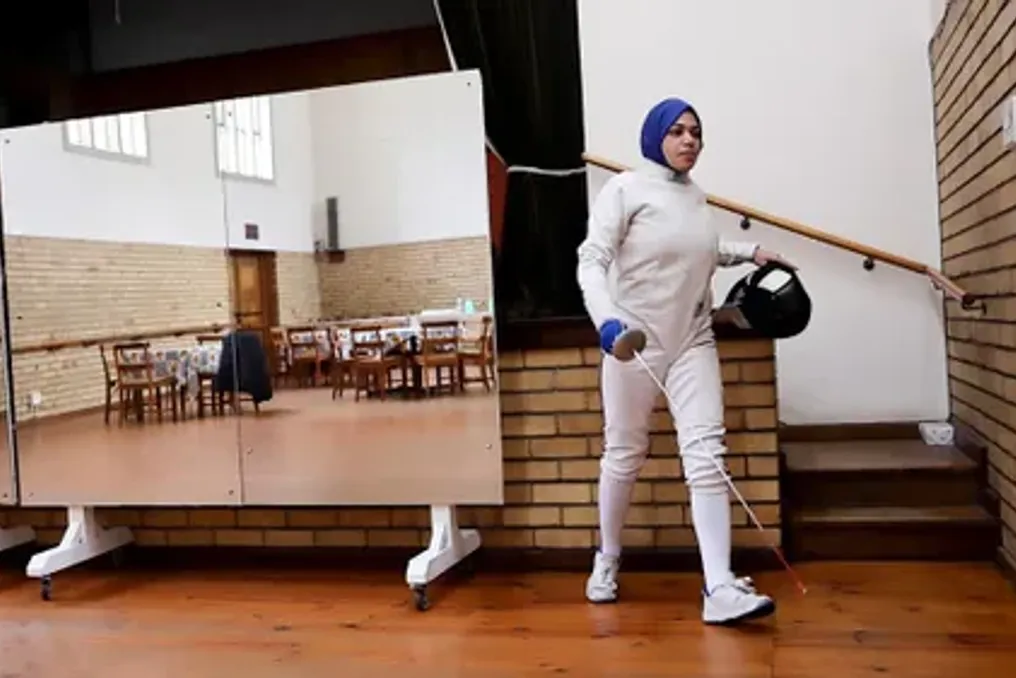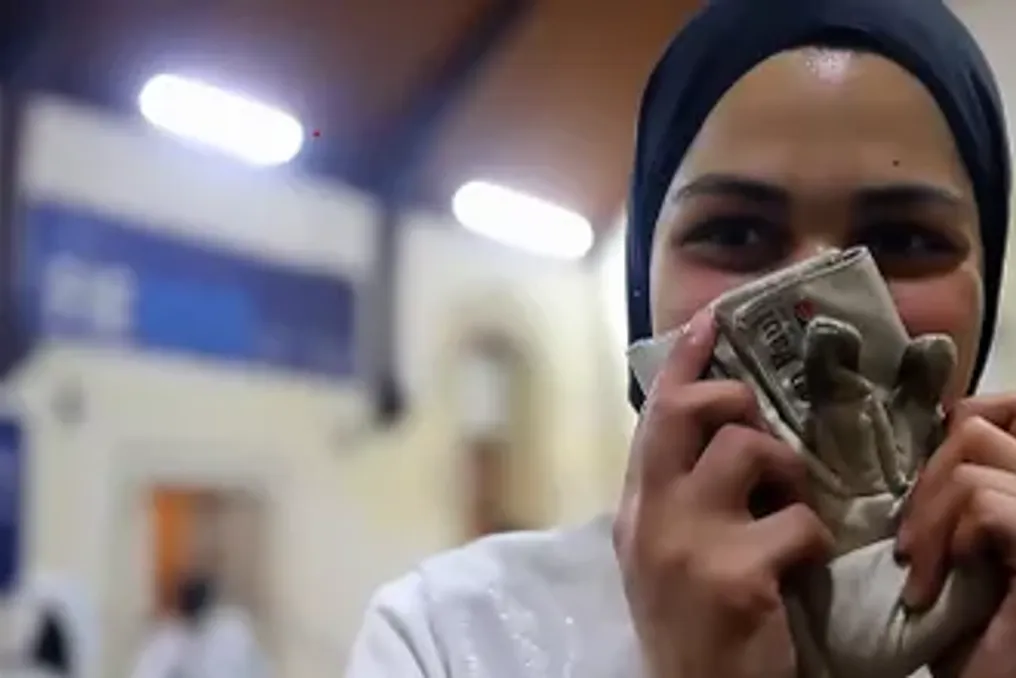
Ruqaya Ismail, recently included in the South African national fencing team, shared that she had to overcome internal doubts to deserve a place on the team that will travel to the World Fencing Championships in Lagos, Nigeria, next month.
Ruqaya Ismail, recently included in the South African national fencing team, shared that she had to overcome internal doubts to deserve a place on the team that will travel to the World Fencing Championships in Lagos, Nigeria, next month.
This journey of the young woman, which began with participation in a school support program and culminated in South Africa's appearance at the World Fencing Championships, demonstrates her determination, as well as the support she received from her family and coaches in battling self-doubt.
As a first-year psychology student, her lightning reflexes helped her make the South African team for the upcoming tournament. When she steps onto the strip—the official metal mat where athletes compete—doubts recede, giving way to split-second decisions, which she compares to playing chess in her mind.
Among the fencers from Cape Town, she is considered one of the sharpest. The young athlete first picked up a foil after members of the Blues Fencing club, based in Gardens, visited her school as part of the club's support program several years ago.
Although she considers herself a homebody who prefers books, series, and rare picnics, she completely transforms her calm lifestyle into the fast-paced and demanding world of fencing. She notes that while the bout on the strip is one-on-one, one must constantly be aware of their actions and capabilities. This requires simultaneously analyzing the opponent's movement, distance, and actions, creating complex but highly educational situations.
She steadily climbed the national rankings through discipline, consistency, and numerous hours of training, allowing her to wear the 'green and gold' colors for the first time. However, behind the mask and polished footwork lies a battle rarely seen by spectators. For Ismail, the most difficult task has always been not so much maintaining distance from the opponent as fighting her own distrust.
She admits that she had to do the most work on her mindset, as anxiety sometimes becomes her biggest adversary. She emphasizes that her progress was shaped not only by hours on the strip but also by the people around her: her mother and her first coach, Alex Colling, who believed in her when she doubted herself.
The coach noted that her selection is part of an impressive year for the Gardens club, whose fencers have already participated in the South African Junior, World Junior, and South African Senior Championships. Furthermore, even more athletes plan to represent South Africa at the Senior World Championships in Hong Kong, the World Fencing Championships in Nigeria, and the Veterans World Championship in Georgia later this year.
He stressed that the results speak to the professionalism of the high-performing program at the Blues club, the high level of coaching staff, who have international training and certification, as well as the commitment and talent of the fencers. Nevertheless, selection is only half the battle. Like many sports enthusiasts, Ismail and her clubmates work hard to cover the costs of representing the country, including airfare, accommodation, competition fees, and specialized equipment.
She believes that some defeats can leave a deeper mark than victories, especially when they show what you are capable of. She learned such a lesson at her first provincial championship as a final-year student during Ramadan, where she fought a national team fencer while fasting and battling nerves. Despite intense fear and feelings of weakness due to the inability to eat or drink, she tried to concentrate and fence with all her might. Although she lost the match, she felt a great sense of pride, unaware that she had reached the semi-finals, and it was her first medal—a bronze one.
Ismail's rise is part of the overall success story of the Blues Fencing club, where head coach Patrick Colling speaks of the growing number of fencers achieving recognition on the international stage. He added that behind every international selection are sacrifices that rarely make it into reports: athletes and their families often have to make difficult financial and life decisions to stay in the game.
Colling mentioned that some choose homeschooling to free up more time for training, and young adults forgo material comforts to fund their sport. One of the main obstacles is limited funding, which also narrows opportunities for gaining international experience necessary for preparing for major championships. Ismail agreed with the coach, noting the clear distinction between the efforts she can control and the support she can only hope for. She stated: 'Training is on me. As for fundraising, I can ask for help, but I cannot decide if the funding will come. That is from God and wonderful people. Training depends on me—I have to choose whether to put in the effort.'
Rukayya Ismail, a first-year psychology student from Cape Town, has secured a place on the South African national team that will compete in the World Fencing Championships in Lagos, Nigeria, next month. Her lightning-fast reflexes were a decisive factor in this achievement.
According to Ismail, when she steps onto the piste—the official metal mat for competition—doubts give way to decisions made in fractions of a second, which she compares to playing chess. The fencer is considered one of the most skilled in Cape Town. She began fencing after representatives from the Blues Fencing Club in Gardens visited her school as part of a club support program.
Despite preferring a quiet life filled with reading and picnics, Ismail immersed herself in the fast-paced and intense world of fencing. She notes that in sports, it is necessary to simultaneously analyze the opponent's actions, their distance, and one's own movements. Although maintaining distance is the least of her problems, she admits that her biggest rival has always been internal insecurity.
She emphasized that forming the right mindset was the most difficult task, as anxiety sometimes became her main obstacle. Ismail thanks her mother and her first coach, Alex Collins, for believing in her during difficult times.
Ismail's rise is part of the overall success of the Blues Fencing Club, where head coach Patrick Collins notes the growing number of fencers achieving international recognition. Collins emphasizes that behind every international selection are sacrifices that rarely appear in the records, forcing athletes and their families to make difficult financial and life decisions to continue training.
He gives examples of young people choosing homeschooling to free up time for training or foregoing material comforts to fund their sport. One of the main obstacles is limited funding, which restricts opportunities for gaining international experience necessary for preparing for major championships. Ismail agrees with the coach, stating that the effort in training rests with her, while securing funds depends on external circumstances and people's help.