Bangalore faces a paradox: the city may experience water shortages in April, but flooding problems by September. However, long before the appearance of cisterns, pipelines, and pumping stations, the city possessed its own method for solving these issues.
Historical Water Management System
Over five hundred years ago, a complex interconnected network of stormwater canals, known as Rajakaluves, was created, connecting lakes across the landscape. During heavy rains, excess water naturally flowed from one lake to another, preventing street flooding. In drier months, the same system helped replenish groundwater and accumulate future water reserves.
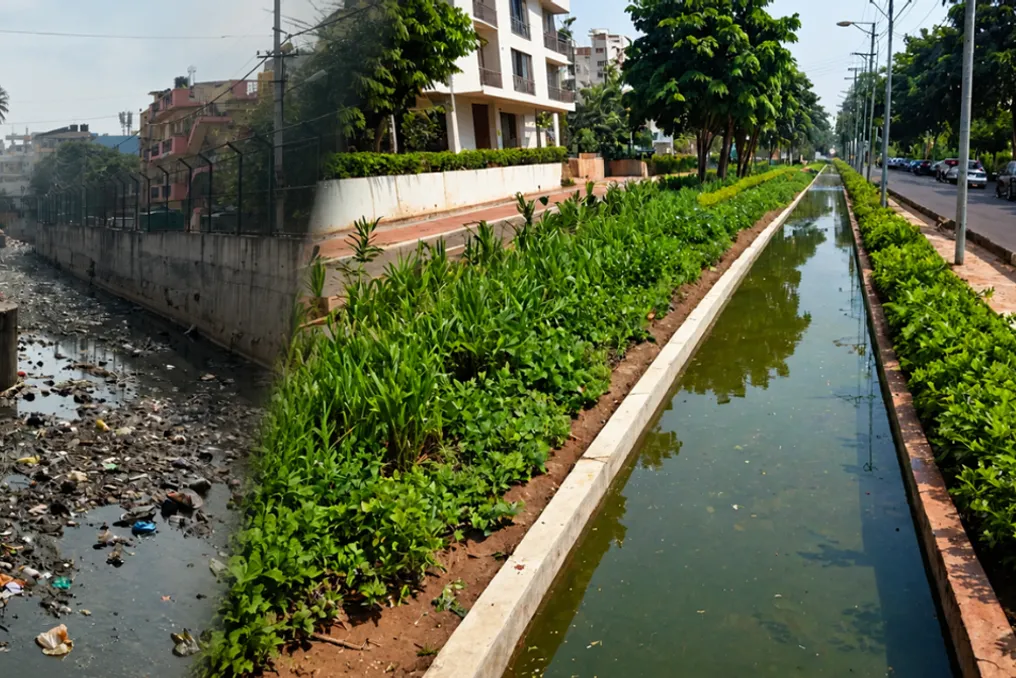
One surviving section of this historical network is the K100 waterway. This canal, which previously served as an open drain carrying about 130 million liters of untreated sewage daily, has been restored into a thriving public corridor. Now people walk here, birds have returned, and rainwater can flow freely again.
Revival of a Rain-Based System
The restoration of K100 is not just cleaning up an abandoned canal; it is reviving a centuries-old water management system that allowed Bangalore to thrive without a major river. Long before water was pumped from the Cauvery, Bangalore relied almost entirely on rainfall. In the 16th century, the city's founder, Kempe Gowda, developed a network of interconnected Rajakaluves that directed excess rainwater from one lake to another through Bangalore's natural valleys.
This system slowed the flow of rainwater, accumulated it in a chain of lakes, replenished groundwater, and reduced the risk of flooding, helping the city balance water supply and flood control for centuries. However, as Bangalore expanded, many of these canals gradually disappeared under roads and buildings, others narrowed, and some were converted into sewer channels instead of stormwater drains.
Pollution Problem and Restoration Process
The K100 waterway was no exception. Over the years, it began carrying nearly 130 million liters of untreated sewage daily. The banks of the canal were covered with solid waste, and the canal became known more for its foul odor than for its original role in Bangalore's water supply system.
The K100 restoration project first required addressing the pollution problem. The Karnataka government, Bruhat Bengaluru Mahanagara Palike (BBMP), Bangalore Water Supply and Sewerage Board (BWSSB), MOD Foundation, and several technical partners were involved. The first step was stopping the inflow of sewage into the canal. The channel bed was cleared, decades of accumulated waste were removed, and new sewerage infrastructure was built to divert sewage away from the stormwater canal. The capacity of wastewater treatment was also increased, which reduced the amount of untreated sewage entering the canal from approximately 130 million liters per day to about 5 million liters.
Transformation into an Ecological Corridor
Only after improving water quality did work begin on the surrounding landscape. Pedestrian paths were established along large sections of the canal, trees were planted to create shaded public areas, and abandoned edges were transformed into accessible spaces allowing people to reconnect with the water. Today, K100 represents a green-blue corridor nearly 12 kilometers long, combining ecological restoration with the creation of public space.
Prospects for Urban Planning
Bangalore's water resource issues are not new. The Rajakaluve system, existing over 500 years ago, was originally designed to solve many of the city's modern problems. By connecting lakes in Bangalore's valleys, it allowed excess rainwater to naturally move across the landscape while replenishing groundwater. In an interview with South First, urban designer Naresh Narasimhan, who developed the K100 Citizen's Waterway Project, noted that Bangalore already has an extensive water network—it simply stopped functioning as intended.
The city receives between 900 and 1000 millimeters of rainfall annually, but a significant portion of this water mixes with untreated sewage in stormwater drains before reaching downstream lakes. According to Narasimhan, it is crucial to view sewage as a resource, not waste, for a city often facing water scarcity. The K100 project reflects this shift in thinking, rethinking drainage not as forgotten infrastructure but as part of a living water system capable of improving the environment and creating valuable public spaces.
The success of this project points to a broader possibility: there are still over 842 kilometers of Rajakaluves in Bangalore, many of which continue to link the city's historic chain of lakes. Environmentalists have long argued that restoring these canals alongside rejuvenating Bangalore's lakes can improve groundwater recharge, strengthen the city's water security, and reduce urban flooding. While K100 itself will not solve Bangalore's water crisis, it serves as an important reminder that some of the city's most effective climate solutions are not novelties; they were part of Bangalore's landscape for centuries, awaiting restoration rather than reinvention.