If Iranian architecture is viewed as the embodiment of wisdom in material form, then the Persian garden represents an expression of Iranian thought regarding the interaction between humans, nature, and water.
Historical Significance and UNESCO Recognition
For over two millennia, this tradition has influenced garden art far beyond Iran and remains one of the outstanding achievements of Persian civilization. In 2011, the Persian Garden was inscribed on the UNESCO World Heritage List as Iran's thirteenth site, recognizing a cultural landscape that unites engineering, geometry, architecture, climatology, and philosophy into a single artistic and ecological system.
Roots of the Tradition and Development of the Style
The origins of the Persian garden date back to the Achaemenid period. Pasargadae, the palace complex of Cyrus the Great, featured a mature form of Chahar Bagh, or four-part garden, characterized by intersecting axes, geometric organization, and controlled water flow. Many researchers consider Pasargadae the earliest known example of a Persian garden. This concept was subsequently refined during the Sasanian, Safavid, Zand, and Qajar periods, becoming one of the most enduring expressions of Iranian culture.
Philosophy and Water Management
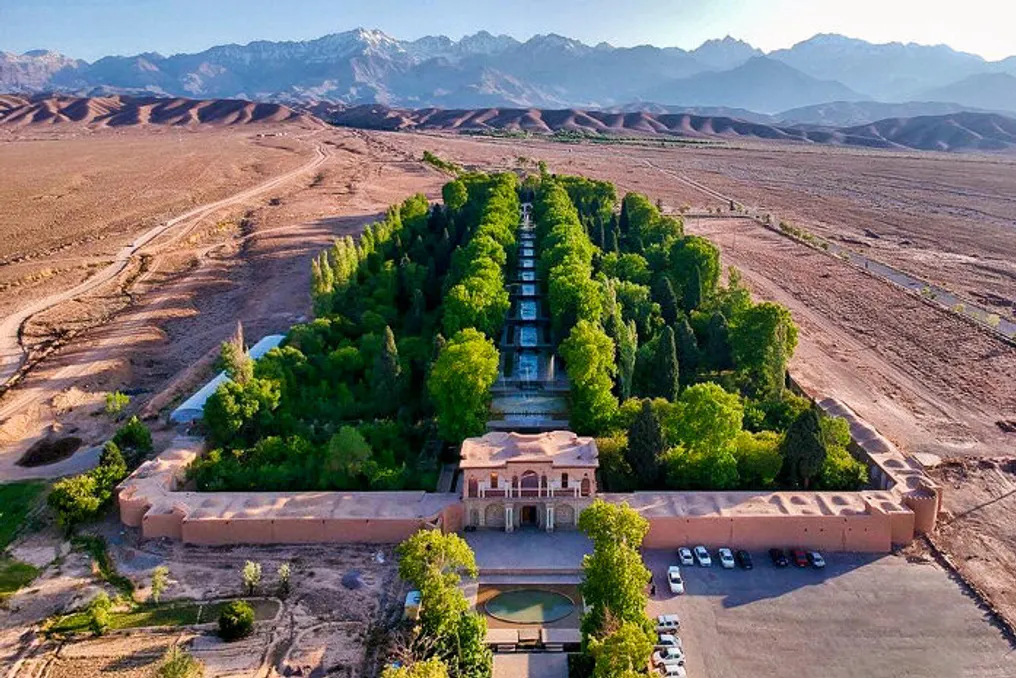
What distinguishes the Persian garden from other garden traditions is the intellectual foundation laid in its design. Water is perceived as a source of life and the primary element organizing the space. Precise geometry, architectural structures, carefully planted trees, shade, reflections, and symmetry work together to create an environment evoking paradise.
One of the most impressive aspects is the complex water management system. Many of these gardens were created in arid and semi-arid regions where creating a green landscape required exceptional technical knowledge. Through the use of canals, natural slopes, stone channels, ponds, fountains, and meticulously designed distribution networks, Iranian engineers transformed dry land into sustainable gardens. This achievement serves as an important example of indigenous technology and long-term environmental management.
Nine Heritage Sites
The site includes nine historical gardens selected from various climatic zones across the country. Together, they demonstrate how Iranian designers adapted to diverse natural conditions, managed scarce water resources, and created idealized landscapes that have become symbols of harmony between humans and nature.
The nine gardens comprising the UNESCO site include: Pasargadae Garden and Eram Garden in Fars Province; Fin Garden and Chehel Sotoun Garden in Isfahan Province; Shahzadeh Garden in Kermanshah Province; Dowlatabad Garden and Pahlavankuh Garden in Yazd Province; Akbarie Garden in South Khorasan Province; and Abbasabad Garden in Mazandaran Province. Despite being located in vastly different environments—from the Hyrcanian forests of northern Iran to the deserts of the central plateau—they share the same fundamental principles: geometric axes, water as an organizing element, a central pavilion, enclosing walls, deliberate tree planting, and carefully balanced relationships between architecture and landscape.
Synthesis of Art and Nature
In the Persian garden, natural elements and man-made components merge to create a unique artistic achievement. The placement of flowerbeds, the flow of water, the arrangement of trees, and the integration of buildings are designed to generate a specific microclimate and sensory experience. The gardens are also closely linked to Persian literature, poetry, music, calligraphy, and carpet design. For centuries, Iranian artists drew inspiration from the imagery of the garden, while gardeners integrated artistic and symbolic concepts directly into the landscape.
Legacy and Contemporary Significance
UNESCO describes the Persian garden as an outstanding example of the exchange of cultural values and one of the most complete garden traditions in human history. Its lasting influence is traceable throughout the Islamic world and beyond, where the concept of the four-part garden inspired numerous royal and urban landscapes. Nevertheless, the Persian garden is not merely a historical model; it remains a living testament to engineering knowledge, spatial planning, water resource management, and the Iranian philosophical view of the relationship between humanity and the natural world.
Today, Persian gardens continue to play an important role in cultural tourism, heritage preservation, landscape design research, and the international presentation of Iran's traditional knowledge. Visitors strolling through cypress-lined alleys in Dowlatabad, listening to the murmur of water in Fin Garden, or observing terraced canals in Shahzadeh Garden, encounter more than just a beautiful landscape. They encounter a civilization that, through knowledge, engineering, and artistic imagination, managed to embody the idea of earthly paradise in physical form. In an era increasingly concerned with sustainability and responsible use of natural resources, the Persian garden offers not only a window into Iran's past but also a timeless lesson on how human creativity can work in harmony with nature.