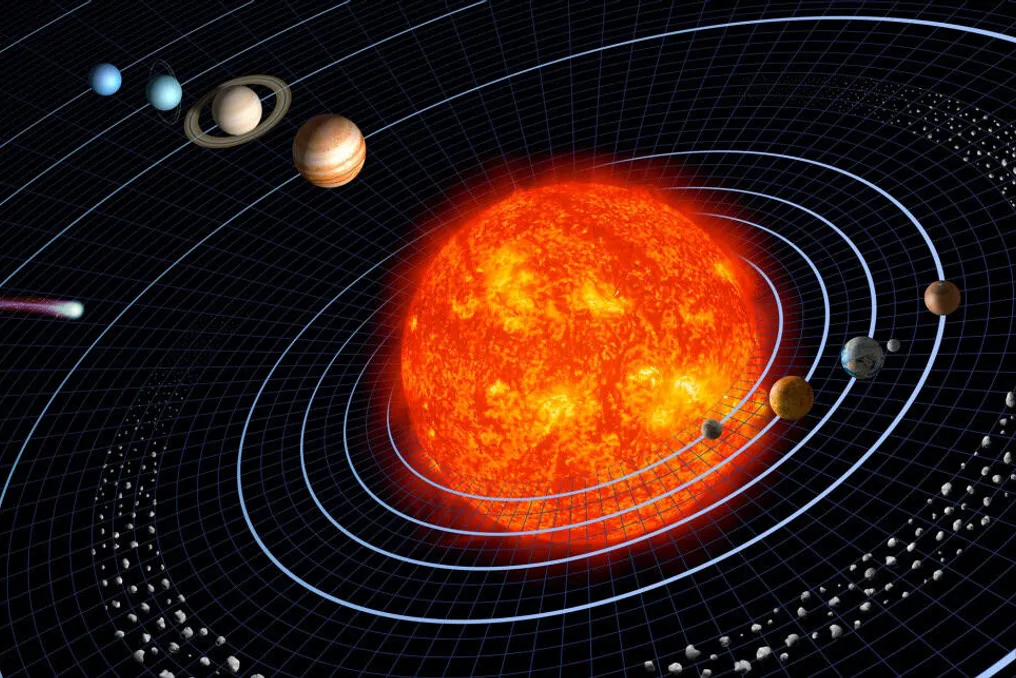
The Milky Way, theoretically, should be a place teeming with life; however, despite numerous investigations, no other civilization has been found. This scenario raises the Fermi Paradox, an enigma that has fascinated astronomers for decades.
The Milky Way, theoretically, should be a place teeming with life; however, despite numerous investigations, no other civilization has been found. This scenario raises the Fermi Paradox, an enigma that has fascinated astronomers for decades.
In 1950, the Italian-American physicist Enrico Fermi was having lunch in Los Alamos, New Mexico (USA), a research center previously established as part of the Manhattan Project, responsible for creating the atomic bomb. During the meeting, the group discussed a cartoon from New Yorker magazine that satirized the disappearance of trash cans in New York, showing green aliens taking trash cans to a spaceship.
Inspired, the scientists began to ponder the possibility of real extraterrestrial visits. They made informal estimates about the probability of advanced alien life. Minutes later, Fermi is said to have uttered the famous question: 'Where is everybody?'. For the Nobel laureate in Physics, logic suggested that civilizations with reasonable technology should exist, which generated the Fermi Paradox, a question that has persisted for over 70 years.
The paradox is based on the vastness of the cosmos, whose immensity challenges human comprehension. It is estimated that there are at least 200 billion galaxies in the observable Universe, potentially reaching two trillion. Each of these galaxies contains millions or billions of stars, and the number of suns in space has 24 zeros, making it probable that each possesses orbiting planets. Carl Sagan emphasized that there are more worlds than grains of sand on Earth, warning that it would be a great waste of space if only Earth existed.
There is an apparent contradiction between the enormous quantity of potential habitable worlds and the absence of any sign of external life. A simplified view suggests that it is only a matter of time until we are found or we find another intelligent civilization.
Although the idea of ETs is ancient, dating back to Greek satires of the 2nd century AD, scientific study is recent. It is crucial to differentiate UFOlogy from astrobiology. UFOlogy focuses on media reports of UFOs (unidentified flying objects) and mysterious aerial phenomena, being conducted mainly by amateur enthusiasts and classified as pseudoscience because it does not follow scientific methodology.
In contrast, astrobiology is the branch of astronomy dedicated to investigating the viability of life outside of Earth. This field focuses on simple life forms, such as bacteria and extremophiles, capable of surviving in hostile environments, such as extreme temperatures or toxins. Astrobiologists analyze nearby regions, such as Mars and Venus, and Saturn's moons, such as Titan and Enceladus, searching for biosignatures—molecules or phenomena produced by life.
The area that studies advanced civilizations capable of communication is called SETI (Search for Extraterrestrial Intelligence). It focuses on detecting technosignatures, that is, detectable signs of technology from Earth, such as radio waves. SETI is based on the Copernican principle, which posits that we live in a common stellar system, and not on a privileged planet.
Although distant galaxies are unreachable, the Milky Way is vast, containing between 100 and 400 billion stars. Initially, it was unknown whether planets were common, but today it is known that they are the rule. Since the discovery of the first exoplanet in 1992, more than 6,300 have been found, largely thanks to NASA's Kepler mission, launched in 2009.
Current estimates based on Kepler data indicate the existence of at least 300 million potentially habitable planets in the galaxy. These are defined as rocky, with mild climates, allowing liquid water on the surface, which is essential for known life.
The search for technosignatures began after Fermi's question. In 1959, Giuseppe Cocconi and Philip Morrison published an article in the journal Nature, suggesting that electromagnetic waves would be the best means for interstellar communication due to their high speed and simplicity. The challenge lies in identifying an alien message in the vast electromagnetic spectrum.
Scientists concluded that the radio frequency of 1.420.4 MHz, corresponding to a wavelength of 21 centimeters, is ideal because it is the frequency emitted by hydrogen, the most abundant element in the Universe. This frequency is widely known by technological societies and functions as a universal channel. Currently, this band is internationally reserved for radio astronomy.
In 1960, Frank Drake initiated the first search for alien signals, using a radio telescope to observe the stars Tau Ceti and Epsilon Eridani, in a project called Ozma. Despite the negative result, Drake is considered the 'father of SETI'. A year later, in 1961, he organized the first world conference on SETI, bringing together scientists such as Philip Morrison and Carl Sagan.
To guide the debate on the probability of other civilizations, Drake developed a mathematical formula. The Drake Equation multiplies several probabilities—such as the number of stars, the proportion of planets, the chance of them being habitable, and the probability of life arising—to calculate the number of alien societies we might come into contact with in the Milky Way.
A new study, conducted by Austrian researcher Sergey Ivliev, proposes an explanation for astronomy's great mystery: why humanity has never detected signals from highly developed extraterrestrial civilizations. This work was published as a preprint on the arXiv platform.
The central thesis suggests that societies reaching a high level of AI-based automation would cease undertaking large, visible space projects. Instead, they would adopt more discreet methods for expanding throughout the cosmos.
This proposal aims to reinterpret the so-called Fermi Paradox, a question raised in the 1950s that contrasts the high probability of intelligent life in the galaxy with the lack of concrete evidence of its existence.
The article introduces the concept of the 'Silent Expansion Filter.' According to this theory, a civilization that establishes an autonomous industrial and computational system outside its planet would stop investing in grandiose endeavors motivated by power or prestige.
At this stage, the priority would shift to more logical objectives, such as knowledge preservation, increasing the species' chances of survival, and ensuring redundancy against possible catastrophes.
This technological stage is termed Autonomous AI-Cosmoindustry (AICI). The study defines AICI as the condition where a society possesses space infrastructure capable of designing, building, repairing, and launching equipment without continuous biological intervention. Current initiatives, such as space data centers, are seen only as preliminary steps in this regard.
The argument is reinforced by reflections from astrophysicist Sergey Popov, who argues that a truly rational artificial intelligence would not have human motivations, such as the desire for conquest or recognition. For this AI, disseminating infrastructure throughout the universe would merely be a risk mitigation strategy.
Instead of moving large populations in vast interstellar vessels, the proposal foresees sending small interstellar probes. The study's calculation indicates that a capsule of about 10 kilograms traveling at approximately 1% of the speed of light would consume a minimal fraction of the energy available to a civilization of this technological level.
These probes would act as contingency systems, carrying records of the knowledge accumulated by the civilization and, potentially, enough biological material for an artificial intelligence to reconstruct society after a disaster. Due to their compact and discreet nature, such structures would be much harder to detect than megastructures or large space fleets.
The researcher also notes that this model would require restrictions on the probes' self-replication capacity, aiming to prevent the scenario known as 'grey goo,' where reproductive machines consume resources uncontrollably.
The hypothesis also provides an explanation for the absence of technosignatures from extremely advanced civilizations. From this perspective, the fact that telescopes do not identify thermal signatures compatible with Kardashev Type III societies would not imply that the galaxy is empty; the reason would be that successful civilizations would choose to remain intentionally discreet.
However, the study points to a less optimistic possibility. If sending these probes is relatively simple for sufficiently evolved societies, the lack of evidence near the Solar System could suggest two things: either humanity is among the first civilizations to reach such a technological level, or there is an extremely complex phase between planetary industrial development and the consolidation of autonomous space infrastructure.