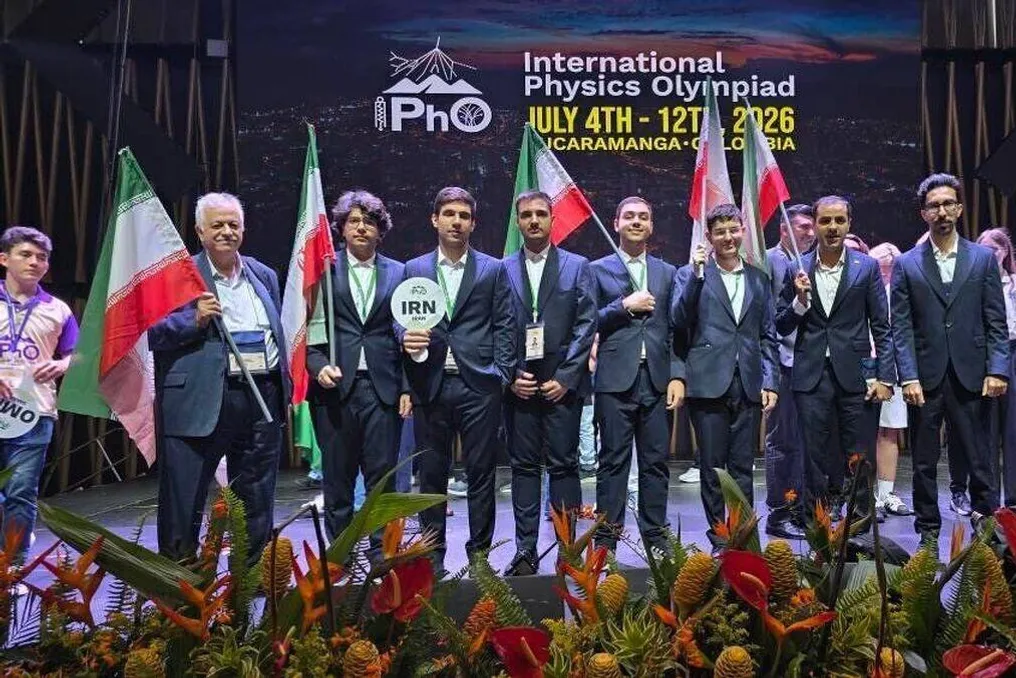
A team of five Iranian students demonstrated outstanding results at the 56th International Physics Olympiad (IPhO), winning three gold and two silver medals.
Details of IPhO 2026
The event took place from July 4 to July 12 in Bucaramanga, Colombia, gathering over 400 participants from more than 90 countries. Among those awarded gold medals were Hirbod Fodaee, Kian Zarrabian, and Mohammad Mirmohammadi, while Amir-Sam Goharpay and Nima Kushki received silver medals.
The main goal of IPhO is to test knowledge, analytical skills, critical thinking, and problem-solving abilities in theoretical and experimental physics at the highest level. The competition includes two five-hour tests: the first is experimental, using provided equipment, and the second is theoretical, focusing on phenomenon modeling.
Team Achievements and Previous Successes
The team's performance was marked not only by medals: Zarrabian placed first in the experimental physics test, while a candidate from South Korea led in the theoretical test. Previously, at the 66th Olympiad in Australia in 2025, the Iranian team ranked 12th in the world, receiving two gold, three silver, and one bronze medal, an improvement from 19th place the previous year.
During the 2026 International Science Olympiad in Physics, which was held exclusively online from June 21 to June 30, 2026, the Iranian team achieved significant success, winning two gold, one silver, and one bronze medal. Hirbod Fodaee was recognized as the absolute winner, taking first place among all participants due to the best result in the Theoretical Exam, earning a gold medal and a national diamond. Amir-Sam Goharpay won the second gold medal, while Kian Zarrabian and Mohammad Mirmohammadi received silver and bronze medals, respectively.
Other International Achievements of Iran
Iran's successes in Olympiads extend beyond physics. At the 36th International Biology Olympiad (IBO 2025) in the Philippines, Iranian students won three gold and one silver medal, securing second place among 81 participating countries. This result surpassed Iran's third place at IBO 2024 in Kazakhstan.
This continuous stream of international achievements coincides with a rise in interest in scientific Olympiads domestically. According to Reza Hosseini, head of the Iranian Youth Club of Scientists, participation in national olympiads increased by 40% year-on-year, rising from 87,000 students in Iranian year 1403 (March 2024 – March 2025) to 121,000 in 1404 (March 2025 – March 2026). Hosseini noted that this figure is the highest in a decade and reflects the growing interest of Iranian students in STEM fields.
Recent Successes in Mathematics and Geography
The Iranian team also demonstrated brilliant abilities at the Fourth International Summer Mathematics Camp (IMSC), held in Beijing, China, from June 17 to July 12. There, they won four gold and two silver medals, surpassing students from Poland and Brazil. The event gathered 58 teams from 46 countries and regions, including 41 international teams and 17 teams from China, with a total of over 500 students, teachers, and coaches.
Furthermore, four Iranian female students participated in the Open International Geography Olympiad (OpenGeo) 2026, winning four medals for the first time, including one silver and three bronze. Artina Heidari received a silver medal, while Setayesh Haknazari, Sana Karbalai Vali, and Gelia Hodabandelu received bronze. This achievement highlighted the comprehensive expertise of Iranian students in geography and is an important step toward preparation for the International Geography Olympiad (IGO).
The OpenGeo competition was organized by the Faculty of Geography, Lomonosov Moscow State University, the MSU high school, and the Primakov School. It was held online on June 20 and 21, and contestants from 27 countries participated. Participants were high school students aged 14 to 19, studying in secondary school or planning to graduate in 2026. The competition consisted of a Written Test with Answers (WRT) lasting 2.5 hours, a Practical and Cartographic Exercise (PME) for 2.5 hours, and a Multimedia Test (MMT) for one hour.