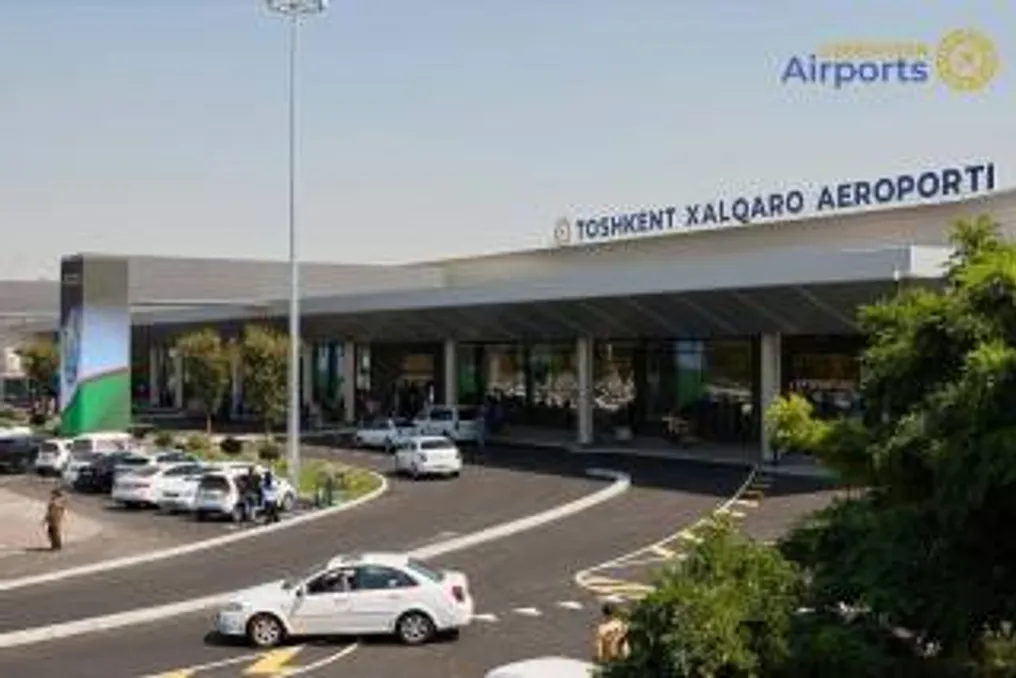
During a press tour organized at the new cargo terminal of Tashkent International Airport, media representatives familiarized themselves with the operations of one of the country's largest air cargo complexes.
During a press tour organized at the new cargo terminal of Tashkent International Airport, media representatives familiarized themselves with the operations of one of the country's largest air cargo complexes.
In recent years, the volume of air cargo passing through Uzbekistan has significantly increased. While the previous cargo terminal was designed to handle 30 thousand tons of cargo and postal items annually, in 2024, approximately 80 thousand tons of cargo were processed through it, indicating that the terminal's capacity was utilized almost three times more than planned. This fact highlighted the necessity of creating modern infrastructure.
The new cargo terminal, which was commissioned in 2025, was built specifically to meet these needs. It currently boasts a capacity of 120 thousand tons of cargo and postal items annually, achieving a result four times higher than the former complex.
The complex covers an area of 5.2 hectares and includes a three-story administrative building, a warehouse spanning 8.5 thousand square meters, cooling and freezing chambers, specialized storage areas for various types of goods, as well as modern equipment for lifting cargo. Separate conditions have been established here for transporting plants, live animals, pharmaceuticals, food products, and valuable cargo.
Automation, compliant with international standards, has been implemented in all processes of the new terminal. An electronic queuing system, digital accounting, and security systems allow for fast and transparent customs clearance of goods. The average time from the landing of a cargo plane to the handover of the cargo to the recipient is only 3–4 hours.
By the end of 2025, over 88 thousand tons of cargo and postal items were processed through the terminal. It is projected that this figure will reach 92 thousand tons in 2026. In the first half of the current year alone, over 48 million kilograms of cargo were processed, representing a 33.2 percent increase compared to the same period last year.
The terminal effectively handles and ships not only industrial products but also perishable goods, agricultural exports, live animals, and cargo requiring special storage conditions. Since the beginning of 2026, over 1.1 thousand tons of agricultural products have been shipped as part of exports, while tens of thousands of tons of various types of goods have been processed in imports.
Given the growing flow of cargo, additional enclosed hangars for import and export are being constructed at the terminal. This will enhance cargo storage security, accelerate logistics processes, and expand the terminal's throughput capacity.
The new cargo terminal has not only expanded the capabilities of Tashkent International Airport but has also marked an important step in strengthening Uzbekistan's position as a key logistics and transit hub in Central Asia.
The American company Apple has once again taken the position of the world's most valuable public corporation, according to the latest data from the Nasdaq stock exchange in the United States.
The smartphone manufacturer managed to overtake its predecessor in the ranking—the technology giant Nvidia. Previously, Nvidia held the first place amid the global growth of interest in artificial intelligence technologies.
During the trading session, Apple's shares increased by 0.2%, reaching a price of $333.94 per share. At the peak of trading, the stock value rose to $334.03, providing a gain of 0.23%. Thanks to this growth, Apple's market capitalization reached a record high of $4.9 trillion.
In the ranking of the world's most expensive companies, Nvidia is in second place, with a value of $4.83 trillion. Third place is held by the Alphabet holding, which manages Google, and its valuation reaches $4.190 trillion.
Furthermore, Apple intends to significantly increase the cost of its flagship gadgets. This is being done to compensate for the sharp increase in component costs, which arose due to global shortages and high demand from neural network operators. For example, it is expected that the price of the basic version of the iPhone 18 Pro may rise to $1,299.
The 512 GB Moto G86 is available on Amazon for R$ 1,844 when paid via Pix. This Motorola device, known for its good cost-benefit ratio, features a significant 39% discount off its original price of R$ 2,999.
This smartphone has a 120 Hz POLED screen and supports up to 24 GB of RAM through RAM Boost technology, equipped with the MediaTek Dimensity 7300 processor. Furthermore, it offers ample internal storage of 512 GB, suitable for storing large amounts of media locally.
The POLED screen measures 6.67 inches and has Pantone certification, ensuring vibrant color reproduction. It operates with a 120 Hz refresh rate and a maximum brightness of up to 4,500 nits, guaranteeing excellent visibility. The screen's durability is protected by Gorilla Glass 7i against various types of damage.
The rear camera setup consists of a 50 MP wide lens with optical image stabilization (OIS) and an 8 MP ultrawide lens, allowing for capturing wide landscapes. The front camera records high-quality selfies with 32 MP. All videos can be recorded in 4K resolution. The internal 5,200 mAh battery promises up to 41 hours of continuous use, and support for 30W fast charging via USB-C allows the device to recharge in about 30 minutes.
The gadget's design has been certified by military standards MIL-STD-810H and has an IP68/IP69 rating, giving it resistance to extreme conditions such as dust, accidental immersion, and high temperatures. In terms of connectivity, the Moto G86 supports 5G networks, Wi-Fi 6, Bluetooth 5.4, and NFC. It is important to note that the 512 GB model will only receive software updates up to Android 17.
Perspectives remain extremely unstable as decision-makers weigh their next move. Meanwhile, inflation is at the upper limit of the target range, and the rand is under constant pressure due to global uncertainty. Furthermore, the Monetary Policy Committee (MPC) concluded its three-month pause in May.
According to Prizm Property Partners, the lowest interest rate in a generation did not equate to the cheapest money. In September 2020, the prime rate stood at 7%, which was the lowest level in decades. With an inflation rate of 3.2%, the real cost of this debt was only 3.8%.
The Durban-based company notes that by July 2022, the prime rate had risen to 9% and continued to climb. However, with inflation at 8%, the real cost of borrowing fell to just 1%—the lowest for the entire period covered by the chart.
Subsequently, by February 2026, the prime rate dropped to 10.25% from its recent peak, which was perceived as a relief. Nevertheless, when inflation reached 3.2% again, the real cost of debt was 7.1%, one of the highest figures in the series.
Prizm argues that this indicates three turning points where the nominal rate and the real cost of borrowing moved in opposite directions. The company adds that using the contract rate as the actual payment rate is one of the most costly habits in the South African property financial sector.
The most striking example relates to the beginning of the series: in January 2004, the prime rate was 11.5%, while overall inflation fell to 0.4%, implying a real cost of debt above 11%, the highest figure on the chart. However, this inflation figure was distorted.
The rand more than doubled compared to the 2001 crisis low, which suppressed import and fuel inflation. Moreover, during that period, the CPI still included interest on mortgage bonds, which had recently been lowered by Reserve Bank rates, mechanically pulling the figure toward zero. According to Prizm, if this measure, which the bank focused on, were excluded, inflation was closer to 4%, and the real cost of debt closer to 7% or 8%, which is still high but not 11%.
Analyzing the full spectrum of data—prime rates, inflation, currency fluctuations, tenant economics, and equity conditions from 2004 to the present, collected from SARB, Stats SA, and JSE—reveals a clear divergence. The question arises: what worries underwriters more now—the 'cheap money' of 2020, which they did not have, or the current easing cycle, which seems cheaper than it actually is?
David Ingle, Chief Property Specialist at Seeff Bedfordview, Edenvale & Modderfontein, noted that most people will watch the outcome after the SARB meeting on July 23rd, but those making sound decisions are paying attention to events leading up to it.
He emphasized that the preparation process for the decision provides almost as much information as the decision itself. Given high inflation, rand pressure from global uncertainty, and the fact that the MPC already suspended its three-year pause in May, prospects remain very balanced while policymakers decide on the next step. Ingle added that he would not be surprised by either maintaining the current rate or a slight increase.
However, he will closely monitor the tone to understand whether SARB is signaling a one-off reaction to global shocks or the start of a longer cycle. In his words, the tone will have a much greater impact on buyer confidence than the number itself.
Earlier this week, Bianca Lakha, a stock analyst, stated that when the Reserve Bank last met in May, it did something it hadn't done since 2023—it raised interest rates to 7%, catching much of the market off guard.
She believes the decision on July 23rd will be more complex than headlines suggest. Although the hike appears justified at first glance due to three consecutive months of rising inflation and reaching 4.5% in May (the highest level in nearly two years), a detailed look reveals that almost all this growth is driven by fuel: gasoline prices rose by almost 25% in a year, and diesel by over 50%, linked to oil prices and the Middle East conflict. If fuel is excluded, inflation barely changed from 3.7% over an entire year, while food prices are actually falling.
In Lakha's view, this puts the Bank in an awkward and familiar dilemma: should it raise rates to combat a supply shock that it did not cause and cannot fix? Higher rates will not affect the price of diesel, but they might prevent the spillover of a one-time shock onto wages and expectations over time. This is the fine line Governor (Lesetja) Kganyago walks, which is why he constantly returns to the risk of secondary effects.
Despite this, the stock analyst believes her base case is holding the rate steady, but it will be a nervous hold, not a comfortable one. She added that for other observers, the message is quite reassuring: 'The rate cut that many households expected has not disappeared. It is simply waiting for the barrel of oil to run out.'