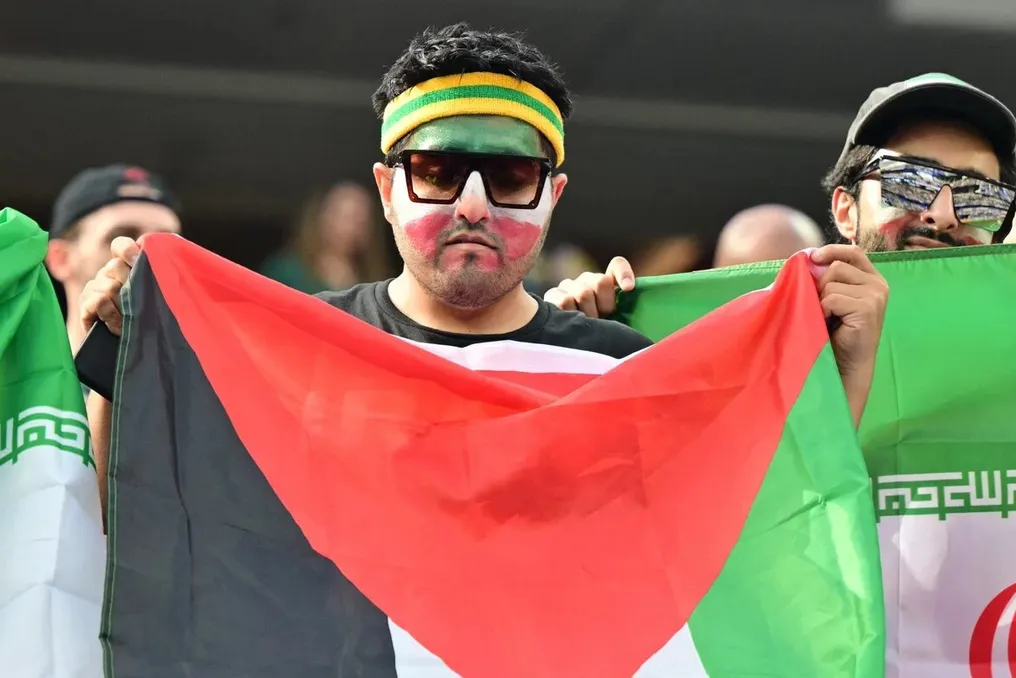
At the 2026 World Cup matches held in the United States, the Palestinian flag has become one of the most noticeable and simultaneously scrutinized symbols. Some fans who displayed these flags reported to Middle East Eye that they were obstructed by security personnel upon entering the stadiums. They were asked to either remove the flags or risk confiscation, despite FIFA rules permitting the display of national flags in stadiums.
Fans' expressions of solidarity
These incidents occurred against a backdrop of widespread solidarity from fans of Arab teams. Palestinian flags appeared in the stands even though Palestine is not participating in the tournament. Many activists advocating for Palestine view these confrontations as a reflection of the growing scrutiny of Palestinian identity in public spaces, even as support for the Palestinian cause becomes increasingly evident.
Ambiguity surrounding rules and participation
As the tournament approaches its Sunday final, it remains unclear whether authorities will permit the display of Palestinian flags at MetLife Stadium in New Jersey. It is also unknown if Israeli Prime Minister Benjamin Netanyahu, who is wanted for war crimes committed in Gaza, will participate.
Stance of organizers and fans
Maisa Morrar, a Palestinian-American organizer from Oakland, stated that FIFA bears responsibility for the confrontations between security and fans. She argued that the governing body's pre-tournament communications regarding the permissibility of Palestinian flags contributed to confusion and prompted security staff to challenge fans' rights. Morrar noted that people regularly bring their flags to World Cup matches, making the issue of the Palestinian flag's permission seem unusual to her.
Omar Dreydi, a Palestinian-American resident of Southern California, recounted being approached by security staff during a match at Levi's Stadium, who told him that 'the Palestinian flag cannot be displayed.' Dreydi informed MEE that due to his connection with Fifa Masters and knowledge of FIFA statutes, as well as working as an NBA player agent, he knew what was permitted and what was not. He posted a video online showing him displaying the Palestinian flag while recounting the confrontation.
After a prolonged exchange, the security officer consulted colleagues over the radio before returning to inform Dreydi that he could keep the flag. Dreydi noted that the officer then returned and said, 'You can relax now,' which caused him to react to the fact that this person had harassed him. This incident drew the attention of nearby spectators, including two Algerians and a woman who began filming the event.
Calls for awareness
Following the publication of the incident online, Dreydi reported receiving numerous messages from fans about the confiscation of their flags. He expressed regret, wishing they knew their rights. He urged fans to study tournament regulations and document interactions with security, emphasizing that the right to display the Palestinian flag is their right, and offered his assistance since he is in contact with FIFA's legal team. Middle East Eye requested comment from FIFA but received no response by the time of publication.
Context of tournament criticism
These events are also taking place against the backdrop of a tournament that is facing criticism on multiple fronts. While FIFA promotes the World Cup as a celebration of football and international unity, activists accuse the governing body of failing to uphold these principles when confronted with issues of war, human rights, and political expression. Critics point to FIFA's inconsistent approach to global conflicts. For example, Russia was suspended from international football shortly after the full-scale invasion of Ukraine in 2022, but repeated calls from the Palestine Football Association and human rights advocates to suspend Israel due to the genocide in Gaza have not led to similar actions.
Furthermore, the governing body has faced increased scrutiny due to its close ties with US President Donald Trump, who has repeatedly attended tournament events. This raises concerns among human rights groups regarding FIFA's willingness to associate with political leaders accused of undermining international law and civil liberties. For Palestinian fans, these broader contradictions transform debates about stadium flags from isolated incidents into part of a wider pattern.
Maisa Morrar believes that much of the support for the flag is linked to the genocide. Dreydi, however, sees in the tournament the ability of football to unite fans, despite FIFA's problems. He stated that the World Cup is a unique sporting event that brings people together, and he sees the pride and joy it brings. When asked what message he hopes to convey, Dreydi replied that it is a matter of equality and inclusivity, asserting that the Palestinian flag, like any other, is allowed in stadiums.
For Morrar, attending the tournament was more important than football. She emphasized the significance of being at a major American stadium during this historic time and seeing it filled with keffiyehs and flags of Palestine, Jordan, and Algeria. She noted that visitors from different countries approached her asking to support Palestine, confirming her conclusion that people support Palestine, and that ultimately, it all comes down to the struggle and liberation of peoples.