The Diriyah Biennale Foundation (DBF) carries out a wide range of activities, including workshops, debates, and public meetings. To sustain this mission throughout the year, the DBF commissioned the construction of a specific building.
The Diriyah Biennale Foundation (DBF) carries out a wide range of activities, including workshops, debates, and public meetings. To sustain this mission throughout the year, the DBF commissioned the construction of a specific building.
This new venture was conceived to serve as the permanent headquarters for the foundation's public programs. The project was designed with the aim of welcoming a diverse audience, encompassing different generations, languages, and cultural backgrounds.
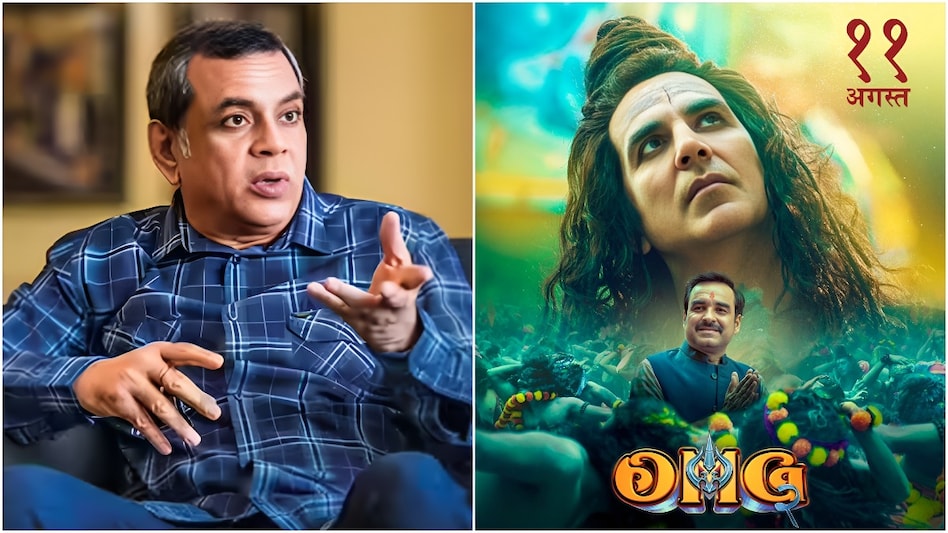
Popular Bollywood actor Paresh Rawal has sparked a new controversy in the film industry by claiming that he wrote the screenplay for the hit film 'OMG 2' (OMG 2), but the filmmakers allegedly released it without crediting him.
The true author and director of the film, Amit Rai, reacted with anger to these allegations. He categorically rejected Paresh Rawal's claims, calling them fabricated. Amit Rai stated that he is the true creator of the film and possesses irrefutable legal evidence to support his position.
In an interview with Hindustan Times, Amit Rai expressed surprise and dissatisfaction with Paresh Rawal's statements. He questioned the basis of such claims, noting that Rawal was making unsubstantiated assertions. However, Rai acknowledged that Paresh Rawal is a highly respected and prominent artist in the industry, so he could not personally approach him to ask about the reasons for such a statement, but the truth is obvious to everyone.
Rai emotionally equated the film 'OMG 2' with his child. He emphasized that he was the sole creator from the beginning of work on the film until its completion. It was he who developed the story, bringing it to the level of school and university material. To confirm his words, Rai pointed to having a certificate from the Screenwriters Association (SWA) and an official stamp on the script bearing his name.
Amit Rai believes that Paresh Rawal should explain why he raised this issue after such a long period. He suggested that the answer might come from Paresh Rawal himself, the film's production company, or Akshay Kumar. With irony, Rai remarked: 'I wrote this film with complete honesty and then showed it on screen. So much time has passed since the film's release, and now he makes such statements. Frankly, he woke up very late.'
While the film's producer Ashwin Warde issued an official statement refuting Paresh Rawal's claims as false, director Amit Rai confirmed his stance by providing legal evidence. However, the film's lead actor and co-producer, Akshay Kumar, has not yet commented on this authorship dispute.
Aamir Khan faced backlash from various political parties following his comments regarding the claim that Sonam Wangchuk was the inspiration for the character Phunsukh Wangdu in the movie '3 Idiots'. Critics accused the actor of remaining silent due to apprehension concerning the ruling establishment.
During a session at the London Indian Film Festival, Khan stated that neither he, nor the director Rajkumar Hirani, nor the writer Abhijat Joshi had met Wangchuk when the film was produced. Khan clarified, saying, 'No, that's not true actually. That is a misconception. I didn't know about Mr Sonam at that time when we were doing this film '3 Idiots'... However, what Mr Sonam is doing is good work in any case. He doesn't have to be based on the character of '3 Idiots' for us to respect him and the work that he does.'
When questioned about Wangchuk's hunger strike concerning alleged issues with the NEET examination, Khan expressed concern for his health, stating, 'I think all of us are very concerned for his health... We hope that it ends well. All of us are hoping he ends his fast and looks after his health.'
The clarification prompted strong reactions from politicians. RJD Rajya Sabha MP Manoj Jha questioned the delay in Khan's statement, remarking, 'It took them years to say this. I don't even remember how many years ago the film was released. Until now, everyone believed the same thing. Only now have you realised that this is what should have been said. It shows having a spine in front of the state is not an easy option.'
Similarly, senior Congress leader Husain Dalwai questioned Khan's apparent fear, suggesting that Khan ought to emulate actor Naseeruddin Shah in speaking without fear and at least show sympathy for Wangchuk. AAP Rajya Sabha MP Sanjay Singh also criticized the actor, asserting that the Modi government has revealed the character of everyone, causing them all to yield and lack the courage to speak.
Advocate and activist Prashant Bhushan suggested that Khan's reply indicated he had become a diminished version of the person who created '3 Idiots' and several other revolutionary films. Former Congress leader Sanjay Jha added a comparison, noting, 'Now Aamir Khan says Phunsukh Wangdu in '3 Idiots' is not inspired by Sonam Wangchuk. Correct. Just like 'Gandhi', the 1982 film is not based on Mahatma Gandhi.'
Meanwhile, Sonam Wangchuk continued his indefinite hunger strike, which entered its 20th day at Jantar Mantar. His protest began on June 28, demanding the resignation of education minister Dharmendra Pradhan due to alleged multiple irregularities in the examination.
Scientists studied the remains of six individuals discovered in the Dashur necropolis. These remains, dating from between 1850 and 1700 BCE, belonged to King Amutibre Hor, four princesses, and one other woman.
The study, published in the journal Frontiers in Environmental Archaeology, demonstrated that women from the Egyptian royal family likely practiced archery regularly and possibly other military exercises, as indicated by changes on their bones.
The Dashur necropolis is located near Cairo and is part of ancient Memphis, which long served as the capital of Ancient Egypt. This complex includes numerous elite tombs and pyramids built during the Old, Middle Kingdoms, and the Second Intermediate Period. Among the known structures are the Bent Pyramid and the Red Pyramid, the construction of which is attributed to Pharaoh Sneferu, founder of the Fourth Dynasty.
Systematic excavations in Dashur were conducted in the late 19th century by the Frenchman Jean-Jacques de Morgan, who headed the Supreme Council of Antiquities of Egypt. Under his direction, researchers worked in the pyramids of Amenemhat II and Amenemhat III and their surroundings in 1894–1895. It was there that the undisturbed tomb of the Thirteenth Dynasty king Amutibre Hor (18th century BCE) and the burial of several members of the royal family, including princesses Nub-Hotep, Itu, Henmet, and Itaveret, were found.
Zainab Hashesh from Ben-Suef University, together with colleagues from the UK and Egypt, presented the results of the analysis of the remains of King Amutibre Hor, four princesses, and one other woman. Anthropological and paleopathological analysis allowed for an assessment of the level of physical strain, as well as the study of black substance found on the bones of five out of the six individuals. Researchers determined that the oldest in this group were King Amutibre Hor and Princess Nub-Hotep, who lived for about 40–44 years, while the youngest woman died at over twenty years of age.
Traces of resins used by embalmers were found on the bones of five known individuals. Fourier-transform infrared spectroscopy showed that in all cases it was resin, but only juniper resin was identified on the bones of Princess Itu, while in the other cases it was a mixture of frankincense and juniper resin. The authors suggest that these resins were brought to Egypt from southern regions such as Nubia or Punt.
Bone analysis showed that belonging to the elite did not protect people from childhood physiological problems; traces of healed injuries, degenerative diseases, and congenital anomalies were observed on the remains of many, including the king. Nevertheless, the most attention was drawn to the discovery of signs of regular and serious physical exertion in the king and several princesses. According to the authors, Egyptian princesses of the Middle Kingdom or Second Intermediate Period regularly trained in archery and other combat exercises. This opinion is supported by the findings of weapons in the burials: a set of bow arrows was found in Nub-Hotep's tomb, and a bronze dagger with an ornate handle was found in the burial of Princess Ita.
>